Back in college I lived in a townhouse with seven other guys. We had a house website with bio pages for the eight of us, head shots, etcWhich I can’t believe is still alive on the Internet.. We feuded with another house of guys across town, driving over at any idle hour just to turn off their power, toss a few hundred uncooked tortillas on their lawn, etc, the usual. You probably heard about us.
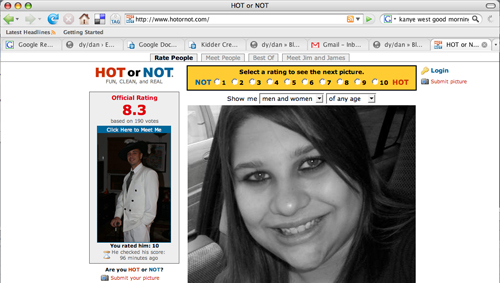
One day we threw all our headshots into some morphing software and got a snapshot of what our composite roommate would look like. We threw him onto a website called Hot Or Not where vanity- and charity-cases alike upload photos for others to rank on a ten-point scale. “We” pulled an eight and partied continuously for several weeks.
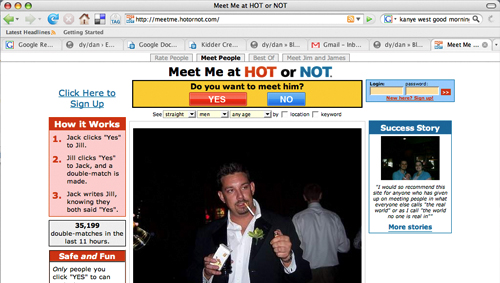
Until last week, I had no idea Hot Or Not was still around. It is and has drawn the attention of researchers from Columbia, Carnegie Mellon, and M.I.T. All these people feeding quantifiable preferences into Hot or Not’s servers, millions on the month, constitutes an ideal data set. Another apparent data set is Hot Or Not’s “Meet Me” service where you can meet someone but only if he or she wants to meet you also.
All that data and analysis, recently released, fascinated me for a 72-hour stretch last week. My job description, as I try to frame it these days, is to make some fraction of what excites me about life (and math, in particular) exciting to my kids. This one was difficult.
Mostly, it’s tough striking up a good conversation over questions which have already been answered. You’ve gotta tease them with clues without frustrating them, drifting just enough information past ’em without giving it all away.
Here’s how we built from nothing to something:
- Discuss the question: “why do we date?” In my classes, answers ranged from the expected (someone’s fun to be around, cute, makes you feel happy) to the really expected (someone’s hot, horny, fertile, has money).
- Focus for a bit on the “fertile” answer and how making babies is a biological imperative for every species.
-
Introduce hotornot.com. These people upload photos of themselves, you rank one, another photo appears, and then it’s three hours later.
- Ask: “Who do you think hands out more ‘hot’ ratings? Guys or girls?” In my classes, both genders selected themselves. (Which confounds me still. Anyone know why?) Turns out it’s guys by 240%. (Which seems like a lay-up to me, but there ya go.)
-
Introduce the MeetMe service. If you want to meet this guy here, you click “meet,” at which point your photo is sent to him and then if he wants to meet you, your e-mail addresses are exchanged, love is found, babies are made.
- Ask: “Who do you think clicks the ‘meet’ button more? Guys or girls?” Guys again.
- Ask: “Who do you think clicks the ‘meet’ button more? People with low ratings or high ratings?” Low. Turns out, for each ranking you slip (from a 6 to a 5, for example) you become 25% more likely to accept a date.
-
You assign the class a hotornot ranking. You arbitrarily assign ’em a 7, setting them up for what happens next.
- You say, “How do you decide which invitations to accept? Do you accept a 3?” Everyone says no. “Do you accept a 6?” Some would only date their level and above. Others recognized that the rankings came from a community that didn’t, e.g., share their affinity for baldness, and would consider a 6.
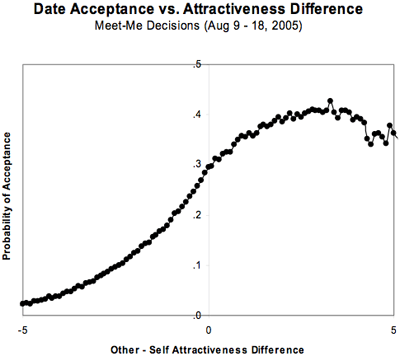
- And finally, you show this chart-gem.
-
You talk about it. The x-axis is tricky. It’s the difference between you and the person asking you out. You point to the extreme left edge and say, “-5. How hot is that person?” Some will say “-5.” Others see that she’s a 2.
- You gesture at the y-axis and say, “Is your probability of going out with this person low or high? Low. Obviously.
- Ask: “What about this graph is expected?” You talk about how the graph rises, as you’d expect.
- Ask: “What about this is unexpected?” And this is, of course, the kicker. Why does the graph take a dip at the end? Why would you decline to meet someone who was five ranks hotter than you? (Your thoughts are welcome in the comments.)
Total cost: ten minutes. In all, a really good way to kick off a period. If you’re feeling brave and you’ve got their trust, you can discuss the question, “how do 2’s find and maintain love?”