Month: December 2007

Total 33 Posts

Asilomar #3: Green Knowledge

Session Title

“Red Knowledge / Green Knowledge: A Different Way to Think about Teaching”

Presenter

Tom Sallee. Professor of Mathematics/Researcher, UC Davis.

Narrative

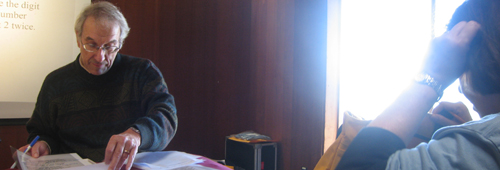
Man’s a titan. He was when I took him for Non-Euclidean Geometry at UC Davis and he was in the Sanderling Room today where he kept an audience rapt with only his measured cadence and an old-school overhead projector. Ninety minutes passed in what felt like ten.

He spoke of red knowledge and green knowledge, the red stuff being procedural/factual and the green stuff being conceptual. He distinguished them by saying that, with red knowledge, “you know whether or not you know it.”

“What’s 8 – 7?” vs. “How do you multiply two-digit numbers?”

“You’ll never hear me say conceptual knowledge and procedural knowledge aren’t both important,” he said. “That’s insane.” But he said he preferred conceptual knowledge because it gave him “a fighting chance” with a problem he’d never seen before.

“We tend to hide our best stuff from our students,” he said, “and I don’t know why.” He was referring to problem solving, honed intuition, creativity, etc.

I reckon this distinction is on the mind of anyone with a blog and of most people reading this. Implementation remains kinda fuzzy for all of us, though.

So the basics are these: during lecture he focuses almost exclusively on green knowledge and he puts it almost exclusively on them to pick up red knowledge independently, through the text.

He focuses each lecture on what he perceives are the largest ideas in calculus (for non-majors). For example:

To three decimal places find a number b such that:
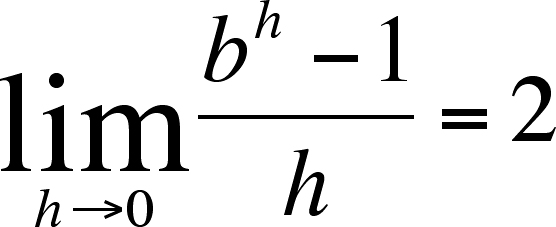
He’ll give that to kids who don’t know L’Hôpital’s Rule, kids who barely know the definition of a limit and draw them around to the idea that you can drop that equation into Excel and get a decimal answer accurate to three, four, five, or fifty decimal places.

He did this for a semester and compared survey results with a willing red-knowledge colleague. The results were descriptive and I wish I could recall the exact wording. My strongest take-away was that, while both classes evinced intellectual laziness that kinda comes with the college freshman territory (laziness that’s kinda our fault in high school) Sallee’s kids were much less intimidated by a problem they didn’t know how to solve and more often felt like class time had been well spent.

Presentation Notes

Acetane transparencies never looked so fine. He’d scribble on a couple, leave ’em up for a few minutes, and then put a new one up. Maybe because it was the second half of the day, maybe because I’ve got a nerd crush on the guy, I don’t know, but I welcomed the lo-fi approach.

Homeless

  • Prefaced his talk with a two-minute summary so that anyone who wanted to bail could bail early rather than late. Classy.
  • Recommended reading: The Structure of Scientific Revolutions, Thomas Kuhn.
  • Rick West: “If you copy an answer, you’ve rented knowledge, you haven’t bought it.”
  • He’s retiring this next year, which lent all kinds of urgency to his talk.
  • The best assignment he ever received at CalTech: a sheet with 100 problems about which the instructor said, “Find all the problems you can do and don’t do them. Find a problem you can’t do and do it.”

Sufficient Megapixels
For Your Consideration

Building a bridge to the 21st century. Vote dy/dan best new edublog and best individual edublog.

Asilomar #2: Proportions

Session Title

“Meaningful Mathematics: Using Proportional Reasoning”

Presenter

Jim Short. District Math Specialist, Oxnard UHSD

Narrative

Proportions are one of Algebra’s biggest ideas and I was pumped to attend a presentation whose title (at least) shared that ethos. Halfway through I bailed.

First activity: the presenter passed out a cool problem concerning proportional reasoning. My seatmate and I discussed our solutions. Then the audience discussed its solutions, generally affirming everyone, etc.

But then the presenter passed out twelve more problems, all entry-level, and we started running through solutions for each one and, I dunno, the crowd seemed into it (a fight basically broke out over one problem) but if I need anything from a 90-minute stretch, it’s a certain unpredictability.

Which isn’t to say you’ve gotta pull rabbits out of hats and then jump into a harmonica medley, just that, if I can figure out the course you’ve charted for my next ninety minutes, I’m bored.

Presentation Notes

PowerPoint. Bullets came in with what looked to be a “Float” animation. The presenter showed off our work with a document camera.

Homeless

  • I swear, I’d die if I saw another mid-20’s male ’round here.

For Your Consideration:

For the future. Vote dy/dan best new edublog and best individual edublog.

Asilomar #1: Motivation

Session Title

“Tell Me Something That is Going to Work: How To Motivate Students!”

Presenter

Timothy Kanold. President, National Council of Supervisors of Mathematics.

Narrative

I relaxed my stance on exclamation points in presentation titles and was pleasantly rewarded with a maximum of sober introspection and a minimum of canned inspiration.

Kanold, if nothing else, asked a battery of good, tough questions, starting with:

  • What is your area of no-talent? (A: Running.)
  • When did you decide it was an area of no-talent? (A: High school, mile three of a nineteen mile run with the cross country team)

And then the big crossover:

  • Can all kids learn math?
  • Whose responsibility is it to be motivated?

We discussed these questions with seatmates and there was a lot of discomfort throughout both, a vast difference between what people wanted to say and what they felt comfortable saying.

I asked TMAO’s miserable icebreaker, “What percentage of the responsibility for student achievement rests on the teacher?” From the guy on my left and the girl on my right came the same response: 50%.

50% in spite of our advantages in age, education, confidence, and salary. I don’t think I have much use for that figure.

Kanold talked about how easy motivation is for math teachers. Kids are pressed into it. Math is required for graduation. He noted, however, that graduation is a lousy stick to get kids motivated since a lot of kids just don’t care about graduation.

His recommended motivational strategies:

  • meaning and context sparks motivation, connecting these things as much as possible to their experience.
  • assign work that is worthy of their effort, as in, not #1 – 50 (odd).
  • communication and engagement reign supreme
  • congruent and comprehensive assessment, emphasizing a “menu” style assessment which sounded somewhat familiar.

He asked us, finally, to agree or disagree with three outlooks on student achievement:

  • What we’re doing here is important.
  • You can do it.
  • I’m not going to give up on you โ€“ even if you give up on yourself.

I want to work in a school where those affirm those statements are promoted and those who waver and demure are marginalized so they can do no more harm.

Presentation Notes

PowerPoint. Low word count, especially compared to later presenters. Early projector malfunctions attest to the need for good preparation and backup plans.

Homeless

  • “Think like an elective.”
  • “Make a place that’s so compelling I want to be here.”
  • Song of the Day: “Jedi Mind Trick,” Lupe Fiasco

For Your Consideration:

Running second place to a class of fourth graders. Vote dy/dan best new edublog and best individual edublog.