Month: March 2008

Total 32 Posts

Vote Judah

My response to the question, “Should 11th and 12th grade be made non-compulsory?” is over at Authentic Education, following an anecdote from my high school years which probably exceeds the bounds of good taste.

I’m not subversive enough to send our kids on their way after tenth grade, but I’m willing to declare the four year plan outdated. Split it in half and dedicate the second part to broader experiences than an analysis of Chaucer’s Canterbury Tales or preparation for College Board exams.

Get them into community college electives and job shadow programs. Get them a home room mentor, someone to show them how to execute a business plan, to teach them how to contact community leaders, and to ensure that they always always always put a lookout on Mr. Albrecht’s door.
How Long Now

Plans For Us dug for traction, found none, and fell. Bill Fitzgerald seems to have sacrificed his infant lesson aggregation service at the altar of paid work. tteach has featured the same landing page for a year to diminishing returns. I guess I should console myself that I Love Math! is still around, such as it is.

But seriously.

Isn’t it a colossal joke that in this [flat, spikey, curly, whatever] world we live in, your best learning experiences and mine are still separated by geography?

Somebody please.

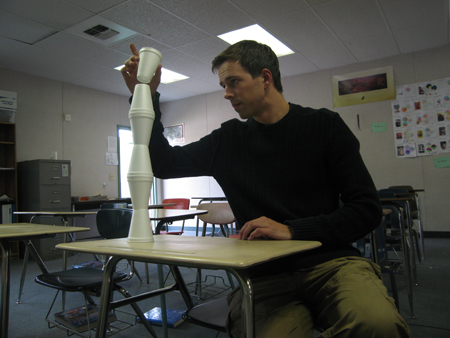
Linear Fun #2: Stacking Cups

My favorite lessons build an hour of complicated, engaging mathematics from a simple picture, question, or anecdote. This is one of those lessons.

  1. The Question

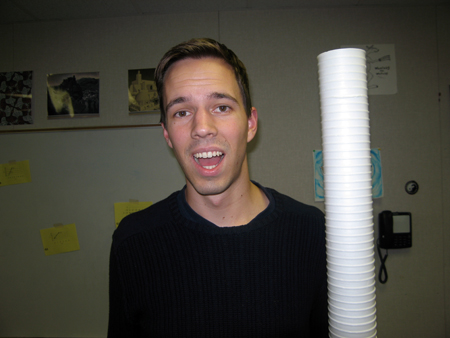
    How many Styrofoam cups would you have to stack to reach the top of your math teacher’s head?

  2. Mess With Your Students

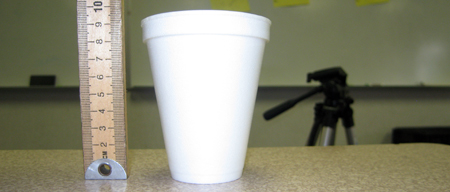
    Tell them you’re 200 centimeters tall (if you’re me). Measure a cup in front of them and tell ’em it’s around 10 centimeters tall.

    Act like you blew it and overestimated the question’s difficulty. Ask them for a fast answer.

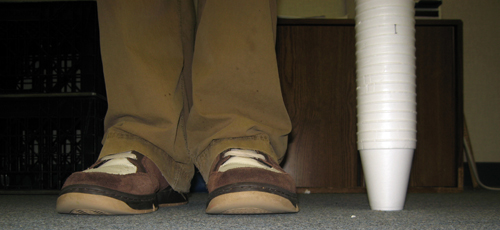
    Someone will divide quickly and tell you “twenty cups,” at which point you hold up a stack of 20 cups and let them wonder how they underestimated so grossly.

    Let them figure out which math problem they actually solved:

  3. Offer Them Materials

    Ask them what they need from you. Some will ask for hundreds of cups. Offer them ten.

    They’ll want a ruler. Offer that.

    Some will chase you around the room, running after your feet with their stack of cups, asking you to hold still so they can eyeball the answer. Don’t offer them that.

  4. Let It Go

    The rest largely runs itself. Just walk around, ask good questions, and correct faulty assumptions.

  5. Good Questions
    1. How many parts of the cup are there? Two.
    2. Which part of the cup matters most over the long run? The lip. The base only counts once but you count the lip every time.
    3. If I asked you to tell me how tall a stack of sixty cups would be, what would you do? Add the height of sixty lips to the height of the base.
    4. If I asked you to go backwards and tell me how many cups are in a 200-centimeter-tall stack, what would you do? Subtract the height of the base and then divide by the height of the lip.
    5. Does it matter if you round to the nearest centimeter? It definitely does.
  6. Get A Graph And An Equation

    Kids will solve this pretty well without either – two groups socked the answer right on the nose – but this is pretty meaningful context for graphs and equations. The lip-height is the slope and the base-height is the y-intercept.

  7. Actually Stack Them

    After you’ve a) taken secret-ballot estimates from each group, and b) written them down on the board in descending order, have one member from each group i) count her cups, ii) stack them by your feet, and iii) call out the quantity for the rest of the class to tally up.

    If, just for instance, you’re twice as tall as some of your students, have one student stand on a chair to eyeball the answer. (“One more. Okay, one more. Nope, too much.”)

    The winning team receives fabulous cash and prizes.

  8. Extend It

    This project has legs. My kids ran outta interest at different points after we announced the winnersNote to self: postpone that announcement until after the extensions. *smacks forehead* but these extensions are all gold.

    1. Ask them the same question with a different cup. A red Solo cupDon’t pretend like you don’t know the ones I’m talking about., plastic, a thin lip, and tall base.
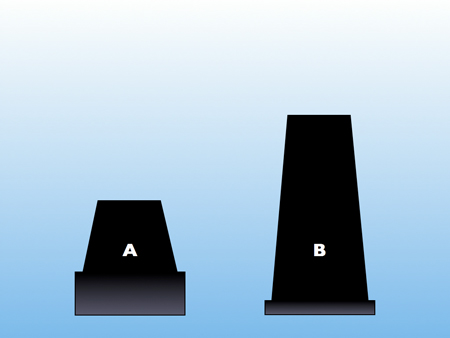
    2. Toss up this graphic.

      Have them measure the lip and base of each.

      Ask them, “Which will be taller after three cups?” (A: Cup B.)

      Ask them, “Which will be taller after one hundred cups?” (A: Cup A.)

      And then – respect, if you see what’s coming – ask them, “How many cups does it take stack A to rise above stack B?” Wham. You’re solving three-step equations.

These are my favorite projectsOne, again, to which I can only claim certain flourishes. The rest comes out of ed-school at UC Davis.: easily scaffolded, easily differentiated, easily assessed, and arising completely from a simple question, a simple prop, and a single image.

More, please.

Bird Flu 2.0

Jeffrey Gene’s Pierce’s Hong Kong school reacts to incidence of Avian Flu:

For one, secondary students and teachers would simply be expected to “go virtual” – that’s a contingency that my school is in the process of preparing for…a new project that I’m needed to work on, I found out a few hours ago via email. Give me 24 hours, I could get that wikispace back up into shape, and we’re good to go.

In the event of a nationwide epidemic, please consider every one of my School 2.0 reservations null and watch how fast I get my UStream on.

[Updated ’cause Jeff’s full name is nowhere to be found in his blog, URL, or Google username, each which is separately misleading.]

Students As Dolphins

My TA (name’s Katy, perhaps you’ll recall) works at a veterinary hospital after school, holding down German Shepherds twice her size for vaccinations.

She was talking to me the other day about reinforcers and punishments, how punishments are so much less effective than reinforcers ’cause animals will modify their behavior just enough to avoid them and no further.

She also said that punishments are plainly ineffective with open water animals like dolphins, which can’t be caged up, or sent outside, or sent to their rooms for punishment.

They just swim away.

This anecdote’s application to classroom management is left as an exercise to the reader.