David Foster Wallace hanged himself last night. DFW did more for contemporary non-fiction, more for the travelogue genre, and more to ignite my own writing than any author I can recall. His commencement address at Kenyon College exactly summarizes how I try to live out my day-to-day, a fact which makes his suicide all the more puzzling, and tragic. I’ll miss his writing a lot.
Month: September 2008
Total 17 Posts
Francesca Ochoa, retiring teacher:
The “new” focus is on `drill and grill’, test-taking skills and a largely prescribed curriculum. The classroom has become a training center reminiscent of the era of de jure segregation where Mexican-American and other students of color were expected to regurgitate memorized material, thus preparing them for jobs in the lower rungs of society.
Sir Michael Barber, education reform strategist:
if the implementation is poor, people will say the whole act was a bad idea and the true opportunity it provides will be lost. If that happened, it would be lost for a generation, and America can’t afford that. I think that’s the biggest risk to the American system in the next two to three years.
As the school year opened, our principal asked us to consider a hypothetical kid who bungled her way through a composition class only to ace the final exam – an essay final which assessed every skill from the year. He asked us to indicate what grade we’d give her with a show of hands.
Mine was the only hand for “A,” which, whatever, I suppose I should admit my biases more often. One teacher indicated an “F” and the rest spread themselves out pretty uniformly across the other passing grades. My philosophy is that it doesn’t matter how hard you try, it matters what you can do
I can accept conflicting opinions on this to an extent, especially when the consequences only involve my principal’s hypothetical unicorn-student, but I get really, really bothered when you assign real, flesh-and-blood students to my remedial algebra class who, by all anecdotal accounts, know algebra backward, forward, left, and right, who scored proficient or higher on their state assessments, but who didn’t feel like completing your tear-out cookie-cutter homework assignments.
For which you failed them and assigned them to my remedial class, where they are now bored, unchallenged, and where – believe me – they really resent you.
What is your homework worth?
[BTW: Updated the supporting graphics for clarity.]
In trying to teach really difficult material – so, math, or any math-based science, I guess – the look of the material rivals the material itself for importance.
The weird thing I realized while breaking several traffic laws on the way to work this morning is that there are no large design decisions. Even when the look of the thing changes drastically – from one field to its inverse, for example – the decision was small, the action simple.
Which Is Clearer?
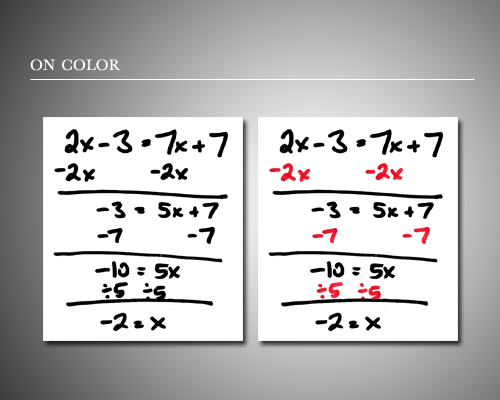
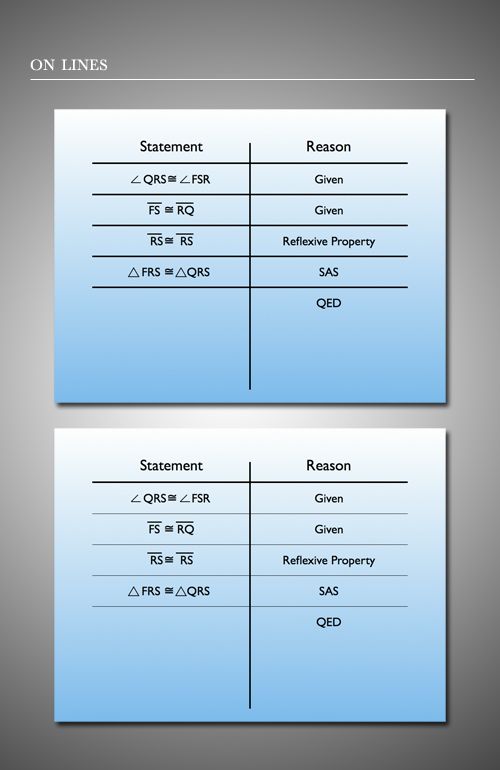
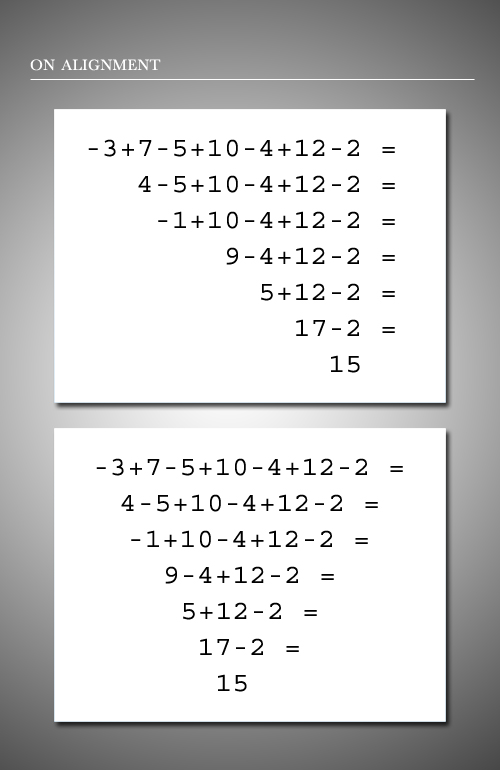
Why It Matters
This makes graphic design a defining aspect of my teaching philosophy, something indicative of the larger whole. My enthusiasm for design points at my belief that small decisions lead to exponential gains, that the sum of my small color, opacity, and alignment choices will lead to a huge net win for my kids, that the math will be exponentially clearer, that we’ll unwaste huge stores of time.
Video Is King
Therefore, if I had unlimited time and capital to create a curriculum, I’d use video, because with video, you make those incremental decisions thirty times every second. If those decisions are made carelessly, of course, the result will be utterly disastrous, turgid, limp, and boring –Â a medium unearned – as I’m sure you’ve witnessed. The inverse is also true, though, and that awareness is now taking me down some interesting paths.
w/r/t my assertion that many students want to know right away if you like them or hate them, that they want to know so fast they’re willing to provoke a response:
I got one the first day. A kid came in clowning hard, looking to assert real fast what he was about, looking to find out what I was about. He was obviously in the business of rattling teachers.
I’m not saying I know how this is going to end but I know how I wasn’t going to let it begin. Out of twenty-four students in class, his was the only name I knew. Yet when I was running down the roster taking attendance, I asked his name just like any other. I wasn’t going to give him any celebrity. I wasn’t going to let him know his circus-act even registered.
This trained obliviousness doubles as a legitimate instructional strategy. Running through some whiteboard exercises with my students, students tossed answers out impulsively – looking to keep the effort-gratification cycle spinning quickly. Their answers were often correct, but I felt them reading me, gauging my eyes and mouth for some indication they had scored.
If I hesitated even a moment, they’d reverse themselves or default to their next, on-deck guess. At that point I’d issue a look, one which I’ll issue maybe a hundred million billion times over the course of this school year. It reads like this:
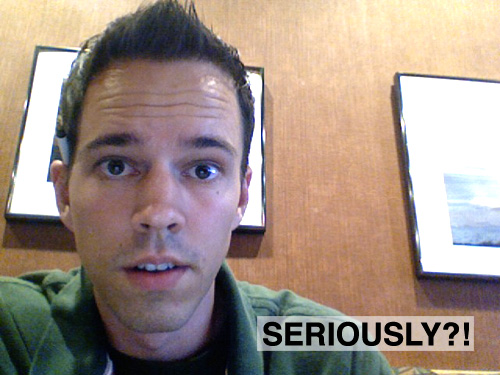
At that point their second-guessing begins in earnest. Problems are re-worked and arguments erupt only to find when the dust settles and the rubble clears that their first answers were correct.
At the end of this first fortnight, I’m realizing how well this affectation works with students, how at the end of the school year they’ll take five or six more seconds on a problem –Â an eternity by the standards of a 14-yo – reworking even the easy ones, and then when I issue that look, they’ll tell me to cram it, insisting on their first answer because they earned it.
I’m also realizing with this new group of students exactly how tight last year’s class and I became, and something else which is nice to realize and never a guarantee: that the time we spent together wasn’t meaningless.