Year: 2008

Total 265 Posts

Web 2.0: Education’s Accidental Friend

Wes Fryer glows over Animoto, the debits of which I addressed some time ago, and a lot of my hesitance to embrace [your pet Web 2.0 tool] crystallized in my response there:

Animoto is wrong for education in every way that it’s right for consumers – and the befuddlement of its creators at its educational market share affirms this directly. Consumers want something that takes the difficulty out of an engaging slideshow but difficulty is essential to learning.

These are businesses, after all, and some businesses (though not all) attract customers by making difficult processes easier. Sometimes (but not every time) those difficult processes are the same ones which impel learning. So while Blogger, for example, makes the right processes easier for students (the mechanics of online publishing) so that they can focus on the difficult one (writing), Animoto simplifies the wrong processes (editing a slideshow with rhythm, music, visual panache) leaving behind only the most menial (select an order for your images, select a track, press go)Again, because I have enormous respect for the skill of Animoto’s editors and of Animoto, itself, as a consumer tool, this screed is only to urge its judicious use among educators..

Many have come to this conclusion before me, I realize, but I am only now fully struck by the fact that the goals of profit-driven Web 2.0 applications and the goals of educators only align accidentally.
Share Your Lists

Dina Strasser, killing me in the comments of the last post:

Was I NOT just up til midnight last night scavenging Youtube for lit term videos??!

Thinking to myself, “{expletive redacted}. No one’s done this yet to my satisfaction… something *else* I need to do?!?”

And then this.

Educators will understand that it is not the mere synchronicity, but the fact that my workload has been LIGHTENED that confirms the hand of God at work here.

Or the hand of Todd Seal, a high-functioning blogger. Can we all get with this program?

Where Is Your List?

Todd’s

I love this. Todd has quietly collated 26 video files and mapped them to a list of 30 literary terms.

20. personification – Comcast: Stop Worrying About Time [D/L], Epuron: His Potential Is OursAn awesome commercial which Todd and I discussed almost a year ago. [D/L]

Johan’s

Elsewhere, Johan earns a dy/dan merit badge for polishing off the complete archives in under a fortnight (skipping and skimming frequently, I hope) and for finding classroom application in an old show and tell video:

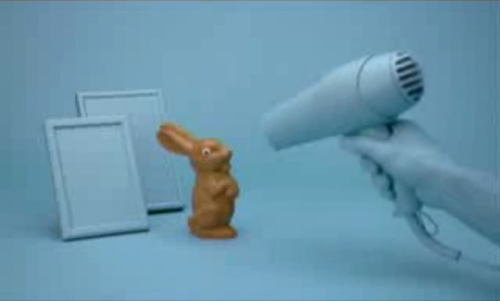
This is what I call epiphany: I just realised the chocolate bunny video [“How to kill a chocolate bunny” will be a perfect way to introduce the types of heat transfer in my physics class

Yours

Certain videos are more substantial than others but the fact is this: someone somewhere is using your content area to create the culture your students consume daily. This has always been the case but only recently could you download it, play it, and talk about it.

So love what you teach and sharpen your eyes to find what you love embroidered within the fabric of popular culture. Don’t present these videos to your students as gimmicks or, worse, as winking concessions to their allegedly lowbrow tastes. These videos are important to them, which makes them important to you.

dy/av : 008 : behind the scenes


dy/av : 008 : behind the scenes from Dan Meyer on Vimeo.

Tags

instructional design, lesson planning, creative process

iPod Edition

dy/av : 008 : behind the scenes (640 x 480)

Previous Episodes

dy/av : 007 : the motiongraphics episode
dy/av : 006 : carver’s classroom management
dy/av : 005 : how i work
dy/av : 004 : thank you, teaching
dy/av : 003 : on the office
dy/av : 002 : the next-gen lecturer
dy/av : 001 : earn the medium

dy/av : 008 : preview

The question comes up once per episode: what tools do you use?

I should have compiled a colophon or an FAQ long ago. Tomorrow I’ll take you behind the spikey-topped gates of dy/av studios, but the tour won’t cover many technical specs so I’ll use this space for the colophon:

Hardware. Canon GL2, primary camera. Canon PowerShot S800, secondary cameraa small point-and-shoot useful for shots which demand I (eg.) sniff deodorant covertly in a supermarket. PowerMacG5 (Quad Core, 2.5 GHz, 4.5 GB RAM, ridiculous). Sennheiser Microphone.

Software. Final Cut Pro, the basic sequencer. Adobe Photoshop & After Effects, the one-two punch responsible for anything especially interesting (cf. that bridge shot in the second episode; all of episode seven).

Time. approx. 12 hours per episode split across three hours pre-production (writing), two hours production (shooting), seven hours post-production (editing).

Music. Three artists, almost exclusively. Lykke Li. Jay Z’s live set at Glastonbury. Mike Skinner.

Motivating Question

The ultimate end of your classroom structures should be invisibility. eg. The best classroom management is unnoticeable. The best classroom lesson plan camouflages the planning while pushing the learning to the foreground. The extreme opposite of this is the teacher who creates a new seating chart every day.

  • How have you set up your classroom routine so that the wires and pulleys disappear?