I’m one day out of a presentation to the Oakland Teaching Fellows on digital projectors (working title: PowerPoint – Do No Harm) and really excited about it. A lot of these folks are right around my age, some older, which’ll make for different dialogue than what I’m used to in my high school classes
This last note-to-myself circles around classroom management and how much easier it is to keep a large group of students focused with a digital projector, presentation software, and wireless remote than without.
One Idea:
Classroom Management: The Triangle Offense
Like This:
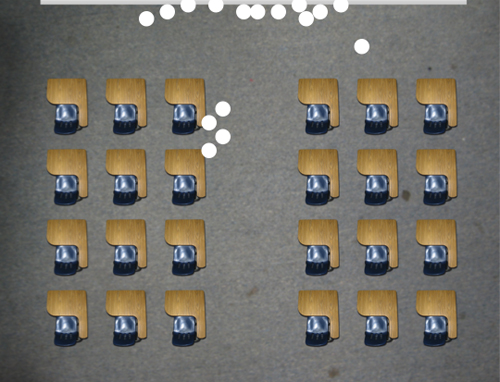
Let’s say you’re in a short lecture block. If your only tools are a chalkboard/whiteboard and chalk/marker, you’re tethered to the board.
You can draw a bit, write a bit, ask questions a bit, but always at the board. If Llewelyn loses focus, you can wander to his desk, maybe ask a softball question to pull him back in, but then you’ve gotta return to the board, all while the kids farthest from you drift off.
Your classroom dot plot looks like this:
Let’s say now you have a digital projector and a wireless remote and you’ve already loaded some discussion-worthy diagrams into your presentation software. You’re mobile.
You walk to the far side of the classroom and address the board. Your focus directs theirs. You toss a question at the opposite side of the room pulling them into your locus.
Your question, the projected image, and the kid answering the question, are three vertices of a triangle inside of which classroom management is a relative non-issue, inside of which you all have really, really good focus.
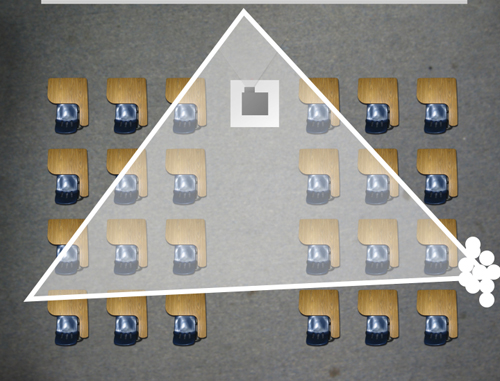
It’s the triangle offense, and it’s very effective.
Previous Editions:
- So Happy Together #1: Easy, permanent storage of cool material.
- So Happy Together #2: Visualize and enliven perfunctory classroom business.
- So Happy Together #3: Become the teacher/learner hybrid.
- So Happy Together #4: Use visual callbacks to refresh their memory.