Year: 2008

Total 265 Posts

When I talk, you listen.

That was the opener. A member of our faculty began an address to the freshman class with that line the other day. A few kids held out and s/he said it again.

“When I talk, you listen.”

I imagine a lot of folks โ€“ especially those who promote the equivalence of teacher and learner, who promote a perfectly democratic discourse โ€“ will chafe at the authoritarianism of it all. Others โ€“ Andrew Keen disciples mostly โ€“ won’t mind.

Personally, I was unoffended. I don’t have much interest in a classroom (or society) where every voice carries equal weight, where experience and education merit no preference. That goes double in a gymnasium full of freshmen.

But I become particular and somewhat critical in the moments immediately after you’ve exploited your authority. In the five seconds after you’ve caught the attention of every freshman at your school (like the Labrador finally catching the car) you either lose it or keep it.

You lose it by leading with filler, by continuing, “Your teachers have talked a few things over in our meetings, which we have every month, and we’ve decided that certain issues face our campus, some which are more pressing than others, etc., etc.”

And they’re gone. Just gone.

If you want to keep their attention, to earn it, you let that silence sit for what screenwriters call a “beat,” essentially the length of one thought, and then you say, “Look, we need you in class, on time. You may not like this but here’s how we’re going to fix the tardy situation around here.”

One is filler. The other is content.

One is signal. The other is noise.

One abuses the strange power dynamic between teachers and students. The other respects it.

Practically Speaking:

  • Cut the first chapter of your book.
  • Lose the first paragraph of your essay.
  • Don’t introduce yourself at your conference presentation.
  • Open with a question or at least a big statement.
  • Don’t follow a joke with leaden, nervous laughter.

Personally Speaking:

In my classroom, if we’re in a work session and I need to talk to the class, to steer ’em somewhere new, I head to one corner of the whiteboard, my only serious place in the classroom, and say, “I need you back here in 5 … in 4 … in 3 …If kids are still talking after the countdown, I don’t give ’em any dirty looks or anything, I just write their names down and keep ’em after class for a minute.,” and whenever they quiet down I pause for only that beat and I immediately โ€“ no filler โ€“ offer them something meaty, succinct, and worth their while.

“If you fell out of an airplane, how long would it take you to hit ground?”

“How fast does Archie, the world’s fastest snail, travel in miles per hour?”

“Are you more likely to roll three sixes with three rolls or flip six heads in a row?”

How I Earn Their Attention from Dan Meyer on Vimeo.

You can throw your back out, as I did for two yearsSneaking suspicion: the seed of all lousy classroom management is fear., imposing comprehensive rules and escalating consequences all to keep your students’ attention or you can just give them something worth listening to.

Information Design: Where To Start

Cosine asked:

… although I like computers and pick up fast, I have little to no information design experience. In other words, I am your dream: a tabula rasa. Where do I begin?

A response via e-mail to another reader asking, essentially, the same question:

Frankly, if it were me, I’d start out with pen & paper. Probably graph paper. Even with my atrocious penmanship and drawing skills, I’d just start representing information in stacks. eg. if I spent twice as much time reading books as watching t.v., I’d make sure the one stack was twice as tall as the other, a design feat made easy with graphing paper.

Not long after that I’d start looking for ways to make my graphs consistent โ€“ same stack width, same block letterhead heading each graph, same colors โ€“ slowly building my way from a merely functional design to an attractive, useful one.

Then I’d scan the paper in or take a picture of it.

No sense in fettering imagination with technology. Just stick with what feels comfortable until the uncomfortable starts to look interesting.

Until I’m able to put some introductory level stuff up here, you’ve got Arthus, blogging away at his technique in a multi-part series.

Updated:

This blogging thing turns back in on itself:

  • Re: course surveys, per Jackie and Vivek’s suggestions, I elided the “neutral” option and gave it here at mid-year versus an exclusive end-of-year administration when the mood is artificially buoyant.
  • Re: my school’s sick new tardy policy, the numbers are in: 43% decline in tardies over the same interval last year. I dig this thing. It takes the emotion out of discipline. Nothing gets heated. “Hey, cool, you’re here. Just leave your passport at the door.” ¶ This is a good start. Now that we’ve got kids in class it’s time to give ’em reason enough to stay there.

Sinister Storytelling

See what I did there?

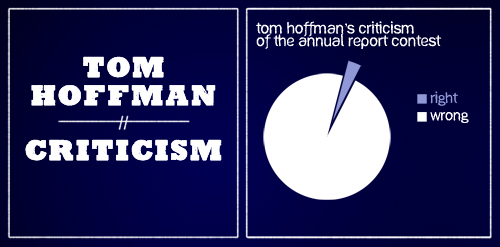
Tom Hoffman connects the storytelling buzz I’m holding down to the recently closed Annual Report Contest and worries that their sum will create a generation of PR flacks.

Do we benefit from identifying with corporations, of thinking of ourselves as a kind of corporation? Do we need further encouragement to define ourselves in terms of quantified income and a mass of consumption habits? I think not.

I don’t disagree with any of that but it simply isn’t true that by creating a summary of your year (whether that’s a two-page double-spaced narrative or an assemblage of facts, charts, and figures like we have here) you’re aligning yourself with corporate interests or engaging in their sort of truth-obfuscation.

Tom’s call for vigilance is warranted, but misplaced at my doorstep.