Year: 2008

Total 265 Posts

Why I Don’t Use Your Textbook

Lately I am a man obsessed. As others are obsessed by numerology, the year 2012, or the birth certificate of President-elect Obama, I am obsessed by the Rule of Least Power and how succinctly it explains why I have never found the right place for a textbook โ€“ any textbook โ€“ in my math classroom.

Whenever my mind starts to spin down for sleep, it wanders to this computer programming axiom and everything becomes hypnotizing and clear. In this waking dream, I see a spider’s web connecting disparate artifacts:

  1. my textbook;
  2. The Wire, Friday Night Lights, The Shield, and 24;
  3. What Can You Do With This?
  4. the Muji Chronotebook;
  5. and the Rule of Least Power, most crucially:

Use the least powerful language suitable for expressing information, constraints or programs on the World Wide Web. โ€“ W3, The Rule of Least Power.

And then I’m inches from some grand unification theory of curriculum design. It’s close. It’s killing me. If I could find seven contiguous hours, I might fully articulate the network and I’d finally have an operational theory, an operational aesthetic, really, putting only a few miles between me and dy/dan: algebra, volume one.

What Can You Do With This: EXIF

For the last month, I have had this single image banging around in my head, hogging valuable CPU cycles. I couldn’t find it anywhere else so I shot it myself. Click the photo for high quality. See the pilot for instructions.

BTW: The comments feature no fewer than two dozen lesson inspirations, at which point the questions become (I think) which lesson inspiration a) will sustain the most interesting math the longest? and b) which prompt can be summarized the most succinctly, the most viscerally? I think those are two of the most important metrics for evaluating these ideas.

Under that light, you have Ben Wildeboer: “Calculate time before impact with the ground.” It’s visceral. The student wonders first how she’ll find that information in a static image. It seems impossible. The result is a page of physics function work.

Also: “How high was the ball when it was dropped?”

Or: “How long has it been in the air?”

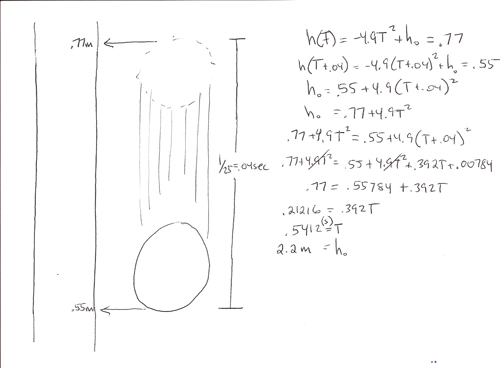
My work for both of those questions:

The first answer is off by nearly a meter. That’s just under 100% error.

BTW: A reader writes to let me know I blew the math here.

It seems that the work shown is using different reference points. At the top of the diagram the top part of the ball is used, and at the bottom of the diagram, the bottom part of the ball is used. I think the top of ball should be used for both or the bottom of ball; either of which would require knowing the diameter of the ball.

He’s absolutely right, which would explain the 100% error.

Oblivion

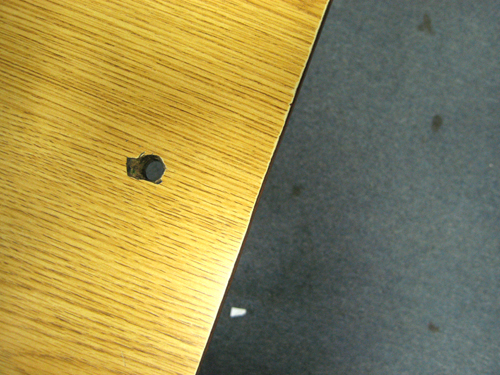
This desk makes me question my convictions.

I have been convicted for some time that, to be a good teacher, you need not have experienced a bright light on the road, a deep voice summoning you to the job. To succeed here (at least in the short term) you need some combination of self-reflection, intelligence, and good humor. The rest can be taught.

But that desk testifies to certain attributes of good teaching that cannot be taught. That desk tells the story of a student who was so bored by her teacher’s instruction that she spent a not-insignificant fraction of her school year tunneling through an inch of wood. More importantly, it tells the story of a teacher whose tedious instruction was her lesser fault.

Her greater fault was oblivion. She had no idea what any of her students were doing at any given moment of class. She kept sacred that invisible curtain between student and teacher. She knew none of her students and knew nothing of what they did during the hours she thought they were paying attention to her.

I don’t know if anyone can untrain that kind of oblivion, to say nothing of training the kind of hyperattunement common to all good teachers, the kind of “court sense” that let Magic Johnson connect no-look passes, which manifests in the classroom as a certain omniscience, as “eyes in the back of your head,” as constant awareness of who is working, who needs refocusing, who is scheming, cheating, and plotting, at all times.

If that kind of oblivion can’t be cured (without great expense, anyway) we must direct ourselves, then, to identifying its precursors in our applicant teachers.

That Is Not What I Meant

Ian Garrovillas attended my spring session in Oakland on integrating digital media into a math classroom and kinda missed the point. His take-away:

[Halloween] was Friday, a review and quiz day. Rather than merely putting up review questions on the board that our class could try and discuss, I interspersed screen shots of scary moviesโ€ฆ


I let the image sit on the screen for a mere 3 or 4 seconds, acting as if I was unaware, before I moved onto the next slide. Got a few students with it. Lovely.

Okay, maybe that is pretty funny.