The more I dig into the question, “How do we turn digital media into learning objects for math students?” the more I’m convinced we need a framework
Though neither of the following two curricula have any kind of public outline, they seem extremely self-consistent and they track (unintentionally, of course) extremely closely to the vision I’m chasing.
Problem Pictures
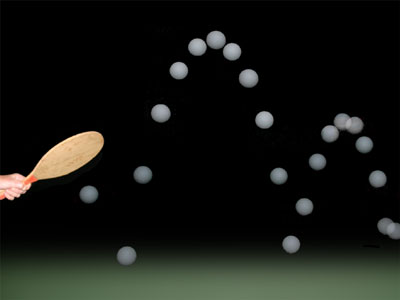
These CD-ROMs (which you can preview here and which Mr. K reviews here) are stocked with images that are each, on some level, “interesting,” and each of which beg a different mathematical question. Mercifully, that question is rarely, “what shapes do you see in this photo?” which is the lowest level of some pyramid which has yet to be named.
Principle Failing: No video, which makes the next entry particularly essential to my investigation.
The Hypertextbook
“Edited by Glenn Elert, written by his students.”
Their investigation of Mario’s acceleration due to gravity may have cropped up on one of your Internets, recently, and was certainly worth your attention. The recipe is consistent throughout Elert’s curriculum:
- Extract some video from pop culture
Talkin’ about Batman Begins, Madden 2006, Jackass – this Elert guy is out of control in my opinion. . - Use physics, math, Wikipedia, photogrammetry, and estimation to answer an interesting question.
Principle Failing: This document is designed more as a record of student learning than as a curriculum for teachers. The media which would propel this thing into classrooms around the world is either absent (as with the Mario investigation) or was uploaded to YouTube which dutifully scrubbed it (as with the Hulk investigation).
To proliferate as fully as they deserve to, these investigations need a complete multimedia supplement, starting with high-resolution captures. In Mario’s case, you would need:
- a clip showing Mario falling from the same height from every Mario game published, edited into a multi-panel split screen. The students would then ask the obvious question, “Why does Mario hit the ground sooner in some games than in others?”
- an individual clip for each jump, no decoration.
- The same clips with a grid superimposed over the footage for measurements.
- A lesson plan with analysis.
Again, we’re working on different projects here, but Elert only includes #4, which means his work will find its way only into the classrooms of the most digitally savvy physics teachers. How many more teachers would benefit had he included the first three? My guess is: a lot.