Month: February 2009

Total 19 Posts

My #1 and #2 Pick

My top two picks were interchangeable until the very end and my top selection, in the end, reflected my slight preference for minimal design over maximal design.

1. Frieder Knauss
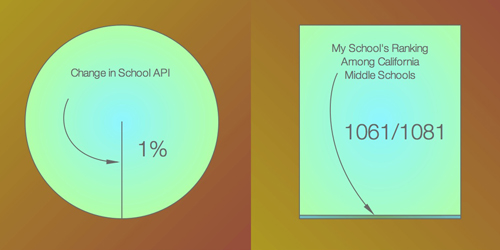
I can add very little to the appreciation circulating on this site except to say that Mr. K manages the hat trick of a) personal retrospection, b) data design, and (the rarity) c) editorial.

That he does this in several thousand fewer pixels than all of his competitors is to his credit, as is the vomit-themed color palette which he somehow sells as an element of his NCLB nausea.

2. Sam Shah
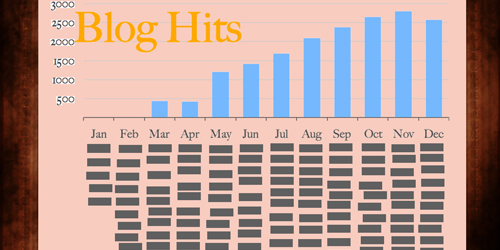
That Sam didn’t place speaks to the overall quality of the entire slate. From fonts to colors to axes and grids, none of his design choices cohere. Yet he tosses them all on the same wall with a stuffed buck and the whole thing looks like some kind of genius aneurysm. The herkyjerky, undistributed, unaligned tabs on his “Blog Hits” slide are a particular high point for me.
My Annual Report Contest II, First Place: Simon Job

[link to his report]

An appreciation by Ben Wildeboer:

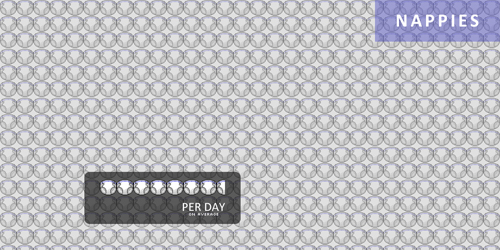
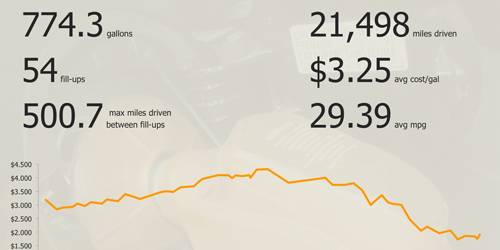
Simon Job knows what he’s doing. First he grabs my attention by plastering his first slide with pictures of his adorable new baby and then goes on to use his four slides to tell a compelling story of his new life with his new daughter. I can sense the major changes his life has undergone after the birth of his first child through the information contained in his annual report- the photo sharing with family & friends, the frequent doctor visits, new sounds in his house, and the unenviable task of changing all those “nappies.” Print out that Nappies slide and post it in every sex ed. classroom and it’d probably do more to prevent teen pregnancy than any method currently in use. The fusion of good, simple design around a coherent storyline made Simon Job’s annual report stick out in my mind above all the rest. Of course, it could just be those adorable baby pictures.

My Annual Report Contest II, Second Place: Frieder Knauss

[link to his report]

An appreciation by Sam Shah:

I ranked Mr. K at the absolute top of my list because his slides, simple and minimalist, speak volumes. With just four pieces of data, Mr. K has painted us a picture of a school flailing at the bottom of the rungs. Students are underperforming, the school’s academic perfomance is not improving, and the school is undergoing administrative shifts too. Follow along with me here, for a short minute, because I think there’s something moral about these slides. They aren’t just statistics, but carefully chosen statistics. Mr. K could have written about the number of teachers in his school, or the number of students he teachers, or whatever. Numbers, as a math teacher, abound everywhere. But instead, he gives us this: somewhere underneath these slides is an imperative that things are not okay the way they stand, that things need to change.

Design-wise, Mr. K hit the mark. Using miniscule areas of simple geometric figures highlights, without being obnoxiously in-your-face, where his school and his students lie relative to other schools in California. The fact is simply that using this same technique four times over is synergistic — but only because four such simple and powerful statistics exist. Take a moment and look at each slide individually. They each say something about the place Mr. K spends a preponderance of his time. But as I said, together, they speak as one. And loudly.

My Annual Report Contest II, Third Place: Ben Wildeboer

[link to his report]

An appreciation by Simon Job:

In his Annual Report for 2008, Ben Wildeboer presented a lot of information with clarity, showing a keen eye for design. Each slide presents more than one set of data, yet this is achieved without overcrowding. The Photographs slide, for example, effectively uses bubbles to show not only the location of the photos, but the number at that location. The Running slide was particularly engaging, so much to look at. I really like how the background has been used as part of the data presented.

The Seniority List

Both Joanne Jacobs and Kevin Carey link up Marguerite Roza of the Center on Reinventing Public Education who recommends, in light of forthcoming budget bloodletting, what no one in education has any business recommending: seniority-neutral layoffs.

Seniority”based ”©layoffs ”©exacerbate ”©job ”©loss. ”©For ”©teachers ”©and ”©other ”©K”12 ”©employees, ”©that ”©means ”©more ”©will ”©lose ”©their ”©jobs ”©than ”©if ”©cuts ”©were ”©made ”©on ”©some ”©other ”©basis. ”©It ”©also”© means ”©that ”©schools”© will ”©be ”©left ”©with ”©even ”©fewer ”©employees ”©to ”©do ”©the ”©job. ”©Kids ”©will ”©see”© their”© classes”© get”© even”© bigger, and even more programs will be cut than would be otherwise. ”©And”© lastly, ”©our national unemployment rates will rise even faster than the budget ”©cuts ”©would ”©suggest”©.

“Is that that awful list?” a teacher asked me.

“Yep.” Five legal-size pages in eight-point font hanging to the left of the staff copier.

In a seniority ranking of my district’s 154 certificated employees, I weigh into the bottom 10% at #131. To filter the CRPE report through my perspective, I won’t survive even an 5% cut to our personnel budget (assuming no retirements or transfers) because, under seniority-based layoffs, the district won’t just hack off the bottom 5% of the list (which could decimate an entire department were it sufficiently junior). They’ll distribute that cut over each department in order to preserve a certain degree of balance in the master schedule. And in a seniority ranking of my district’s 10 certificated math teachers, I weigh in at #10.

“Some other basis” is the operative policy black hole in the CRPE report. We don’t have another basis.