Kate Nowak: Demon Mathematics
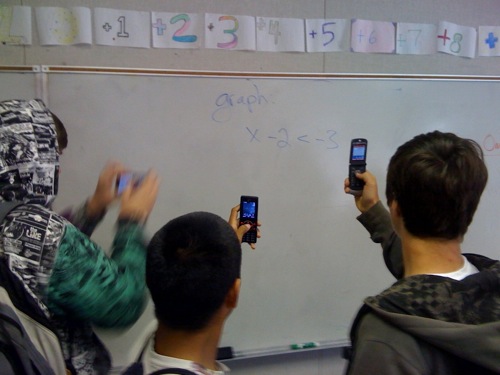
Kate posted a clip which exposes the profits oil companies make by working the rules of rounding to their advantage. It’s mathematically engaging and relevant and well worth dropping into some dead air at the end of class.
But I don’t know what the kids do with it.
Mostly, it runs afoul of the rule of least power which, for our purposes, means the medium has to hint at a question while leaving several square miles of pasture open around it for student exploration. This guy, in contrast, lays out an explicit thesis and supports it completely, leaving little room for inquiry.
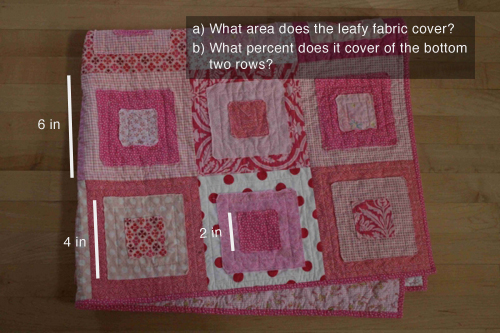
Denise Gaskins: Quiltometry
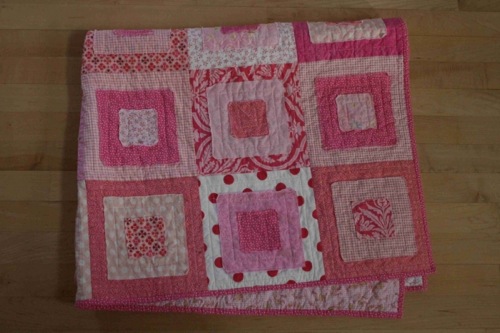
Your mileage will vary, obviously, with your class’ enthusiasm for quilting. I appreciate this, though, because it doesn’t just beg that wormy chestnut, “what shapes do you see here?”
Three notes:
- Ask: “how many different kinds of fabric do you see in the bottom two rows?” a question which anyone, regardless of mathematical ability, can answer or guess at. (Similarly: the question “will the ball hit the can?” is a prelude to mathematical inquiry but isn’t, itself, strictly mathematical.)
- Then ask: “how much of each kind of fabric do you need to quilt the bottom two rows?” a question which is unanswerable without more information. This begs the very, very valuable student inquiry, “what information do I need here?” and the very, very cool lazy-student follow-up “what is the least amount information I can get away with knowing here?” ¶ From there you can go lots of fun places, some of which might involve the practicality of purchasing fabric in one-yard increments with a fifty-four-inch bolt width, something I would know absolutely nothing about.
-
Textbooks ruin these problems:
Be less helpful, etc.