Year: 2009

Total 161 Posts

Cigotie, Ctd.

Cigotie and his mom stopped by this weekend to register their opinion on the obstacles to creative growth facing today’s students. Both are extremely good-natured, especially since they are responding to a post entitled, “How Do You Solve A Problem Like Cigotie?

Cigotie: I also see many kids online doing the same exact thing, as inspirations like Video CoPilot, Creative Cow, etc. And I also agree on how people are getting too sucked into a world, full of copying and project file manipulation, that they have lost all creativity themselves.

Stepping On The Intellectual Scale

Stephen Downes, off Graham Wegner’s lament:

Find an area that you’re interested in, blog on it, daily, and then keep doing it for ten years, even when it seems out of fashion, even when it seems like your influence is waning and other people’s stars are rising. Reflect your reading, your learning, your developing understanding of the field. Stay true to your own values, and don’t relent when it looks like you’ve peaked.

If I go a week without blogging, that wobbly, nagging feeling I get owes less to an obligation I have to an audience and more to the fact that this is the place where I learn and an outlet for my excitement. If I don’t blog for a week, then either a) I haven’t learned enough, b) I haven’t been excited by enough, or c) I haven’t carved out enough time to keep that learning and excitement cycling through my brain. Blogging, in any of those cases, is a nice way to step on the intellectual scale and take a reading.

What Can You Do With This: Other People

Kate Nowak: Demon Mathematics

Kate posted a clip which exposes the profits oil companies make by working the rules of rounding to their advantage. It’s mathematically engaging and relevant and well worth dropping into some dead air at the end of class.

But I don’t know what the kids do with it.

Mostly, it runs afoul of the rule of least power which, for our purposes, means the medium has to hint at a question while leaving several square miles of pasture open around it for student exploration. This guy, in contrast, lays out an explicit thesis and supports it completely, leaving little room for inquiry.

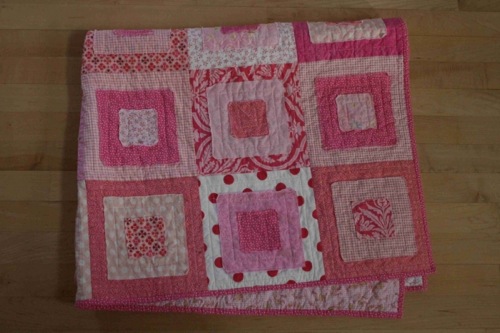
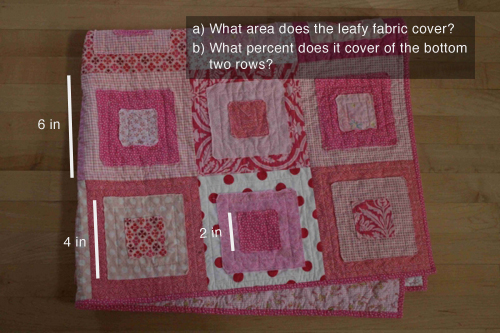
Denise Gaskins: Quiltometry

Your mileage will vary, obviously, with your class’ enthusiasm for quilting. I appreciate this, though, because it doesn’t just beg that wormy chestnut, “what shapes do you see here?”

Three notes:

  1. Ask: “how many different kinds of fabric do you see in the bottom two rows?” a question which anyone, regardless of mathematical ability, can answer or guess at. (Similarly: the question “will the ball hit the can?” is a prelude to mathematical inquiry but isn’t, itself, strictly mathematical.)
  2. Then ask: “how much of each kind of fabric do you need to quilt the bottom two rows?” a question which is unanswerable without more information. This begs the very, very valuable student inquiry, “what information do I need here?” and the very, very cool lazy-student follow-up “what is the least amount information I can get away with knowing here?” ¶ From there you can go lots of fun places, some of which might involve the practicality of purchasing fabric in one-yard increments with a fifty-four-inch bolt width, something I would know absolutely nothing about.
  3. Textbooks ruin these problems:

    Be less helpful, etc.

[photo credit]

Cute!

This never fails to crack me up, like the homework problem is Miley Cyrus and the whiteboard is our Pacific Garden Mall. Or something.

Other classes are even savvier, with smaller groups of friends rotating to one student the responsibility of sending the photo to the others. Digital natives, 21st-century skills, etc.

Are You The Steve Jobs Of Your Teaching?

If you haven’t caught John Siracusa’s essay by now, odds are good you aren’t interested. It’s essential reading, though, for anyone trying to connect blogging to serious professional development and not, say, to an abnormally supportive faculty lounge where everyone shares your exuberance and thinks your last post was great.

Like greed, criticism gets a bad rap, especially when it’s presented in large doses. It’s impolite. It’s unnecessarily obsessive. It’s just a bummer. But the truth is, precious little in life gets fixed in the absence of a good understanding of what’s wrong with it to begin with.

Elsewhere, he describes criticism as “a virtuous cycle created through apparent viciousness” which is exactly how I would describe last month’s (very satisfying) Darren-Dan-Jason slide remix.

For my part, after some large missteps and a lot of reconsideration, I am finally comfortable with this blog’s critical stance. It turns out not to be terribly difficult to respect an individual and her serious commitment to teaching while at the same time holding her work up for serious scrutiny. I’d argue, even, that the two are equivalent, that, issues of tact notwithstanding, to offer any less to each other is the real disrespect.

Some may find this abrasive and check out but my remaining commenters, unsurprisingly, are a seriously critical bunch and keep me relentlessly on message, forcing me to justify and rejustify my crackpot pedagogy. And, most days, I’m pretty sure that’s all the professional development I need.

[via]