Year: 2009

Total 161 Posts

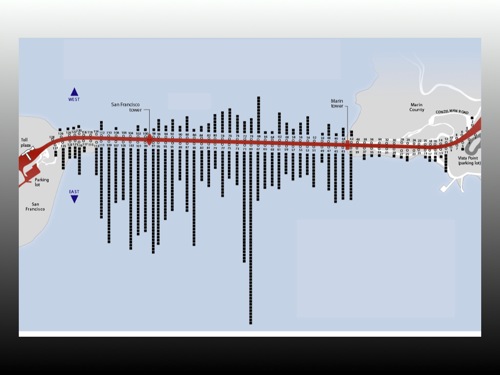
Golden Gate Suicides

This series and the accompanying infograph make for fascinating class discussion. I stripped the graph of most of its identifying features โ€“ captions, legends, and titles โ€“ tossed it onto my students without introduction or fanfare, and had them intuit those features back to life.

This year, more than any year before it, I am comfortable leaving an interesting question unanswered. This is to say that my students will debate a question like, “Where did people commit suicide most often? The 69th what?” and, as the conversation exhausts itself, they can’t count on me to step in with the answer. This is to say the opposite, that as the conversation exhausts itself, I will shrug and advance the slide to some new work, content to leave the question unanswered.

I don’t have any evidence to suggest this approach to learning will a) increase your Algebra test scoresIn fact, if you apply this detached stance to core curriculum โ€“ adding fractions or solving the quadratic equation, for instance โ€“ I can guarantee you the opposite., b) help the US compete with the Indian subcontinent, or c) any of that. I only know that i) my students seem less afraid of wrong answers and more patient with irresolution, ii) they seem, as learners, less certain and more curious, iii) I enjoy teaching more, and iv) the next time we attempt to define an Unknown 1) I will hear from more new voices while 2) the old voices will be all the more eager to kick the Unknown in the teeth before it limps away yet again.

A Fifth-Year Teacher’s Creed

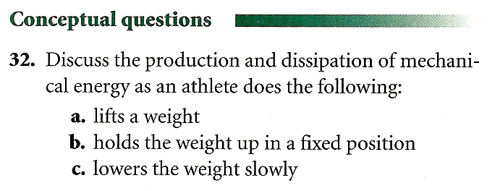
I checked out a copy of our Holt, Rinehart, Winston Physics textbook and the situation is grim. The text stabs forcefully at conceptual development with questions like this:

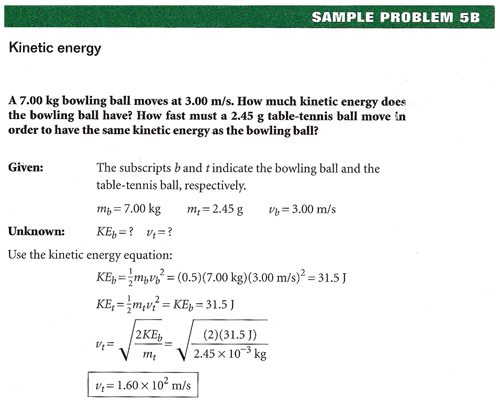
But these interludes of open-ended, critical inquiry are preceded by example problems like this:

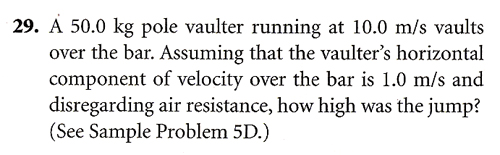
… which are meant to drive practice problems like this:

Which kills me, of course. Basically, the students are taught to identify the relevant formula, match the given information to variables in that formula, and solve for the unknown variable. Helpfully, all the given information will find its way into the formula somewhere. Helpfully, the practice problem will reference the relevant sample problem in case the student forgot the relevant formula.

What we have here, essentially, is a compelling passage of conceptual development thoroughly undercut by practice problems which promote thuddingly linear and literal inquiry. Essentially, we have Holt tossing cupfuls of water onto a raging fire while Rinehart and Winston dump gallon after gallon of gasoline onto it from the other side. I mean, we aren’t even pretending to prepare our students to apply this stuff creatively, to the world around them. Because out there, in the world, no one will helpfully tell them what chapter of the book they’re looking at, no one will helpfully reference the relevant sample problem.

And so I tell myself:

Be less helpful.

Two Warmup Questions, Worlds Apart

February 7, 2008:

I bought my car new on January 15, 2006. Today, February 7, 2008, it has 37,846 miles on it. On what date will I need my 120,000-mile tune up?

February 20, 2009:

On what date will my car need its 120,000-mile tune up?

In 2008, my students proceeded admirably through a challenging problem, successfully navigating proportional reasoning, but let’s not pretend I did anything for their ability to see the world through a mathematical framework.

In 2009, my students had to ask themselves, “what do I need to know in order to answer this question?” a line of inquiry thoroughly absent in 2008, a line of inquiry thoroughly absent in my textbook, which supplies only relevant information and, in some cases, “helpfully” suggests a route to the solution.

As my (patient) readership has no doubt realized, the impotency of our textbooks to do anything but teach procedure has recently whacked me over the head. Part of this, I realize, is fundamental to the print medium, which doesn’t permit a layered application of mathematical structures, but part of this is the inexcusable lack of imagination of publishing houses, whose bundled supplements are both costly and unhelpful, who don’t understand that they need to help students less:

Dan bought his car new on January 15, 2006. It’s a four-door sedan with 16-inch wheels. Today, February 7, 2008, the car has 37,846 miles on it. He lives 24 miles from his job and drives, on average, 48 miles per hour. The weather in his hometown ranged from 23ยฐ to 107ยฐ. On what date will he need his 120,000-mile tune up?
Obama’s Joint Sessions Speech: The Education Excerpt

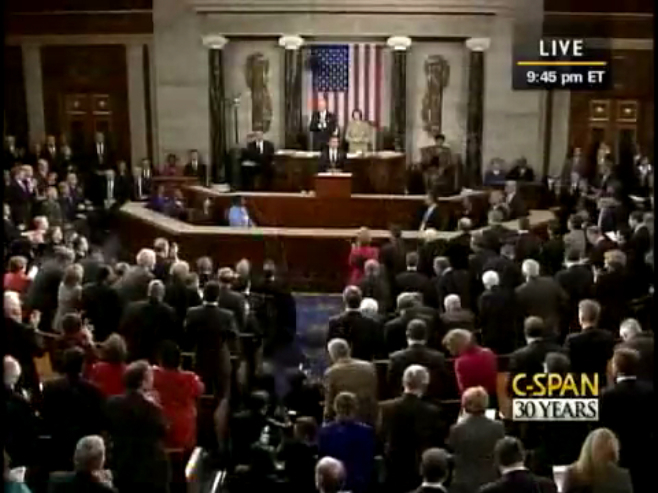
I felt like talking to my homeroom class about the education excerpt of President Obama’s Joint Sessions speech so I ripped it and then excerpted it a little further. [entire education address; smaller excerpt]

I realize this is Pacific Standard Time and some of you are just finishing lunch right now on the East coast but how cool is it that our President delivered an enormous policy address in our nation’s capital last night and I can have the (middling-quality) video in front of my students for discussion the next morning. Obviously, everything is going to be just fine.

The excerpt we’ll be addressing, for good and bad:

In a global economy, where the most valuable skill you can sell is your knowledge, a good education is no longer just a pathway to opportunity. It is a prerequisite.

Right now, three-quarters of the fastest-growing occupations require more than a high school diploma, and yet just over half of our citizens have that level of education. We have one of the highest high school dropout rates of any industrialized nation, and half of the students who begin college never finish.

This is a prescription for economic decline, because we know the countries that out-teach us today will out-compete us tomorrow.

So tonight I ask every American to commit to at least one year or more of higher education or career training. This can be a community college or a four-year school, vocational training or an apprenticeship. But whatever the training may be, every American will need to get more than a high school diploma.

And dropping out of high school is no longer an option. It’s not just quitting on yourself; it’s quitting on your country. And this country needs and values the talents of every American.