1.
Ben Blum-Smith inspires a new anti-jargon edu-slogan:
… what happens is that when kids reach a point in their mathematical education where they are asked to prove things, they find
- that they have no idea how to accomplish what is being asked of them, and
- that they don’t really get why they’re being asked to do it in the first place.
The way out of this is to give them a crisis. We need to give them problems where the obvious pattern is not the real pattern. What you see is not the whole story! Then, there is a reason to prove something.
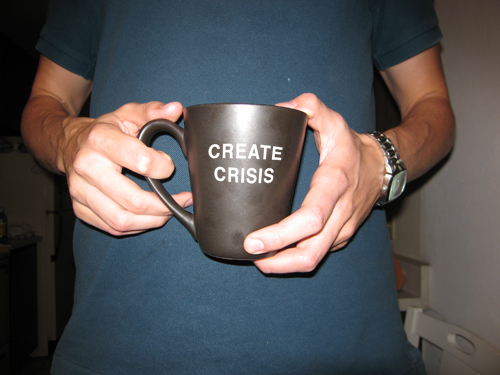
Create crisis.
I have become convinced, overwhelmingly, that my value to my students as an educator is bound up less in what I know (though knowing things doesn’t hurt) than in my ability to engineer a safe, controlled crisis in their learning process (which, I think, requires knowing a whole lot about something very little).
Blum-Smith’s post connects a lot of my recent disconnected writing – in particular, my intention to be less helpful and my interest in a learning process that positions new knowledge as the solution to the limitations of old knowledge. As far as teacher mug slogans go, “create crisis” should start some good conversation in the faculty lounge.
Aside: I’m reviewing some of O’Reilly’s Head First material (for some small profit, in full disclosure) and their authors do a fantastic job creating crises. There are two chapters in the Head First Programming, in which the reader learns searching, strings, and branching. Watch how they do this:
- First, you learn how to pull down the text of a webpage for your “employer,” the CEO of Starbuzz.
- But then your employer gets sick of looking at raw HTML and you have to search strings to find the price information he’s looking for.
- But then he needs an emergency option so he can place an order if the price drops below a certain point.
- But then he needs a notification system, so your program will Tweet him that information immediately.
And so on. It’s extremely satisfying.
2.
Nina Simon, a Santa Cruz neighbor, designs participatory museum experiences which she has dubbed “Museum 2.0.” She compiled an excellent list of questions that support and suppress participation:
Here are some of the wrong questions:
- What is the girl in the painting doing? (too teacherly)
- What does freedom mean to you? (too abstract)
- How would you define nanotechnology? (too impersonal)
- What’s the best song you’ve ever heard? (avoid superlatives – they make some people anxious)
- What do you think? (too general)
Let’s set aside the fact that she uses “teacherly” as a pejorative. The applicability of this post to anyone who spends the majority of her work day asking students questions should be obvious.
Furthermore, I haven’t set aside the puzzle I posted in You Have No Life. I’m ripping pages out of the playbooks of people who spend their working lives “engaging the imagination so that people don’t feel threatened by it”: Nina Simon (museums), Jane McGonigal (games), and David Milch (television, quoted). The projects highlighted at the Kickstarter blog (miscellaneous) are essential reading also.
3.
Robert Cringely hops on the higher-education-is-screwed meme in Burn Baby Burn [via]:
Education, which – along with health care – seems to exist in an alternate economic universe, ought to be subject to the same economic realities as anything else. We should have a marketplace for insight. Take a variety of experts (both professors and lay specialists) and make them available over the Internet by video conference. Each expert charges by the minute with those charges adjusting over time until a real market value is reached. The whole setup would run like iTunes and sessions would be recorded for later review.
I’m not in the prognostication business. I draft off more serious thinkers on the open question of the effect of the Internet on higher education. I don’t know if I’ve missed a dumptruck-sized hole in Cringely’s reasoning but I found the piece extremely provocative and I’ll be revisiting it later in this space.
4.
I want to buy a coffee table book packed with anecdotes just like this one from Ian Garrovillas, illustrating the healthy, cool interaction between a student and teacher.