Year: 2009

Total 161 Posts

New Tweecher Induction

Alison Blank:

Everyone out there seems so full of love for the students and the job that it carries them through the long hours, but it hasn’t been enough for me to break out of the vicious cycle of frantic work and procrastination I’ve been stuck in since first grade.

This is as good a description of teaching’s tumultuous first year as you’ll find out there on the blogs. It also summarizes:

  1. teaching’s great deception โ€“ “love your students and the rest will follow.”
  2. teaching’s jarring transition โ€“ from sleepwalking into your 08h00 MAT 180 class to teaching your own classroom of sleepwalkers where every bad work habit you’ve accumulated over your entire life pays off huge negative returns.

Let’s table this post for a few years. It took me five years to feel even a little put-together in this job, to feel like I wasn’t just scrambling to keep pace, but I give Alison half that.

Had I gone to grad school this year, I would have put some time into a collage of new teacher profiles. Not my kind of new teacher. Not the traditionally inducted teacher, two mentors assigned by his district over two years, mentors who in all likelihood teach an unrelated subject. The sort of new teacher aptly described by statistics like “50% attrition rate.”

Rather, scan the list of commenters at Alison’s blog, scan her Twitter crowd (Twitter account required, sorry), and tell me you don’t think she’s going to bend the induction curve upwards.

Let’s assemble a control group. We’ll have the experimental group spamming questions at jackieb, jdyer, dcox21, colleenk, samjshah, k8nowak, sweenwsweens, dgreenedcp, et al, while blogging the experience as time permits.

I don’t know if it’s any kind of model. I only know it would’ve made me a much happier teacher, much sooner.


Ad Check

I can’t be the only person afflicted with these sidebar ads. The series is notable for taking guys who have at most 7% body fat and then Hulking them out even further through some form of isometrics or meditation or whatever. They doubled down on whatever game they’re running, though, with this particular before/after set. You have to imagine it animating back and forth between the two:

The deceit here is vaguely mathematical so I asked my first class of students, “What is it selling and how does it try to sell it?” Most identified the product as some kind of weight loss formula and/or protein shake. No one identified the deceit.

So I asked my next class, “What is it selling and how does it lie?” Many suggested we were looking at two different people here, which I said was false (with about 99% certainty). One student thought the ears were the giveaway, which is true, though not the giveaway he thought they were.

I guess I’m curious a) if you notice the deceit and b) if there’s any way to translate that deceit into an actionable math unit?

Update: Yeah, it’s the distortion, which is about 17% too wide in the first image and 17% too tall in the second image. Should it worry me that none of my students caught it?

Here are my estimations of the undistorted images.

Graph: effectiveness of ad v. percent distortion.

[Update: Holy cow. They fixed the proportions in the latest ad buy.]

What I Would Do With This: Pocket Change

[following up from here]

Appeal To Their Intuition

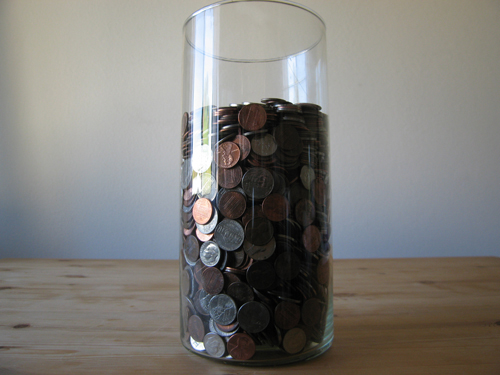
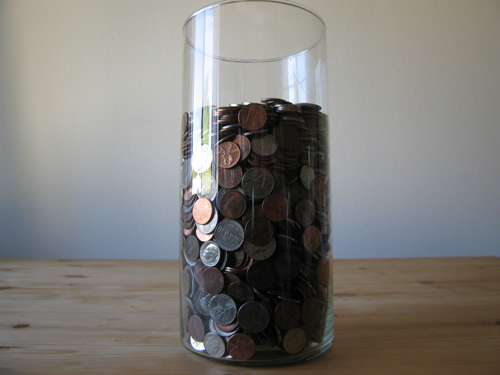
“How much cash is this?” Take guesses. The student risks nothing with a guess but that investment pays off huge for the teacher over the life of the exercise because the student wants to know who guessed the closest.

Build Slowly

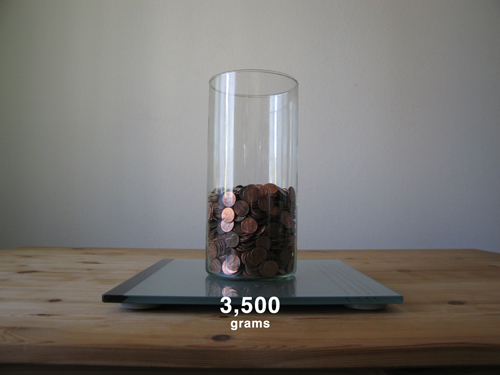
Again, ask “how much cash?” but also ask “how heavy?” Show them the weight. (I zeroed out the jar from every weight measurement you’ll see here. Don’t worry about it.) Spitball some ideas for determining the value of those coins. You’re trying to motivate the idea that the weight of the coins ties directly to how much the coins are worth. Pull up the relevant Treasury website.

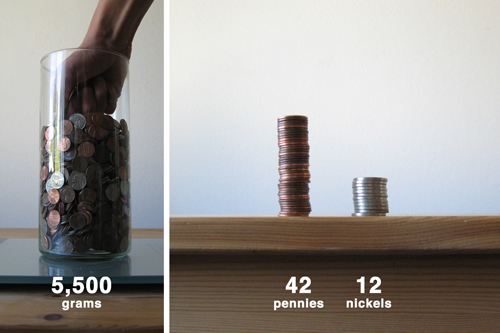
Then mix in some nickels. Scoop out a small sample. Play with that. Set up a proportion between value and weight.

Iterate

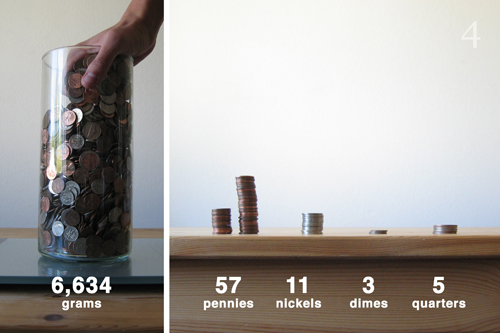
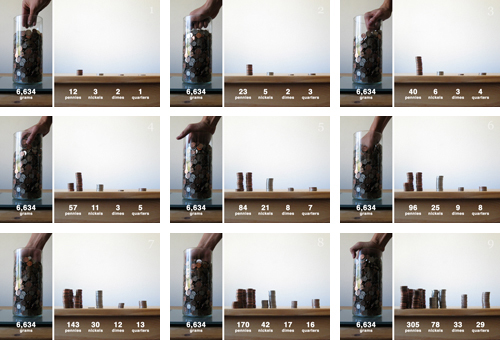
Now you have pennies, dimes, nickels, and quarters. I took nine sample scoops, everything from small to big.

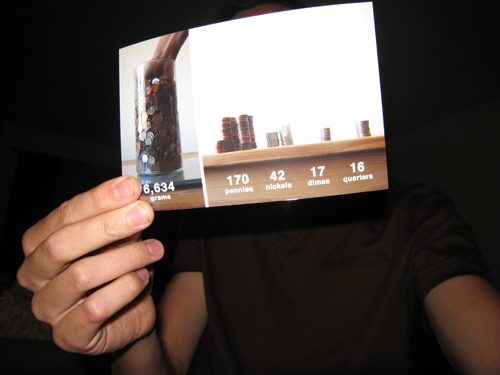
I formatted these at 4×6 so I could print them out at our local one-hour shop for a few bucks and put one in front of every student.

Throw A Curve Ball

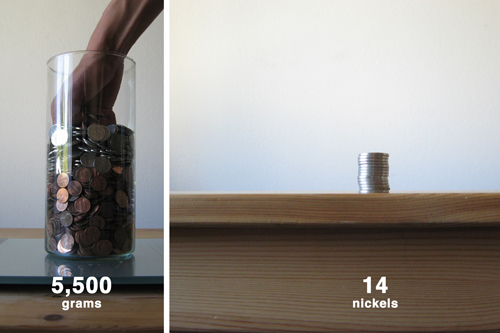
Some will finish quickly. You tell them you have a jar of coins that weighs 5,500 grams. You reach in and pull out 14 nickels. How much is the jar of coins worth?

They’ll run these calculations and come up with an estimate of $55. You tell them it was really $34, which is huge error. Ask for sources of error. Then toss this up and talk about it.

Confirm The Answer

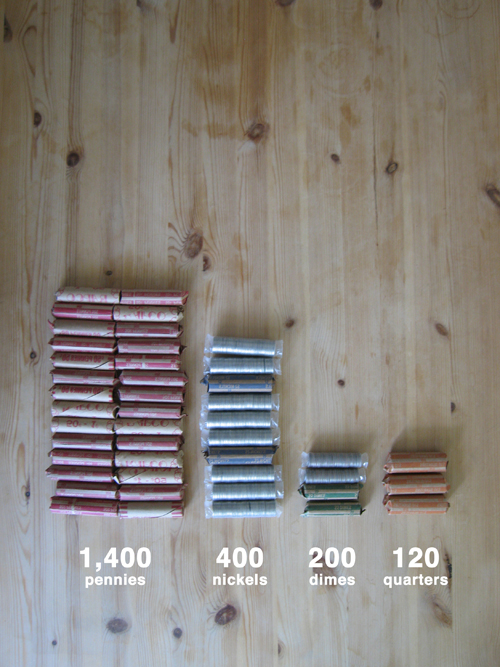
$84.00, if you were curious.

It’s essential to give some kind of visual confirmation of the answer, both so we can give credit to good initial guesses and so we can talk about sources of error. (ie. “who was off by the most? did sample size matter at all?”)

Miscellaneous

  1. Show them CoinCalc, the backend of which does exactly what we’ve done here.
  2. This activity follows-up nicely on the goldfish activity, where we used a small sample of fish to determine the total population of a lake.
  3. We yield the floor to Jason Dyer and anybody else who would like to debate the question, “why are we doing this digitally?”

Download

Here’s the entire learning packet [62MB].

What Can You Do With This: Pocket Change

[followed up here]

Let’s push this forward. The question is “how much cash?” The reference point is CoinCalc.

Your challenge is to outline the supporting materials so that this activity will a) scale from easy to hard, b) throw a few curveballs at the students who figure out its mechanics quickly, and c) offer visual confirmation of the answer to provoke a discussion of sources of error.

If you then consider the fact that a) it’s easier to mix coins than unmix them and b) it’s easier to tally the value of a roll of coins than a pile of loose change, you’ll understand why producing this unit took a week of detailed planning and an afternoon of careful shooting.

[click for high-res]

What I’m Trying To Say:

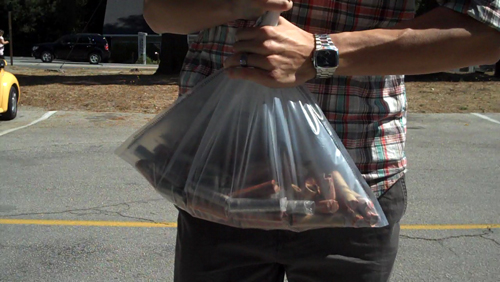
I withdrew $100 in pennies, nickels, dimes, and quarters from my bank account last week. I walked out of the bank holding a plastic sack full of change, feeling like some kind of underachieving bank robber.

I did this because I live in mortal terror that if I ignore the WCYDWT fairy even one time, she will leave me for another math teacher and whisper interesting ideas in his ear. For this reason, I put her ideas into some kind of play as fast as I possibly can.

I was just thrilled she didn’t tell me to literally rob the bank. I mean, it’s conceivable.