Sessions Reviewed:
-
Linking Best Mentoring Practice and Online Support for Beginning Teachers. Nina Girard.
-
Using Mathematics Homework with an Eye on Equity and on Mathematical Integrity. Deborah Loewenberg Ball.
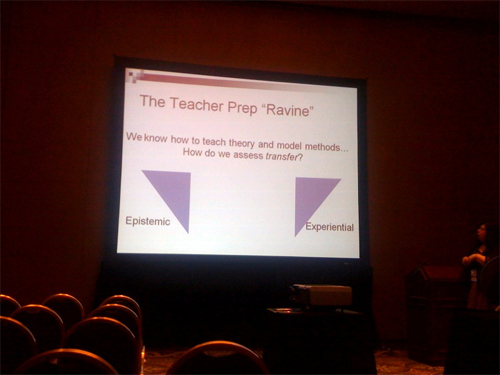
The Teacher Prep Ravine
Girard described a ravine between epistemic and experiential ledges. How do you bridge it, getting new teachers from learning about teaching to actually teaching?
Girard and her team used the free Moodle course management system in four ways:
-
A wiki for sharing ideas and resources.
-
A journal for student reflection.
-
Blog posts, prompts written by Girard for new-teacher comment. Girard spoke of certain blog threads that caught fire in a way that was gratifying like when you hear students talk in the hallway later in the day about what you were teaching that morning. (I’m not sure how well I relate to that analogy, but I think I get it.)
-
A forum for conversations initiated by new teachers.
None of this will shock guys like Couros or Shareski who have been doing this with new teachers for awhile now, or Kuropatwa who does this with his math students. Girard presented all of this with the matter-of-factness it deserves. It’s just a sensible way to extend classroom conversations outside of the time you’re alloted by your bell schedule or your course’s credit-hours.
New teachers who are hesitant to join a conversation full of type-A teachers may bloom online, said Girard. It was also useful for teachers who struggled with content knowledge. Many of the forum posts were requests for lesson help.
Girard and her faculty are encouraging graduates to hold onto their login credentials, to continue contributing to and benefiting from the resource wiki, and to share their knowledge with the next class of new teachers. The potential there is kind of inspiring.
Homework That Doesn’t Hurt
Deborah Loewenberg Ball began with a concise summary of inequity in education in America. She singled out students whose schedules were overflowing; students who had work after school, either earning money for the family or babysitting so others could; students who had limited access to resources, either knowledgeable family members or materials like scissors and tape.
She then asked the session’s motivating question:
How do you create homework that is mathematically valuable but still accessible to all students?
She introduced us to her Elementary Mathematics Laboratory, a two-week program for incoming fifth-graders to learn math in interesting, novel ways for a few hours a day.
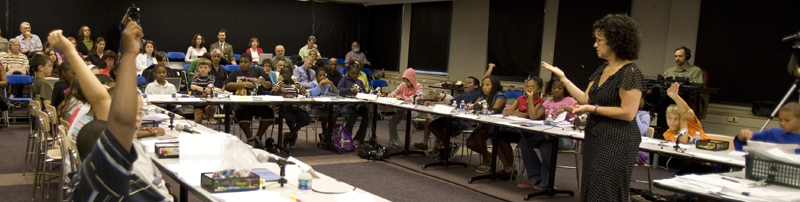
She never said so explicitly but I assume EML is where she conducts the majority of her research. And why not? Check out the banner image on the EML website.
You have two video cameras around the room, table mikes spaced all around the students, and a lav mike on the teacher. The research page says they photograph all the public spaces like whiteboards, overheads, and student posters. The room is positively rigged for research.
At the EML, they decided that homework is best used for …
- … between-class work to bridge the gap between today and tomorrow.
- … structured, independent work to free up in-class time for social or extended learning. (cf. these guys.)
- … study-skill development, for learning how to learn and study math and develop a productive disposition.
Her demonstration assignments required no more paper than what they were printed on and they were further scaffolded by …
-
… a student contract to the effect that this is a serious class and you will need to complete this work to be successful.
-
… a teacher contract designed by the students to the effect that the teacher will bring the heat every single day. The practical result of both contracts was largely symbolic but DLB said it set a powerful tone for the course.
-
… homework kits containing scissors, tape, and other necessary supplies.
-
… explicitly labeled problems. Three varieties.
-
Independent practice. Skill development, reinforcement, and reflection, designed to be completed without help. In fact, students were told not to get help.
-
Preparation for new work. “Go as far as you can.” This was work they hadn’t been fully taught, designed to teach tolerance for difficult work and a productive disposition toward math. Students didn’t finish the majority of these assignments.
-
Work to be shared. This was to improve home/school communication, to develop a student’s ability to narrate her own work. “Share what you’re learning with someone in your home.”
The EML (which, it must be said, hardly resembles a student’s experience in a traditional classroom during a traditional school year) posted a 100% homework submission rate. I’d soften my stance toward homework even further if I could a) get someone to teach me how to create these assignments and b) get several members of my department on board to distribute that creative work.