It’s my fallen nature to blog about successes more often than failures. The balance with WCYDWT, though, is especially out of whack. I had a productive conversation with Jackie Ballarini at NCTM earlier this year that reminded me to rein in certain misconceptions.
So I’d like to clear my throat here. I hope to assure you that I’m just as much of a hack as anybody with this stuff, though I’m a really happy hack.
Here are the facts:
We don’t do WCYDWT every day in my classes.
Most of my teaching strays only four or five degrees from the path beaten by my textbooks. We do a full WCYDWT unit – the kind of home run that I post here – perhaps once every two weeks. Naturally, that pace picks up every school year as I swap out old parts for new and as more of y’all do that hard work for me.
We do tell mathematical stories every day, though they’re often brief.
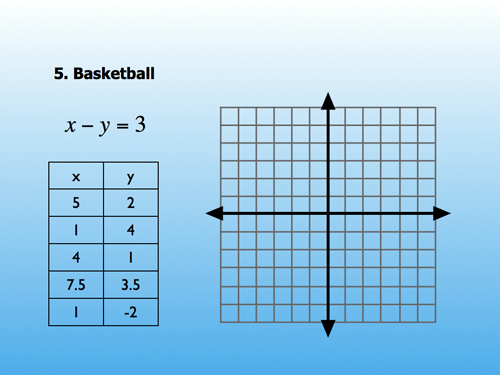
For example, we did a few problems with standard form lines last week. I put up an empty graph, a table of coordinate pairs, and a standard form equation. “Who is the imposter?” I asked. “Who doesn’t belong?” The students then had two methods (graphing or evaluating) for determining the villain.
That’s probably the smallest unit of math storytelling I can offer. I didn’t shoot videos. I didn’t take photographs. I just reoriented my textbook’s existing activity towards drama.
You can do that tomorrow.
The home runs take a really long time.
If I posted it on this blog, it took me (on average) three hours spread out over three weeks. Some take a lot longer. Most require research.
For instance, I was in Chicago in early May with my family and we took a fantastic architecture tour. The tour guide offered me a gem of a WCYDWT idea so I interviewed him afterward. That led me to track down an expired building code from Chicago c. 1930. I’m now hunting down a book that’s out of print and absent from every public and commercial collection in Santa Cruz County. I can’t buy it. I can’t borrow it. I’m going to get it.
I file this in my day planner under “leisure time.” The process exhilarates me. My teaching is my life, in the healthiest possible sense of the expression.
Home Runs : Triples : Doubles :: 1 : 5 : 30
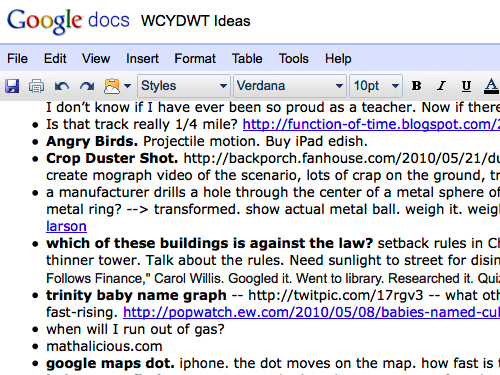
I have a document in Google with a few hundred WCYDWT ideas. I add to it weekly. Most additions contain just a sentence and a link.
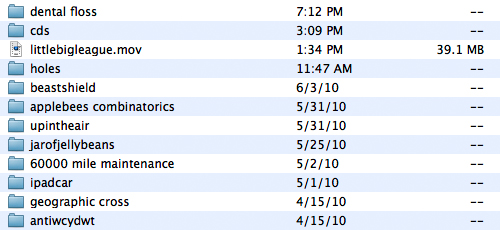
Then I have several dozen folders on my Mac. Each folder contains images, videos, Photoshop documents, Geogebra applets, and other files contributing to a story from the Google document that had to be told in greater detail, a story that was compelling enough to demand more of my time and attention.
For every thirty entries in the Google document and every five folders on my Mac, I post one WCYDWT entry here.
Of those three venues, the Google document is the most dear to me. It’s where I put inspiration. It’s how I convert inspiration into something, clearing it from my mental queue, freeing up room for more.
You can do that tomorrow.