[see midterm]
1. Which of Will’s commenters has suggested a pseudocontextual problem?
Very few of them, it turns out. Which isn’t to say that all of the suggested problems are good problems, just that our worst tendency in these discussions is to conflate the term “pseudocontext” with “problems I don’t much care for.” Pseudocontext uses the full authority of the teacher or the textbook or of grades to force a connection between The Math and The Context that doesn’t naturally exist. This is a separate matter from “Do professionals really use math in that way within that context?” or “Will my students care at all about the math, even though it exists naturally in this context?”
Spot check me here but I find it pretty easy to divide the suggestions at Will’s place into four categories:
Valid Context, Of Inherent Interest To Basketball Professionals
These questions are ideal, and really hard to find. Will is probably better off asking a basketball player, a coach, or a sportscaster because they won’t waste his time (or, especially, theirs) with pseudocontext.
Glover:
You can probably set up different metrics – basically giving different weights to things like free throw percentage, scoring, rebounds, steals, etc. – and compare players and be able to claim “I can prove that Kobe is better than Lebron” or whoever else you want to compare. This would also extend to comparing teams and stuff.
Have you seen John Hollinger’s formula for player efficiency? It’s gargantuan. Have your students create their own, balancing factors however they choose, checking the results against their intuitive sense of the best basketball players. (ie. “I know Kobe’s the best but my formula is coming up with Lebron.” So you rebalance.)
George Woodbury:
There are some probability applications. If a free throw shooter has a 75% chance of making a free throw, what are the chances that he or she makes 2 free throws? 1 of 2? 0 of 2?
Pair with video clips of different shooters at the line. Given their overall average, place bets on which players will hit both, which will hit one, and which will miss both. Then show the answers.
Valid Context, Uninteresting To Basketball Professionals But Interesting To Students If We Develop It Well
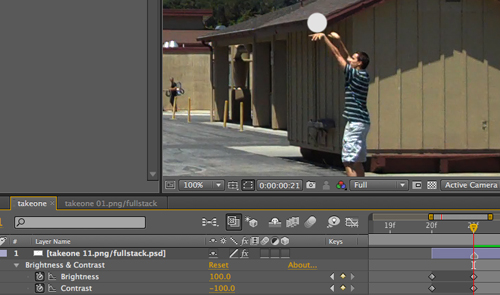
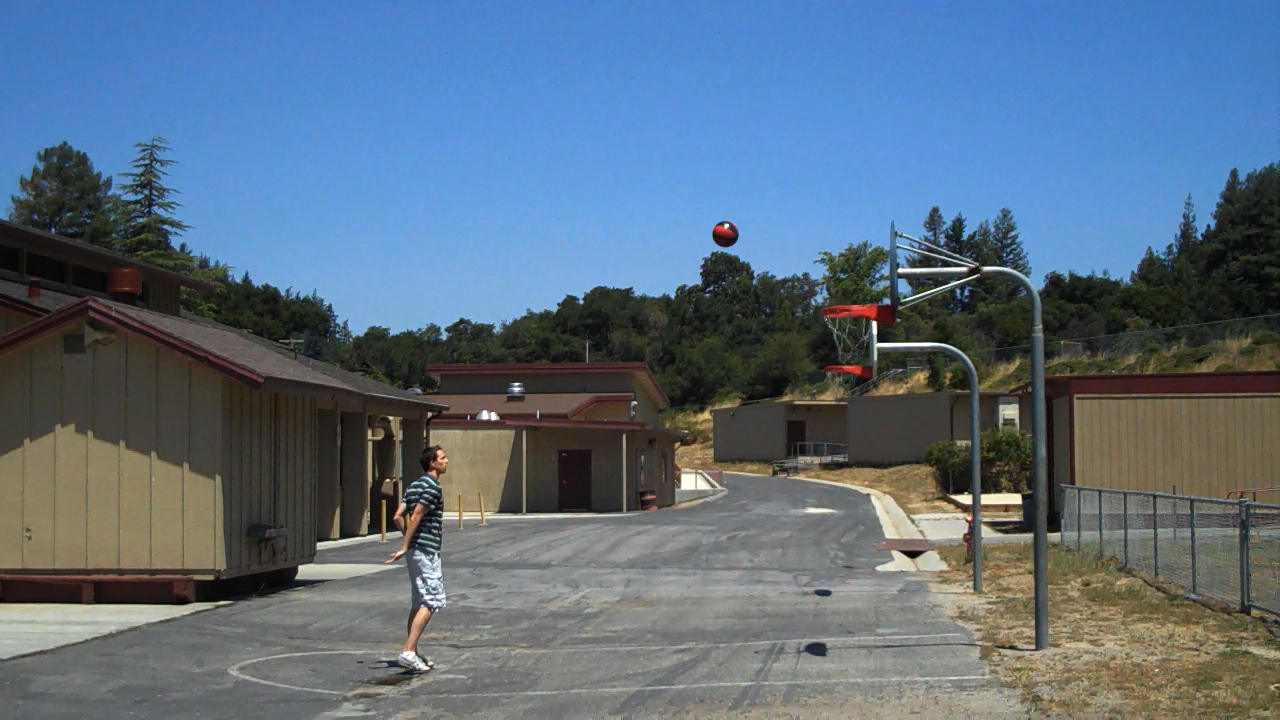
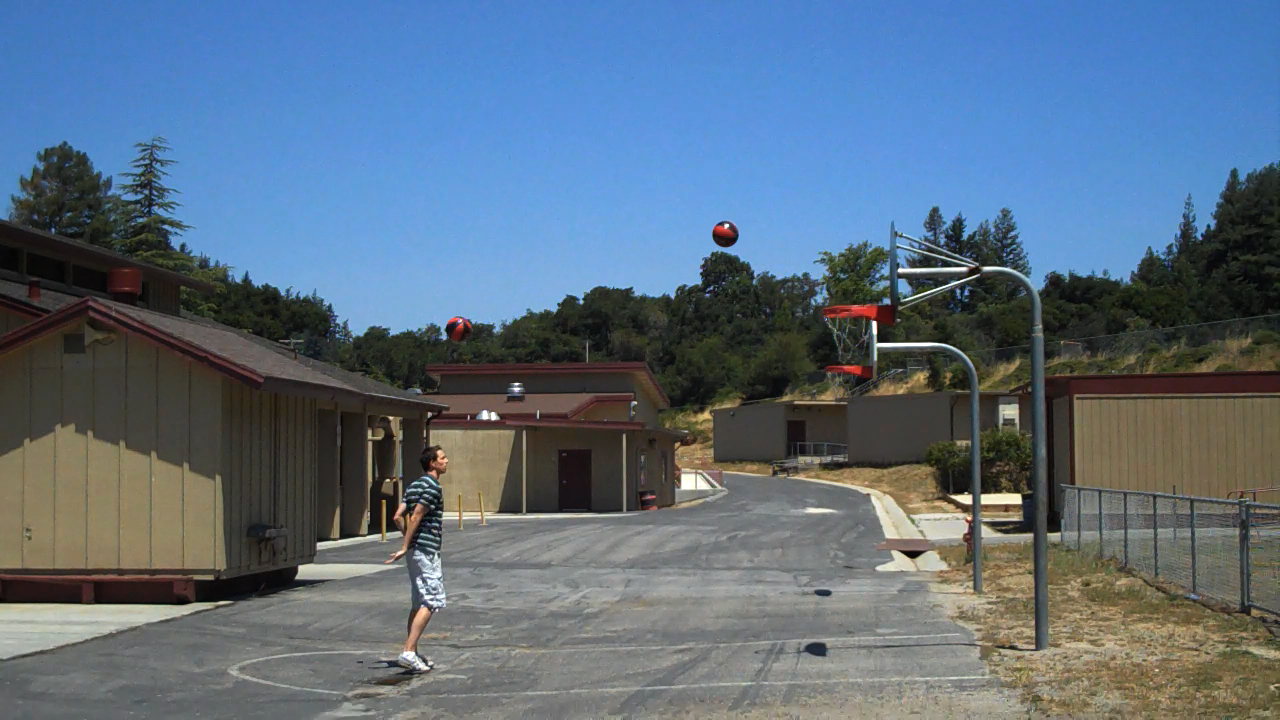
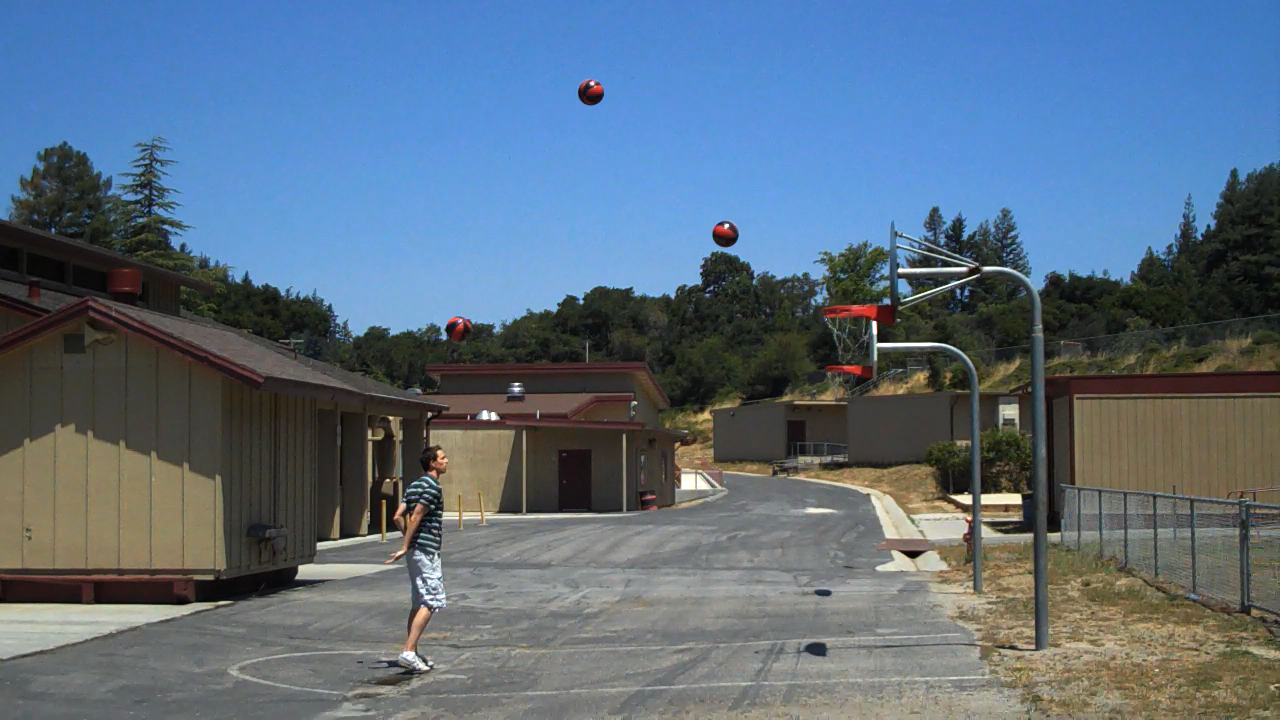
Do basketball players need to know anything about 3D vectors? When they go for jumpshots are they converting force to acceleration and then solving the quadratic formula to see if the ball will land? No, but these problems are of interest to students. Especially if we visualize them well, if we present them in a format that appeals first to intuition (“do you think it goes in?”) that only later uses math to formalize that intuition.
Angie B:
Dan Meyer’s dy/dan blog had this on it.
wmchamberlain:
How about studying the lines and shapes on the court? A little bit of geometry there.
I like the challenge here. There is a lot of geometry in the lines and shapes on the court. But the hard work remains. What question do you ask? What problem do you pose to get students diving into the geometry of a basketball court, wondering “what kind of shape is the three-point line anyway?”
One idea: I draw two points on a piece of paper. The line between them is the baseline on one side of the court. Can you draw a scale replica of the rest of the basketball court. Bonus: do it with a compass and straightedge alone. Extra bonus: write a program that accepts two mouse clicks and does the rest automatically.
Valid Context, Uninteresting To Basketball Professionals, Also Uninteresting To Students
It’s within your professional jurisdiction to ask these questions, but these questions only appeal to math teachers. Not basketball professionals, and certainly not students. But they aren’t pseudocontextual. These problems have an inherent connection to basketball. If anybody is selling a term to describe these problems (ideally something more descriptive than “lame”) I’m buying.
Lyn Hilt:
Incorporate geography…calculating traveling distances/methods to visit arenas and attend games.
Jason Kornoely:
If it takes one player an average of 15 seconds to dribble across the field, how much time would it take for a team of x to finish?
Rhett:
[What is the] volume of skin making up ball assuming skin is 1/16 th thick?
Pseudocontext
Jason Kornoely:
Determine the hypotenuse using the distance from the free throw line to the center of the hoop and the height of the hoop.
This was the only response I could call pseudocontext with absolute certainty. The Pythagorean theorem has no use or meaning here. The teacher is imposing the theorem on a context that doesn’t want or need it.
2. Create a math problem in response to Will that would be pseudocontextual.
Chris Sears:
Kentucky and UCLA have appeared in the NCAA Division I men’s basketball tournament 80 times, with Kentucky appearing 8 more times than UCLA. How many times has each team appeared in this tournament?