I take these speaking jobs for three reasons.
- To maintain the tuna-casserole lifestyle to which I have become accustomed, even though I’m only bringing in the part-time research assistant money these days.
- To compel me to find better structures, metaphors, visuals, and exercises for communicating good curriculum design.
- For the helpful feedback and criticism the attendees offer.
These groups of grownups are my classroom for the foreseeable future. It’d be a waste of a blog if I didn’t share what I learned last weekend.
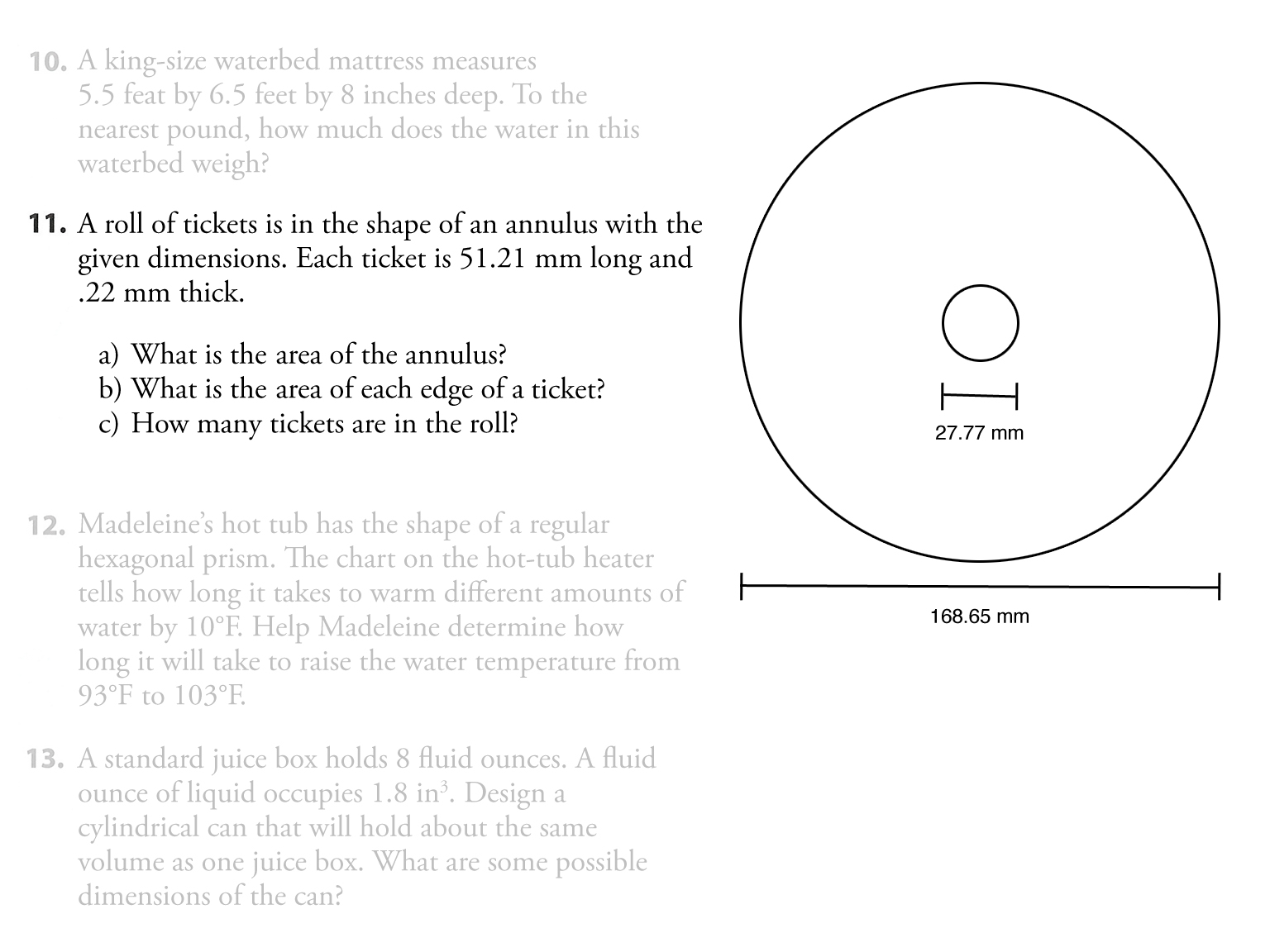
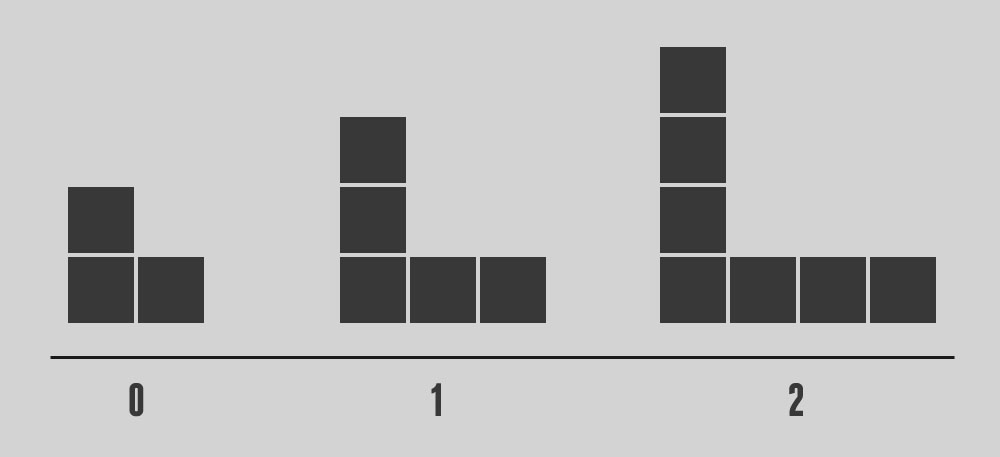
- Mathematical notation isn’t a prerequisite for mathematical exploration. Mathematical notation can even deter mathematical exploration. When the textbook asks a student to “find the area of the annulus” in part (a) of the problem, there are at least two possible points of failure. One, the student doesn’t know what an “annulus” is. (Hand goes in the air.) Two, the student knows the term “annulus” but can’t connect it to its area formula. (Hand goes in the air.) ¶ That’s the outcome of teaching the formula, notation, and vocabulary first: the sense that math is something to be remembered or forgotten but not created. ¶ Meanwhile, let’s not kid ourselves. The area of an annulus isn’t difficult to derive. Let the student subtract the small circle from the big circle. Then mention, “by the way, this shape which you now feel like you own, mathematists call it an ‘annulus.’ Tuck that away.” ¶ Similarly, if I give you this pattern, I know you can draw the next three pictures in the sequence. That’ll get old so I’ll ask you to describe the pattern in words. You’ll write out, “you add two tiles to the last picture every time to get the next picture.” I’ll show you how much easier it is to write out the recursive formula An+1 = An + 2. ¶ I’ll ask you to tell me how many tiles I’ll find on the 100th picture. You’ll get tired of adding two every time, and we’ll develop the explicit formula A = 2n + 3, which makes that task so much easier. ¶ Terms like “explicit” and “recursive” and “annulus” can do one of two things to the exact same student: make the kid feel like a moron or make the kid feel like the master of the universe.
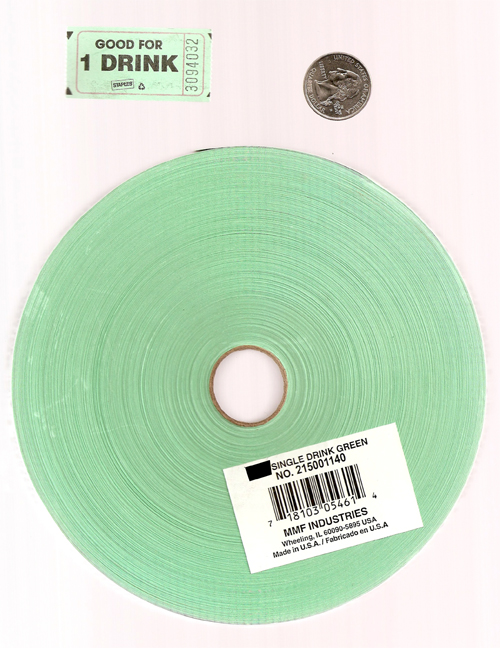
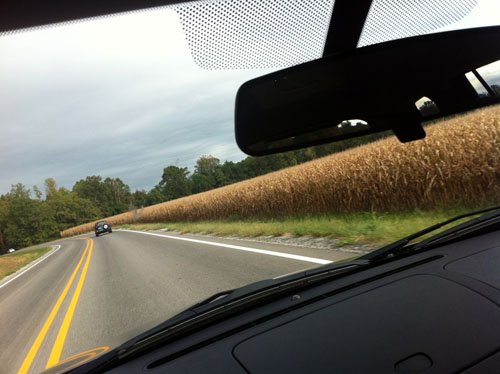
- “Talk to someone who actually makes ticket rolls. What kind of math does he have to do to make the thing,” said Russ Campbell, a community college adjunct instructor at least twice my age. Great idea, Russ. Speaking of which, pursuant to some harebrained WCYDWT idea, I spent twenty minutes on the phone with my local and state Departments of Transportation last week and it was almost too much fun to handle, peppering questions at engineers who were all too delighted that anyone gave a damn about how they calculated recommended speeds for curved roads. More of this.