Year: 2010

Total 151 Posts

Teaching WCYDWT: Misconceptions

It’s my fallen nature to blog about successes more often than failures. The balance with WCYDWT, though, is especially out of whack. I had a productive conversation with Jackie Ballarini at NCTM earlier this year that reminded me to rein in certain misconceptions.

So I’d like to clear my throat here. I hope to assure you that I’m just as much of a hack as anybody with this stuff, though I’m a really happy hack.

Here are the facts:

We don’t do WCYDWT every day in my classes.

Most of my teaching strays only four or five degrees from the path beaten by my textbooks. We do a full WCYDWT unit – the kind of home run that I post here – perhaps once every two weeks. Naturally, that pace picks up every school year as I swap out old parts for new and as more of y’all do that hard work for me.

We do tell mathematical stories every day, though they’re often brief.
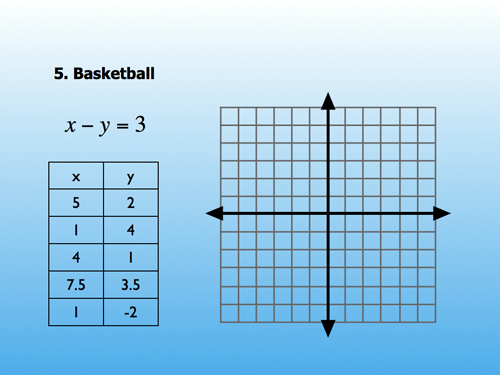
For example, we did a few problems with standard form lines last week. I put up an empty graph, a table of coordinate pairs, and a standard form equation. “Who is the imposter?” I asked. “Who doesn’t belong?” The students then had two methods (graphing or evaluating) for determining the villain.

That’s probably the smallest unit of math storytelling I can offer. I didn’t shoot videos. I didn’t take photographs. I just reoriented my textbook’s existing activity towards drama.

You can do that tomorrow.

The home runs take a really long time.

If I posted it on this blog, it took me (on average) three hours spread out over three weeks. Some take a lot longer. Most require research.

For instance, I was in Chicago in early May with my family and we took a fantastic architecture tour. The tour guide offered me a gem of a WCYDWT idea so I interviewed him afterward. That led me to track down an expired building code from Chicago c. 1930. I’m now hunting down a book that’s out of print and absent from every public and commercial collection in Santa Cruz County. I can’t buy it. I can’t borrow it. I’m going to get it.

I file this in my day planner under “leisure time.” The process exhilarates me. My teaching is my life, in the healthiest possible sense of the expression.

Home Runs : Triples : Doubles :: 1 : 5 : 30
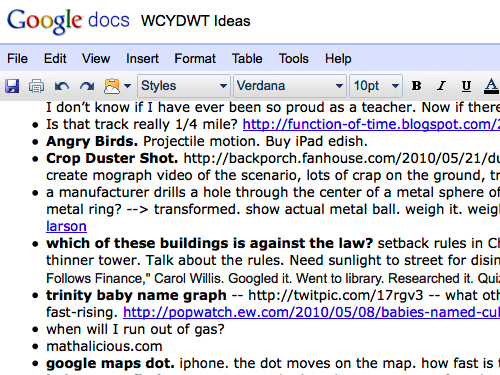
I have a document in Google with a few hundred WCYDWT ideas. I add to it weekly. Most additions contain just a sentence and a link.

Then I have several dozen folders on my Mac. Each folder contains images, videos, Photoshop documents, Geogebra applets, and other files contributing to a story from the Google document that had to be told in greater detail, a story that was compelling enough to demand more of my time and attention.

For every thirty entries in the Google document and every five folders on my Mac, I post one WCYDWT entry here.

Of those three venues, the Google document is the most dear to me. It’s where I put inspiration. It’s how I convert inspiration into something, clearing it from my mental queue, freeing up room for more.

You can do that tomorrow.
TMAO Rides Again

Maybe? The post reads like Kilian Betlach (neé TMAO) but I’m surprised to find his byline on a blog called “The Future of Teaching” given his skeptical stance towards your edu-technology of choice.

Regardless, “Kilian” puts words to an escalating fear of mine: that advocates of ed-technology have grown weary of extending (what they have presumed to be) carrots to classroom teachers and are starting now to see the appeal of Arne Duncan’s sticks:

My knee wants to say it’s a little afraid that the reform 2.0 folks are lining up with those who promote an excellence agenda, one that says our top kids must be prepared to be better than the top kids from other countries, and never mind what’s happening (or not) in Washington Heights, the RGV, or Deep East Oakland. This isn’t necessarily so, and it isn’t unavoidable, but my knee wants to constantly shout that as we try to (re)imagine what the public schools of 2030 will look, we must do so from the perspective of those schools have never well served.

It’s hard for me to distinguish (for one example) this Scott McLeod post from a press release from the desk of Michelle Rhee. Both drip with the same disdain for teachers who would have enacted their (McLeod and Rhee’s) preferred vision for public schooling years ago were it not for their (the teachers’) willful, clannish embrace of mediocrity.

Teaching WCYDWT: Storytelling

2011 May 12: I gave this post another pass a year later.

The job of the dramatist is to make the audience wonder what happens next. Not to explain to them what just happened, or to suggest to them what happens next.

David Mamet

Once you’ve learned something, my experience is that if you do something with that learning, if you turn your learning into something else for somebody else, it starts a flywheel spinning awfully quickly where you start learning more and then doing more with that learning and then you’re on CNN.

A recommendation: turn your learning into a story for somebody else.

Why a story rather than a persuasive essay or a pillow sampler? For one, the story is a medium that runs on greased rails between very different people. It’s an efficient transaction, even between me and my grandpa. For another, it’s hard for me to ignore how many elements of good teaching have their predicates in the three acts of a good story.

The First Act

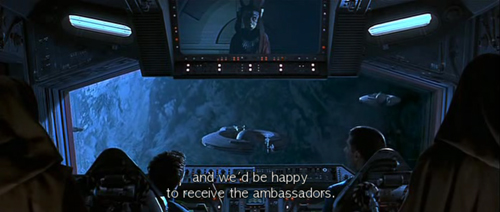
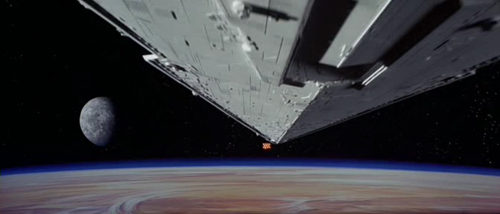
Consider the opening shot of Star Wars, a movie which is nothing if not a story well told.

The moons. The tiny ship pummeled by the huge ship. The chase. The symbolism of the green and red lasers. The camera rolling just inches from the huge ship’s underside so it (the huge ship) appears to go on forever.

I’m not saying every lesson needs to (or can) open this way. I am saying there are obvious advantages to opening a learning moment with a series of clear, intriguing constraints (again: the tiny ship, the huge ship, the chase) that invite speculation and curiosity.

I’ll leave the injection of poor teaching onto the opening sequence of the first Star Wars prequel as an exercise for the reader. Hint:

The Second Act

During the second act of a story, your protagonist encounters allies and antagonists and uses the former to help resolve problems created by the latter.

During the second act of our lesson, students seek out the limits of the problem and try to determine valuable information and skills for resolving it.

The storyteller / teacher needs to assist the viewer / student just enough to make the viewer / student wonder what’s coming next and enable her to put that answer together on her own. It’s almost easier in these instances to help too much, to nudge a viewer or a student too forcefully, than it is to help too little.

Here’s an example from television where that goes right and wrong. These two shows both feature armed standoffs between criminals and cops. One show asks you to work hard to determine the motives and capabilities of the characters, the tone and possible outcomes of the scene. It’s a satisfying, tense experience. The other show signals all those answers awkwardly, and loudly, elbowing the viewer in the ribs with some ominous strings on the soundtrack.

You should be able to determine one from the other.

Click through to view embedded content.

Obviously, I need a better illustration with fewer adult themes here. Perhaps think about those sloppy literary adaptations where the writer couldn’t describe the source text visually so she has the main character narrate all those thoughts on the soundtrack.

The mandate for filmmakers is show, don’t tell.

Question, don’t tell is far from the worst mandate you could choose for the second act of your lesson.

The Third Act

Consider, now, a) great movie endings alongside b) Ben Blum-Smith’s Pattern Breaking series. If we allow the relationship between storytelling and teaching, Blum-Smith’s broken patterns represent the third-act twist: Rosebud is a sled; Bruce Willis is really dead; Darth Vader is Luke Skywalker’s father; 2, 4, 8, 16, 31. These patterns lull you into a false sense of certainty before yanking the rug out from under you, leaving you scratching your head, wondering what you missed, sending you back through the narrative again, scouring the story for other clues, conjuring up new theories.

Other movies choose to set up a sequel in their final minutes, like Batman Begins positioned the Joker as The Dark Knight’s next villain. Do you see how neatly that fits into Avery Pickford’s definition of great problems:

The problem should be deep. It should be rich enough to spend hours, days, weeks, months, or years working on variations, generalizations, and extensions.

Great problems and stories lead to more great problems and stories.

Questions

“Perplex them,” one of my old high school math teachers advised me when I told him I was going into teaching. Perplexity isn’t the same as confusion; rather, it’s a very, very productive form of confusion. My favorite teachers and storytellers perplex me repeatedly throughout a lesson or movie.

How do you teach people to tell perplexing stories? Even harder question: how do you teach people to tell perplexing stories about math?

My fear is that this skill, more than most others in my practice, reduces to character traits that can’t be taught. Storytelling requires empathy, an understanding of an audience’s expectations, their current knowledge, and their prior experience. I don’t know how you teach empathy. Perhaps it can only be modeled.

Certainly, here are fair pre- and post-assessments of storytelling:

  • Tell me about something you learned recently that exhilarated you. Tell me about it in such a way that I understand your exhilaration. ie. “Holy cow. ‘Oman’ is the only country in the entire world that starts with an ‘O!'”
  • Tell me about something you learned recently that exhilarated you. Tell me about it in such a way that I experience that exhilaration for myself. ie. “What is the only country in the entire world that starts with an ‘O?'”

It’s the assessments in between that mess me up.

Organizing Principles

As I lock picture on season six of this incoherent teevee drama called “Teaching,” I am very interested in articulating some general themes and principles around which I’ve tried to organize my instruction. Problem is: the more time I spend creating math problems, the more I detach myself from those interesting generalizations. I am grateful, then, to a couple of edubloggers who have done some of that heavy lifting for me.

1. The Skills Aren’t Arbitrary

Tim Childers:

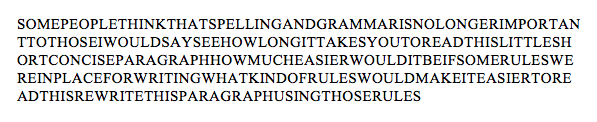
The original Greek texts [of the New Testament] were written in all capital letters with no spacing and no punctuation. I wondered what would happen if I gave kids the note below on the first day of class?

It is exceptionally easy for me to treat the skills and structures of mathematics as holy writ. My default state is to assume that every student shares my reverence for the stone tablets onto which the math gods originally etched the quadratic formula. It is a matter of daily discipline to ask myself, instead:

  1. what problem was the quadratic formula originally intended to solve?
  2. why is the quadratic formula the best way to solve that problem?
  3. how can I put my students in a position to discover the answers to (a) and (b) on their own?

That’s hard.

And the same mandate goes for any hapless ELA teacher reading this blog. Why spaces? Why apostrophes? Why different words for “happy” and “ecstatic?” Why hyphenated compound adjectives?

2. Great Problems Are The Coin Of The Realm.

Avery Pickford offers a five-bullet definition of great problems. It’s excellent and concise. Here is the first bullet:

The problem should be accessible. It should minimize vocabulary and notation, have multiple entry points, and include ways to collect data of some sort. It should have multiple methods that promote different learning styles and celebrate different ways of being smart.

Dr. Tom Sallee, math professor and president of College Preparatory Mathematics, gave two of the best conference sessions I have ever attended (recapped here and here) and said this in one of them about good problems:

A good problem seems natural. A good problem reveals its constraints quickly and clearly. Developing good problems is not at all an easy task. I have a lot of experience with it and I have failed many times.

The best part about this particular currency is that as I get richer, you do too. When you create and post a great problem about Applebee’s, that’s money in my pocket as well.

I find myself dazzled daily by the great problems y’all share. We’re just printing money lately.

Good Bloggers On Good Blogging

Kate Nowak leads; Sam Shah follows. Both offer some great advice if you’re looking to get into blogging. Alternately, if you’re reticent and timid about the whole thing, here’s a poignant quote from Kate, three months before she wrote her first post:

I don’t have a blog, because I have nothing original to contribute.

So there you go.