Year: 2010

Total 151 Posts

And Like That They Invented Mathematics

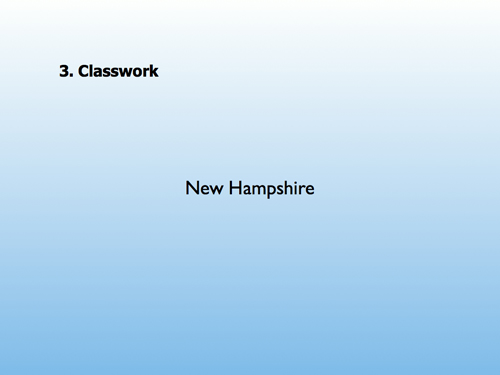
I asked them to pull out their notes and write down “New Hampshire.” They did. Then I told them to write down five more state names.
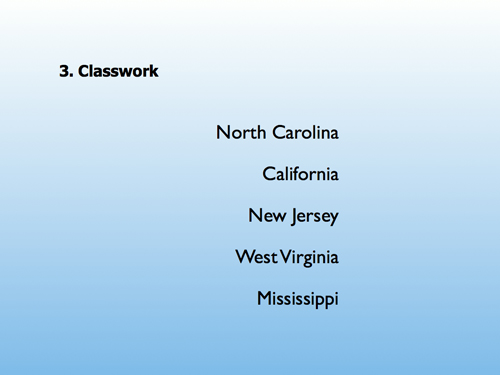
I should have ratched this up to fifteen but five was annoying enough for most. They grumbled and I gave them permission to abbreviate the names in whatever way made sense to them.

Most students balked at “Mississippi.” They abbreviated every state name but that one. “Too many states start with ‘MI,'” they said. We talked about how tricky it is to decide on a rule for abbreviating, how it can lead to confusion later.

You see where this is going, right?
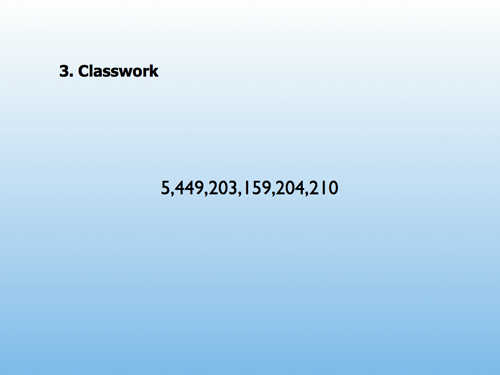
I had them write down the number “5,449,203,159,204,210,” which they did. Then I had them write down more numbers and I gave them permission to abbreviate again.
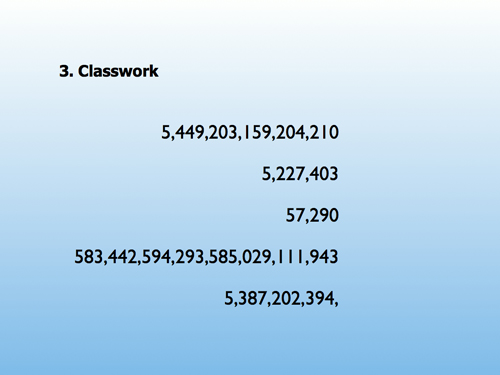
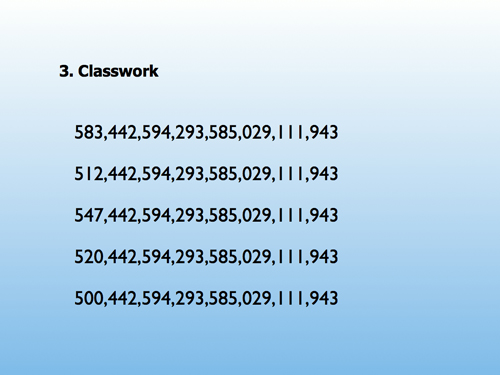
The next part happened quickly but required a lot of encouragement because students have been trained to treat numbers like so many sacred little statues. (“Do not touch the numbers! Do not feed the numbers!”) We asked ourselves, “which is the most important digit here?” After that, students started coming up with variations on the same theme:

5, 15

From there it was a really quick shuffle step to 5.45 x 10¹⁵ through this slide here.
Too many of my students have decided that math is a weird irrelevant game with arbitrary rules that are known only to strange old people whose hands are stained by dry-erase marker. From my experience, nothing works quite as well to disabuse them of that impression than putting them in a place to accidentally invent that game themselves.

Involuntarily Conscripted Into The Math Wars

It’s difficult for me to overstate how tedious I find the commenters at Kitchen Table Math, and math warriors more generally. It’s like watching two sides argue whether it’s better to feed children fruits or vegetables. Both sides approach the new and unfamiliar interested foremost in determining to which reductive party it belongs so they can get properly exercised. ร‚ย This requires a healthy amount of unhealthy inference and I’m not inclined to engage any of it. (ie. “All we need are grocery line problems, apparently.” Have mercy.)ร‚ย 

Skill practice and conceptual development are both essential. I have no interest in any war between them, nor in anyone who suggests they’re enemies. I will put this judgment on the record, though: I have only ever found one of them difficult. Even in my first year, at my worst, I could dip into any number of instructional strategies and problem sets to teach students how to reliably factor, solve, simplify, and evaluate. I have always found it difficult, however, to give my students tools to resolve problems that they haven’t yet seen, to empower their intuition through math, or to convince them to give a damn.

I know I could turn to any one of the KTM pedants at any time to help me improve my skill practice instruction. ร‚ย (Okay, maybe not after calling them “pedants.”) There are far fewer people who have any help to offer me on the harder challenge of math education.ร‚ย 

NCTM / NCSM: Where Are The Kids?

I’m grateful, again, to Key Curriculum, for luring me down to NCSM; to Ihor Charischak, for extending my stay through NCTM; and to Nana, for letting me stay in the guest room. Both conferences were worth my time, particularly NCSM, where my ratio of session hits to session misses was unbelievably high.

I had a variation on the same conversation with six or seven people at both conferences, people who were all closer to the end of their careers than the start, people with elevated angles of sight on math education in the U.S. (elevated enough that several specifically told me not to quote them on my blog), and they all wondered the same thing:

Where are the new teacher-leaders?

One individual clocked the average age of an NCSM attendee at 57. Another, an edtech vendor, said that the biggest liability to his business was his own age. I received a lot of kind notes on my Ignite session but some of the praise was really hyperbolic, predictions about my place in math education that, based on five minutes in front of a projector screen, were flatly unreasonable, and indicative of a certain desperation to point to someone — anyone — on the other side of a yawning leadership gap.

NCTM and NCSM need to convince younger math teachers and younger teacher-leaders of their value. We can do that and bridge the leadership gap with the same solution:

Make it really, really easy for new teachers to connect with mentors over the Internet and vice versa.

Many opportunities exist for older, talented educators to mentor younger educators. Crucially, though, few of them demand any less than an eight-hour-a-day commitment. Teacher mentorship is currently a full-time job in the U.S. Or, if you’re working in an induction program, two hours per week with two or three new teachers. I don’t know how to sell that investment to any of the six or seven people I spoke with in San Diego, all of whom have day jobs.

There are very few high-yield investments for twenty minutes per day of an amazing educator’s time, but that can change.

We need to give Stack Exchange a long look. Stack Overflow is the first stop for anyone looking to crowdsource a programming question and the people behind it have decided to extend their platform to other disciplines. Their stated goal is to “make the Internet a better place to get expert answers to your questions.” You can connect those dots.

I won’t summarize all the factors that have made Stack Overflow a valuable resource for developers though my opinion is that many of them would translate into value for teachers. I encourage you, instead, to read their FAQ. Read some sample questions. Then come back here and let us know how you could see yourself working on this bridge between expert and novice educators, if at all.

NCTM 2010 โ€” Day Three

NCTM is the forward-thinking younger sibling of NCSM and was, therefore, much more progressive about wireless Internet access.

Session Attended:

How to Develop Computational Skills without Drill, During Problem Solving. Jerry Becker.

So Here Are A Few Interesting Problems That Permit Constructive Solutions While Still Assessing Basic Skills

Becker brought out two problems that a) assessed both computation and reasoning and b) scaled all the way from basic counting through limits, which isn’t a small trick.

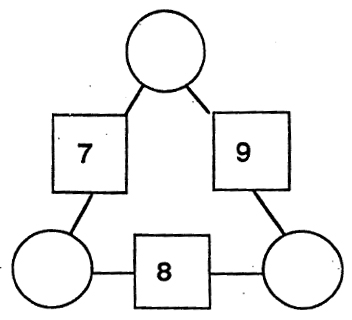
First, arithmogons. Add adjacent circles to get the middle rectangles. Then do it in reverse. Develop a rule for solving them quickly. They scale from easy to algebra at whatever speed your students want.

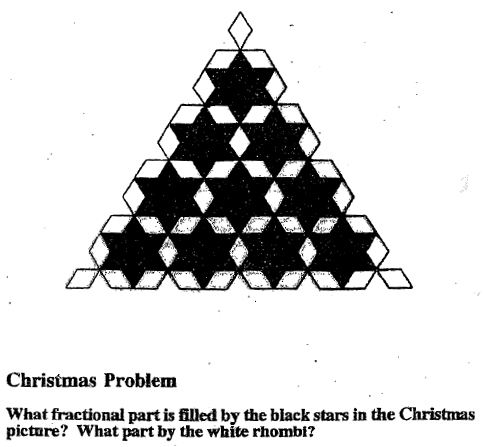
Second, the Christmas problem, which goes from counting all the way up to limits as you add more and more rows to the pyramid.

The Really Curious Part

The session was remarkable mostly for the one hundred copies Becker made of a 55-page handout he spread across ten chairs. “Take one from each pile,” he said as I walked in.

He only used (conservative estimate here) seven of those pages. When he ran out of packets, he promised the remaining attendees he would mail them a copy (as in postal mail) if they left him their addresses. I swear I am not making this up.

Here’s an excerpt of an e-mail Becker sent out to the group several days after the conference:

I apologize for running short of the handouts at our session. But I will have the handouts duplicated in the next couple days and then put them in the U.S. Postal Services mail to you – snail mail, so it might take a few days. But I am working on it already. The address labels will be typed up tomorrow.

So I don’t know.

It struck me several times throughout both conferences that we need to counter-program a session across from the “Newcomer’s Orientation.” I’m not talking about “Rolling Your Own Backchannel with Twitter.” Scale that back. Way back. Something more like, “How to Make National Presentations a Lot Less of a Chore for Presenters,” featuring URL shorteners, Delicious, PDFs, basic FTP. maybe drop.io. You name it.

(BTW: here’s a PDF of Becker’s handouts.)