Year: 2010

Total 151 Posts

Final Exam Question #51

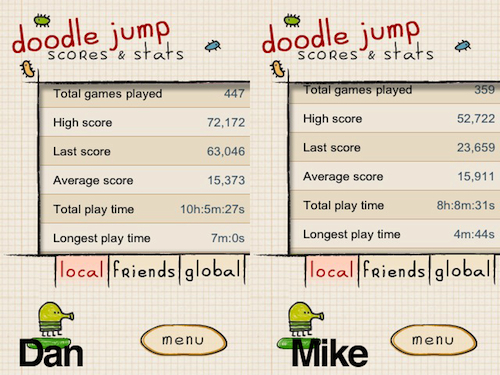
Who is better at Doodle Jump? Mike or Dan? Why?

The first semester ended, not with a bang, but with two days of canceled class… because you can’t be too careful with those Santa Cruz tornadoes. and two days of hasty final exams. My remedial Algebra class spent a lot of time this semester on what California calls computational fluency and what I would rather call the awesome descriptive power of numbers.

Which has meant, thus far, everything from times tables to proportions to infographics all leading to the motivation for the question above: when your friend is being kind of insufferable about how good he is at Doodle Jump, you can use numbers to shut him up!

It is a feature not a bug, in my opinion, that Mike and Dan can draw their own self-serving conclusions from the same set of numbers.

Kate Nowak Joins The Dark Side Of EdTech Evangelism

Kate, tripping guilt with the best of them:

If you want to find excuses for why you can’t possibly teach class differently than you have for the past n years, you will find excuses. If you want to find solutions, you will find solutions.

If they got to Kate they can get to any of us. Double the watch. No one sleeps tonight.

PS. But seriously: where is the comparative study of “no excuses” rhetoric between the Rhee reformers and the edtech evangelists? If you close your eyes, they sound the same.

PPS. Do not close your eyes!

BetterLesson Looking Better

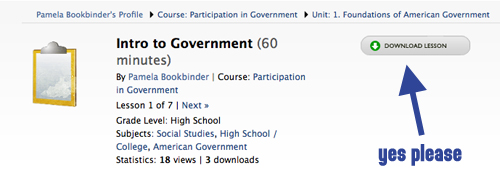
I have no idea when the BetterLesson team deployed this feature, but it’s great. Essential, even, for this kind of site and the implementation is exactly what I would expect:

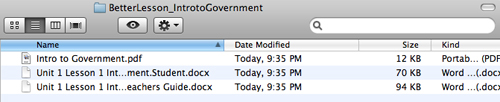
One click and you have the lesson plan in PDF and all the supplementary files in a folder on your desktop:

However finely they’ve tuned their downloading, the upload procedure still encourages teachers to share content standards, worksheets, and pacing guides, which, unless I’m wrong, aren’t anything that will set a community of teachers ablaze. My persistent impression is that creative educators will feel constrained by BetterLesson.

On Getting The Concept Checklist Wrong These Last Six Years

May as well get this out of the way as long as I’m in this public state of contrition.

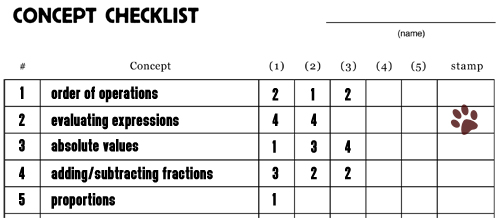
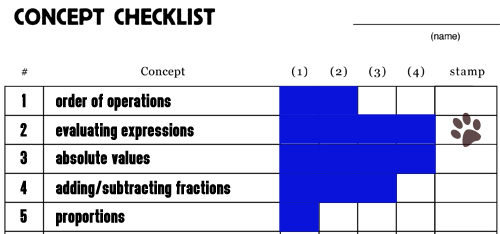
The concept checklist, in theory, is where students track their progress towards mastery. They write down concept names in rows as we test them and then record their scores (on a four-point scale) along that row, one after the other, each time they retake a concept quiz. I log only their highest scores in the gradebook and whenever they record two perfect scores on a concept, they never have to take that concept again.

The concept checklist is a mess. I run through the same script every year, illustrating the same process with better and more precise visuals every year to no avail. The process confuses students. The process puts students farther from meaningful self-assessment not closer. I saw another checklist crumpled in the trash last week and figured it out.

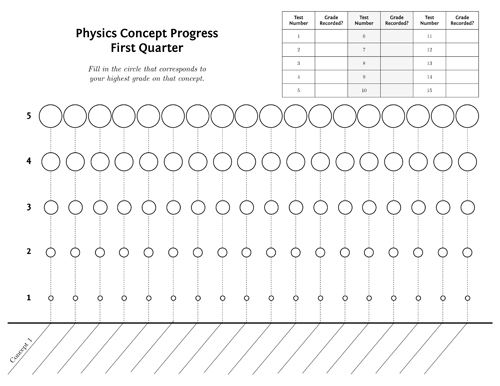
Their highest score matters much more to me than the specific ordering of low scores preceding it. So forget the earlier low scores. Students add length to the bar as they improve on earlier scores. This checklist design is consistent with our class ethic that “what you know now matters to us more than what you used to know,” whereas the other design maintains a permanent record of “what you used to know.”

So here’s an updated attachment.

BTW: Reader Jacob Morrill does me one (or two or three) better with his adaptation, which is superbly designed:

This Blog Is Counterproductive

Some comments on my last post:

#1

I read stuff like this, and the first thought that goes through my mind is, “Man, I suck at teaching math.”

#2

I’m with Steve. I realize how far I am from where I should be.

#3

I’m with Steve and Craig- I can’t teach this way yet because my brain isn’t aware/smart/intuitive/mathematical enough to first notice these things, then develop a lesson, and actually deliver and make sense of it.

#4

I’ll echo Steve’s comment, I read this site and I feel like a fraud. I don’t know anything about teaching math.

I don’t teach to disempower students and I don’t blog to disempower teachers.

My largest point with these WCYDWT features, way above any other, has been that compelling, interesting math is everywhere. That you can capture it, mount it, and bring it into your class in such a way that students will also find math interesting and compelling and, in the process, become a little less intimidated by their own imaginations.

But I really suck at teaching that to teachers. Both off comments like those quoted above and off a recent, gruesome experience teaching online, it’s clear that I’m missing some key piece(s) of scaffolding.

Course Prerequisites

I’m trying to determine the prerequisites for this kind of coursework and – correct me here – I’m pretty sure there are only two:

  1. You like math. You weren’t forced into this job.
  2. You use math. You’re high on your own product. This isn’t a game to you. Math has made your personal life richer, easier, or more meaningful in the last week.

From there it’s a simpler matter of teaching:

  1. process – how to flip an interesting thing around into a challenging thing, detailed somewhat in my last post.
  2. technique – how to (i) capture photos / video, (ii) copy and paste images from the web, (iii) rip DVDs, (iv) download TV shows, (v) layer measurements on top of photos/videos, and (vi) post all of the above online.

Once the process becomes intuitive and once any three of those skills become easy, I think you fall quickly into this virtuous cycle of seeing interesting things > teaching interesting things > seeing more interesting things. The coefficient of friction falls to zero. It’s like skating on ice.

Case In Point

Kate Nowak, on the bite-sized opener clip I ripped from Parks and Recreation and posted two weeks ago:

This is cute, and totally slipped by me even though I watch this show.

I see little daylight between me and Kate as educators, which makes her comment all the more illustrative of the skills I’m talking about, skills which I use often enough that my antenna is on auto-scan for these passing mathematical moments. If I had to guess, Kate has never (iv) used BitTorrent to download a digital copy of a TV show and excerpt a clip in QuickTime, which means there is a certain degree of interference between her antenna and those moments.

Does That Make Sense?

If I allow myself any charity here it’s to acknowledge that this process is as much lifestyle as it is technique, and blogging – or any kind of asynchronous forum where dialogue plays out slowly – may be the wrong forum for teaching it. The right forum has proven pretty well elusive, though.