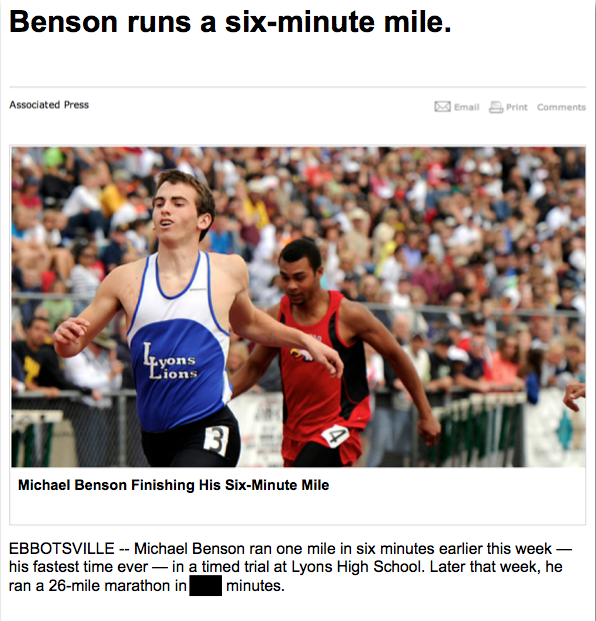
I added an #anyqs component to the workshop I facilitated in Grand Forks, ND, last week. This was new for me. At the end of the first day, I assigned homework:
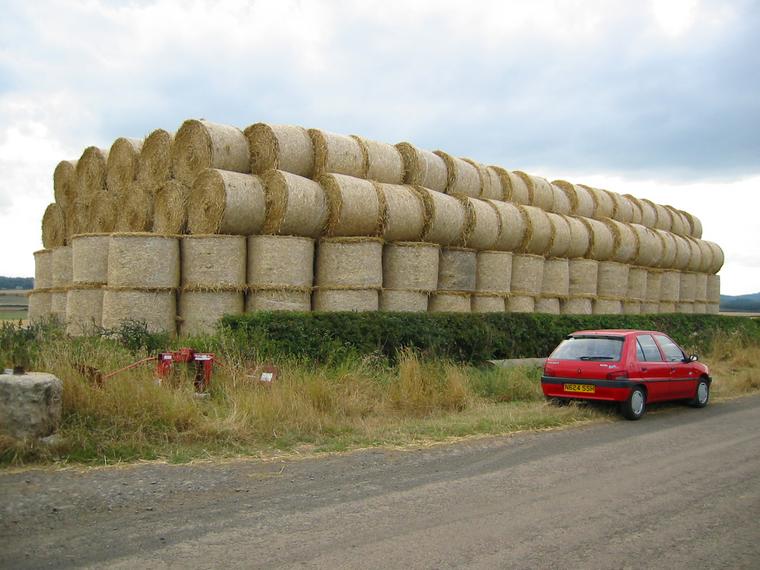
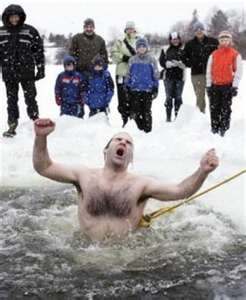
Give yourself one photo or one minute of video to tell a mathematical story so perplexing that all of your students will want to know the ending, without you saying a word or lifting a finger.
I received e-mails all the way through the night and into the morning before the second day’s session. I loaded each entry into a slidedeck and reeled them off to the group over 25 minutes.
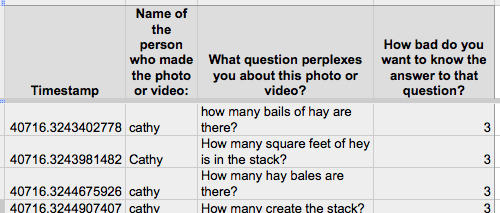
At the same time, I had the participants working in a Google Form. For each entry, they’d write up a) the name of its designer, b) the question it provoked, c) the perplexity of that question (ie. how bad they wanted to know the answer).
The yield on that investment of 25 minutes was incredible. We spent the next hour mining and interpreting data and drawing conclusions about effective curriculum design with digital media. It was some of the productive professional development I’ve ever been a part of.
I posed several rounds of questions for table discussion. The first round began after they had just submitted all of their questions:
- Was the exercise fun? Was the exercise useful?
- What will be the most common question for your entry?
- How curious will people be about it?
- Which ones were you most curious about?
Then I sent out a link to the Google Form results and posed the second round:
- How effective was your entry at provoking a common question?
- How could you have made your entry more perplexing?
- Whose entry was the “best”?
- What do we mean by “best,” anyway?
While they batted those questions around, I dug into the spreadsheet and found the median response for each entry’s perplexity rating. Six of them tied for the highest median rating:
We reviewed those six, briefly, and then I posed a third round of questions:
- What’s special about these entries?
- If you had a favorite that didn’t make the cut, what isn’t captured by this measurement (the median perplexity rating)?
-
Dan and Nancy both feature leaky faucets filling up a container. In what ways are those two entries different?
Selected Answers To Those Questions
- The unanimous consensus was that the exercise was fun. Fun isn’t necessarily a prerequisite for an effective PD exercise, but man does it ever help.
- One participant said the #anyqs exercise was useful, mainly, for “training my eyes.” She elaborated that after just one pass at #anyqs the day before, she was already more alert to the applications of math in her life outside the math classroom.
- The issue of subjectivity has been one of the most fascinating conversations about #anyqs online, and so it was in Grand Forks also. Are the questions of math teachers about this image a useful proxy for the questions of students? Will a student from North Dakota have a different question about a video of a wheat thresher than a student from California? One participant noted that the high school and middle school teachers in the workshop asked questions that were linked closely to their content areas? (Strong data mining, right?) The sum of my thinking to date? Yes, the process is subjective. In spite of its subjectivity, field testing my curriculum with teachers has improved it immensely for students. Perplexity can transcend our demographic differences.
- I forgot to mention this in Grand Forks but the easiest, best way to make your video-based problems more perplexing is to use a tripod. Or to simply put your camera down on something sturdy. The reason being is that it’s so much harder to gauge so many different measurements (speed, for instance, or height) when the camera is wobbling back and forth and up and down, throwing your subject around in the frame.
General Remarks
- I have designed a lot of different constructs to explain to myself (and others) perplexing curriculum design. None has been as effective as mathematical storytelling. I’m particularly chagrined to think back on all the times I’ve broken a problem down into the four tasks of “verbalization, visualization, abstraction, and decomposition.” That construct resonates with my grad school peers, but it’s terrible vocabulary for teacher professional development. (ie. “Okay, so where do you find the decomposition of this task. How would you help the student abstract the problem space?” etc. Gross.) I’ve never heard table groups reference “decomposition” in one of my design activities. The language of storytelling, in contrast, was a constant feature of their conversations.
- One participant: “We need a website for sharing these.” Yes.
- Another participant: “Kids should bring in their own photos and videos.” Maybe.
- This is the dy/dan drinking game: every time I put my readers to work to make me smarter or more effective in my studies or at my job, drink. I was legally unsafe to drive after receiving hundreds of pages of student work for my Michael Benson experiment. I was black-out drunk after using the work of @salmathguy, @reimerpaul, @eduz8, @techsavvyed, @fnoschese, and @wpeacock202, for fodder in my #anyqs workshop. Y’all should be so lucky to have readers like y’all.
- There was a horrible moment in the early morning of the last day when I planned to hand each participant 28 strips of paper (one for each person’s #anyqs entry) on which she’d write her question and the name of the designer. Once we finished, I figured we’d trade the slips back to each other, a process that would probably take forty-five minutes on its own, right? So take a shot for Google Forms as long as you have the bottle out.
Your Homework
- How are the two leaky faucet videos [Dan, Nancy] different? Which one is better? Define “better.”
- One participant submitted this video of Carl Lewis’ 1984 Olympics long jump. He was perplexed by the parabolic motion of Lewis’ jump. Instead, nearly all of his colleagues (and yours truly) wondered how fast Lewis was running at lift-off. Given infinite resources, tools, the ability to travel anywhere in time and space, how would you capture Lewis’ long jump in a way that highlights the perplexity of his parabolic motion?
And Now A Word From Our Sponsor
If any of this seems interesting to you, let me recommend my Perplexity Session, which I’ll be hosting in Mountain View on 9/10/11.
Here’s John Scammell with a celebrity endorsement:
As someone who was fortunate enough to see one of the early incarnations of this workshop, I can tell you that it is incredibly valuable professional learning. Dan is a skilled facilitator, and more importantly a great teacher. I highly recommend it.