Draw a shape on squared paper and plot a point to show its perimeter and area. Which points on the grid represent squares, rectangles, etc. Draw a shape that may be represented by the point (4, 12) or (12, 4). Find all the “impossible” points.
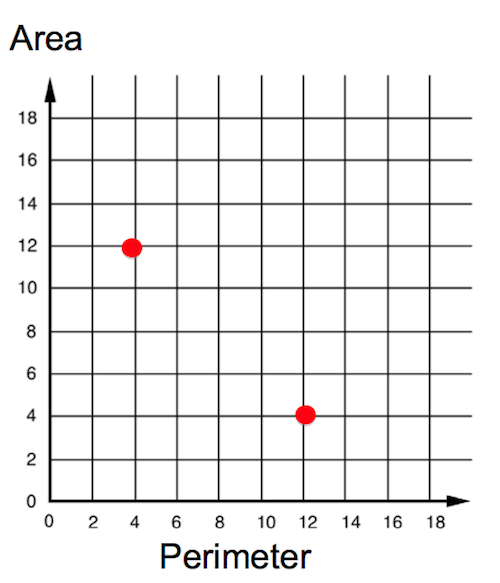
I like this problem a lot (I’ll spoil some of the fun in the comments) even though it’s fundamentally dissimilar to most of the problems I write about here.
One of the best parts about my working life right now, including grad school and my work with publishers, is my daily exposure to the vast set of answers to the question, “What makes for good math education?” That exposure has helped me find the edges of the usefulness of my own answer to that question, one which I’ve been developing for years, and for that I’m grateful. There’s nothing more pathetic than walking around convinced you’ve found the answer, forcing yourself to perceive other answers as either inferior to or derivative of your own, missing out on the bigness of the work of math education, on its richness and difficulty. Realizing the smallness of my own work relative to the whole has made me a much happier worker. That’s the odd thing.
So I’m grateful to instructors like Labaree and Stevens who urged us all to quit trying to solve the problem and focus first on describing the domain of the problem and its range of solutions. With that focus, I started to see fundamental similarities between this problem above and other problems I like.
- They all reveal their constraints quickly and clearly. They’re brief. This one gives you a compelling task in a handful of words. You don’t have to meander through four or five steps to understand its point. See also: “How many pennies is that?”; “Will it hit the hoop?”; “How long will it take him to go up the down escalator?” Also notice how none of the questions Bowen Kerins poses in this comment would exceed the 140-character limit on a tweet.
- They all use images to express their tasks concisely and to perplex the learner. That image alone would be enough to provoke some productive mathematical questions, even if none of them would necessarily be as productive initially as “Where are all the impossible points?” Perplexing images have that power. Also, imagine expressing that task using words alone. How much longer would that postpone the student’s encounter with the point of the task?
- They all feature low threat levels and low barriers to entry. The task above allows the student to come up with a hypothesis and test it with new data instantly, from scratch, using nothing more than her mind, a piece of paper, and a pencil. The task allows a teacher to encounter a struggling student and say to her, “Would you just draw a rectangle for me? Any rectangle.” and start there. Once the student has graphed that rectangle on the plane the teacher can say, “Would you do that with five more rectangles and let me know what you notice, if anything?” The student can basically generate her own second act, which is better than most of the problems I design, which often require the advance knowledge of a certain mathematical model, without which you’re basically screwed.
- They all ask you to understand the math forwards and backwards, inside and out. First it asks, “Given a shape, where’s the point?” Later it asks, “Given this point, what’s the shape?” This reversal of the question and the answer encourages students to understand their own thinking comprehensively.
Let me close with a tweet from David Cox, a math teacher who also gives a damn about design.
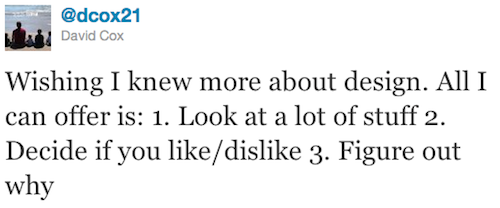
Know what tasks you like. Know why you like them. Know the similarities between tasks you like. And, special notes to myself:
- Know the research that describes those tasks.
- Keep a loose grip on your own sack of solutions.
BTW: Here’s an e-mail Alan Schoenfeld sent our problem-solving class describing the aesthetic of problems he likes.