The medium is the message. The medium defines, changes, and distorts the message. The words “I love you” mean one hundred different things spoken by one hundred different people. Those words convey different meanings spoken on the phone, written on a fogged-over bathroom mirror, and whispered bedside in a hospital.
YouTube videos, digital photos, MP3s, PDFs, blog posts, spoken words, and printed text are all different media and they are all suited for different messages. When you attempt to distribute mathematics through any of these media, it changes the definition of mathematics.
Silicon Valley’s entrepreneurs, venture capitalists, and big thinkers assume a shared definition of “mathematics.” They innovate around the delivery of that mathematics. CK-12 has PDFs. Khan Academy has YouTube videos. Apple has iPad apps. ALEKS and Junyo have computer adaptive tests. Very few of them understand that each of those delivery media changes the definition of mathematics.
Even worse, at this moment in history, computers are not a natural working medium for mathematics.
For instance: think of a fraction in your head.
Say it out loud. That’s simple.
Write it on paper. Still simple.
Now communicate that fraction so a computer can understand and grade it. Click open the tools palette. Click the fraction button. Click in the numerator. Press the “4” key. Click in the denominator. Press the “9” key.
That’s bad, but if you aren’t convinced the difference is important, try to communicate the square root of that fraction. If it were this hard to post a tweet or update your status, Twitter and Facebook would be empty office space on Folsom Street and Page Mill Road.
It gets worse when you ask students to do anything meaningful with fractions. Like: “Explain whether 4/3 or 3/4 is closer to 1, and how you know.”
It’s simple enough to write down an explanation. It’s also simple to speak that explanation out loud so that somebody can assess its meaning. In 2012, it is impossible for a computer to assess that argument at anywhere near the same level of meaning. Those meaningful problems are then defined out of “mathematics.”
Do you want to know where this post became useless to Silicon Valley’s entrepreneurs, venture capitalists, and big thinkers? Right where I said, “Computers are not a natural working medium for mathematics.” They understand computers and they understand how to turn computers into money so they are understandably interested in problems whose solutions require computers. Sometimes a problem comes along that doesn’t naturally require computers. Like mathematics. They may then define, change, and distort the definition of the problem until it does require computers.
Some companies pretend those different definitions don’t exist. They pretend that we all mean the same thing when we talk about “mathematics.” Khan Academy acknowledges the difference, though, and attempts to split it by saying, in effect, “We’ll handle the math that plays to our medium’s strength. Teachers can handle the other math.” So Khan lectures about things that are easy to lecture about with computers and his platform assesses procedures that are easy to assess with computers. Teachers are told to handle the things for which teachers are a good medium: conversation, dialogue, reasoning, and open questions.
That delegation only works to the extent that teachers and computers convey complementary definitions of mathematics. But the message from Silicon Valley and the message from our best math classrooms contradict one another more often than they agree. On the one hand, Silicon Valley tells students, “Math is a series of simple, machine-readable tasks you watch someone else explain and then perform yourself.” Our best classrooms tell students, “Math is something that requires the best of your senses and reasoning, something that requires you to make meaning of tasks that aren’t always clearly defined, something that can make sense whether or not anyone is there to explain it to you.”
I won’t waste any effort complaining that my preferred definition of mathematics has been marginalized. That effort can be better spent. Anyway, in every way that affects Silicon Valley’s bottom line, the Common Core State Standards have settled that debate. Mathematics, as defined by the CCSS, isn’t just a series of discrete content standards. It contains practice standards, too: modeling, critiquing arguments, using tools strategically, reasoning abstractly, and others. The work of mathematicians. Any medium that tries to delegate one set of standards to computers and the other to teachers should prepare for a migraine.
Designers of curricula, assessments, and professional development should all attend to the need to connect the mathematical practices to mathematical content in mathematics instruction.
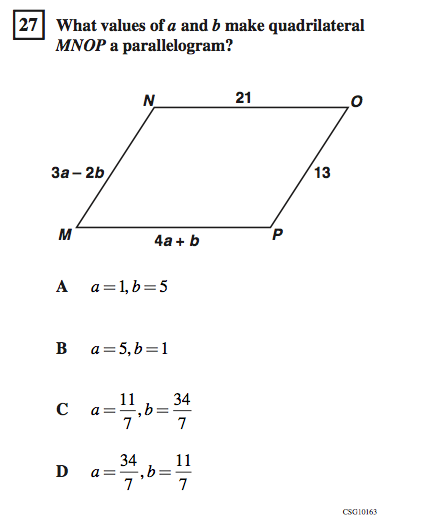
Has your ed-tech startup been struggling to demonstrate statistically significant gains on the California Standards Test, which features tasks like this:
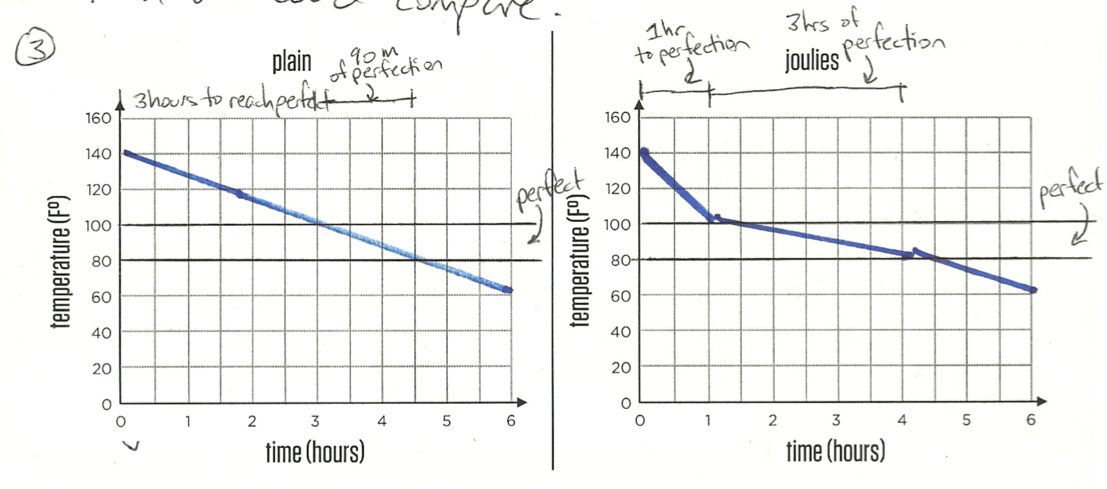
That’s your home-turf. Simple, machine-readable assessments. It will never get any easier for you than that. How much worse will your results look when we assess the same standard in 2014 with tasks that connect mathematical content to mathematical practices:
The medium is the mathematics. How does your medium define mathematics and is that definition anything that will be worth talking about in two years?
Full Disclosure: I’m a doctoral student at Stanford University in math education. I was a high school math teacher. I consult with ed-tech startups as time allows. I also develop digital math curricula that I sell to publishers and give away online.
Comment Policy: My usual policy is to close comments on posts that mention Khan Academy because they get silly almost instantly. But Khan Academy is only a symptom of a sickness that’s gripped this valley for as long as I’ve lived here. That sickness interests me and your thoughts on that sickness interest me. I’m leaving comments open but I’ll trashcan anything that doesn’t enhance our understanding of that sickness. That includes “Attaboys,” etc.
2011 Feb 7. Neeru Khosla, founder of CK-12, responds in the comments.
2011 Feb 7. Josh Giesbrecht posts a useful reply at his own blog, focusing on technology as an assessment, not technology as a medium.
2011 Feb 7. Web Equation from VisionObjects does a fantastic job translating scribbles on the screen to LaTeX.
2011 Feb 7. Silicon Valley’s (unofficial) rebuttal to my post is at Hacker News. Let me excerpt a few responses.
jfarmer poses a very productive alternative to my thesis, “What is technology good for?” rather than “How does technology change mathematics?”:
In design, a skeuomorph is a derivative object that retains some feature of the original object which is no longer necessary. For example, iCal in OS X Lion looks like a physical calendar, even though there’s no reason for a digital calendar to look (or behave) like a physical calendar. The same goes for the address book.
This is what I see happening in online education. I don’t think it’s a case of “lol, Silicon Valley only trusts computers,” but rather starting off by doing the most literal thing.
Textbooks? Let’s publish some PDFs online. Lectures? Let’s publish videos online. Homework and tests? Let’s make a website that works like a multiple-choice or fill-in-the-blank test.
These are skeumorphs. There’s no reason for the online equivalent of a textbook to be a PDF, it’s just the most obvious thing.
For me it’s 1000x more interesting to ask “On the web, what’s the best way to do what a lecture does offline?” than to say “Khan Academy videos are the wrong way of doing it.”
Arun2009 offers a common view, that mathematics is many different things to many different people:
The trouble with trying to arrive at any single definition of Mathematics is that Mathematics is different things to different people. A research level Mathematician might see it differently (finding patterns, abstraction, theory – axioms and proofs) from an Engineer who has a purely practical interest in it (cookie cutter methods and formulas). For everyday use Mathematics is a set of algorithms for doing stuff with percentages, fractions, basic arithmetic etc.
He’s absolutely right, but if we’re pragmatic in the least, we’ll ask “which of those definitions does the most good for students?” and we’ll look at the Common Core State Standards, which is the de facto definition of mathematics for those students. (My appeal to the CCSS was an attempt to reduce exactly this subjectivity.)
Various hackers took me to task for claiming it’s difficult to represent mathematical notation using computers. ie. the square root of 9/4.
nickolai:
Square root ? “(3/4)^(1/2)” or maybe “sqrt(3/4)”. There’s no complexity in parsing that. I do agree it is not as natural as on paper but maybe tablets will find a way to improve that. Thats what innovation is here for after all.
japhyr rebuts convincingly, in my opinion:
He is writing about math education. The characters (3/4)^(1/2) make sense to all of us who have already learned math and know some programming languages, but that syntax is pretty confusing to students who are just developing a real understanding of exponents.
angersock:
One could make the argument that any mathematical syntax is equally confusing for the novice–so why not start them on something they’ll be using later anyways?
That’s an interesting idea but unless we’re also positing a universe with utterly ubiquitous computing, we’d be better off preparing students to communicate in media that are readily available. What if a computer isn’t available for our students to code some LaTeX to express themselves?
davidwees illustrates my overall point well. Does this seem natural to anybody?
\png \definecolor{blueblack}{RGB}{0,0,135} \color{blueblack} \begin{picture}(4,1.75) \thicklines \put(2,0.01){\arc{3}{3.53588}{5.8888}} \put(.375,.575){\line(1,0){3.25}} \put(1.22,1.375){\makebox(0,0){\footnotesize$ds$}} \put(.6,.5){\makebox(0,0){\footnotesize$x=0$}} \put(3.36,.5){\makebox(0,0){\footnotesize$x=\ell$}} \dottedline{.05}(1.0,.575)(1.0,1.10) \put(1.0,.5){\makebox(0,0){\footnotesize$x$}} \dottedline{.05}(1.5,.575)(1.5,1.40) \put(1.5,.5){\makebox(0,0){\footnotesize$x+dx$}} \put(1.22,.65){\makebox(0,0){\footnotesize$dx$}} \dottedline{.04}(0.6,1.12)(1.25,1.12) \put(1.0,1.14){\vector(-1,-1){.45}} \put(.58,0.83){\makebox(0,0){\footnotesize$T$}} \put(.77,1.05){\makebox(0,0){\scriptsize$\theta(x)$}} \put(1.18,1.16){\makebox(0,0){\scriptsize$\theta(x)$}} \dottedline{.04}(1.5,1.41)(2.1,1.41) \put(1.5,1.44){\vector(4,1){.67}} \put(2.22,1.59){\makebox(0,0){\footnotesize$T$}} \put(1.95,1.45){\makebox(0,0){\scriptsize$\theta(x+dx)$}} \end{picture}
Symmetry, takes the conversation to Khan Academy:
As to why many people might want to defend Khan Academy, well, its because I think I would have been much happier with Khan Academy than the math education I actually had, and I would very much like it to be available to children like myself. I was bored stiff in math class in middle and high school, and being able to work at my own base, not bound by the slowest person in the class, would have been amazing.
This same sentiment crops up in the comments thread here and I think it’s utterly on point. Teachers are a great medium for lots of things that a YouTube video isn’t. “Conversation, dialogue, reasoning, and open questions,” as I put it in my post. If you, as a teacher, aren’t taking advantage of your medium, if you’re functionally equivalent to a YouTube video, you should be replaced by a YouTube video.
Sudarshan summarizes that elegantly:
Incompetent/bored math teacher < khan academy < better online learning platform < Good math teacher.
FWIW, I stopped by that thread and summarized my argument in three lines:
- There are different ways of defining mathematics, and some of them contradict each other.
- Silicon Valley companies wrongly assume their platforms are agnostic on those definitions.
- For better or worse, if you’re trying to make money in math education, the Common Core State Standards are the definition that trumps your or my preference for recursion, computational algebra, etc, and those standards include a lot of practices for which, at this point in history, computers aren’t just unhelpful, but also counterproductive.
2011 Feb 10. Zack Miller e-mailed. Zack graduated from Stanford’s teacher training program. He now teaches at the charter school where I’ve been consulting with my adviser and two other graduate students. He’s a proponent of blended learning, individualized instruction, and Khan Academy, in particular. He gave me permission to excerpt his e-mail. I’m going to post the entire thing, bold one line, and make a comment on that line at the end.
Students’ mathematical learning and sense-making has a much higher ceiling if the material they encounter follows a coherent mathematical narrative that is relevant to and keeps pace with their current individual mathematical understandings.
The above is not a reality in most math classrooms. Students’ math understandings are Swiss cheese, largely because time, not competency, was fixed in their math education. What’s standing in the way of the above becoming a reality? Resources and good data. 1 teacher must provide 100 unique learners with learning experiences, daily. Can our country’s median teacher (or best teacher) provide a learning experience that is in each student’s zone of proximal development every day (and also be an expert in classroom management, curriculum, parent communication, data analysis, etc.)? No. So we’ve looked for ways over the years to ameliorate the situation (tracking, heterogenous classes, differentiation, etc.).
Silicon Valley is trying to innovate because students’ mathematical learning has a much higher ceiling if curriculum always meets their ZPD, and perhaps now there are ways we can offer that. THIS IS BLENDED (not to be confused with computers replacing traditional classrooms with traditional video lectures). Yes, the medium matters — without question — but breaking from the ratio of “30 students:1 pace” matters more. Any tool that gathers relevant data and/or provides good learning experiences helps me individualize, and (like many of your commenters) I disagree that there is no computer-based tool that does this (Geogebra, for one, was great for today’s lesson that you and your team designed!).
I agree that, at present, Silicon Valley’s current tools are limited. Pedagogy is weak. But I disagree that doing this:
“We’ll handle the math that plays to our medium’s strength. Teachers can handle the other math.”
Implies also doing this:
Silicon Valley tells students, “Math is a series of simple, machine-readable tasks you watch someone else explain and then perform yourself.”
Isn’t it possible to frame computer-based tools in a way that supports your definition of math (a definition that I happen to closely align with)? Doesn’t procedural fluency (which will still be a large portion of Common Core assessments, I believe) support reasoning, problem solving, and sense-making?
And lucky for our students, people like you will help Silicon Valley with their pedagogical shortcomings and misguided definitions of math. As the quality and quantity of “learning experiences offered” improve, students can have a more individualized experience, and that high ceiling can be realized.
My point is that the tools that allow you to individualize math instruction are not neutral on the question, “What is mathematics?” My second point is that not every answer to the question, “What is mathematics?” harmonizes with every other answer. Sometimes they clang around against each other awkwardly.
2011 Feb 15: EdSurge offers a summary of this post and its responses over at Fast Company.
2011 Feb 15: Just noticed (way late) that Jacob Klein, one of the founders of Motion Math, responded here. Klein is hip deep in the culture I’m describing here and he makes games that help students practice mathematical skills I value, so give him a look.