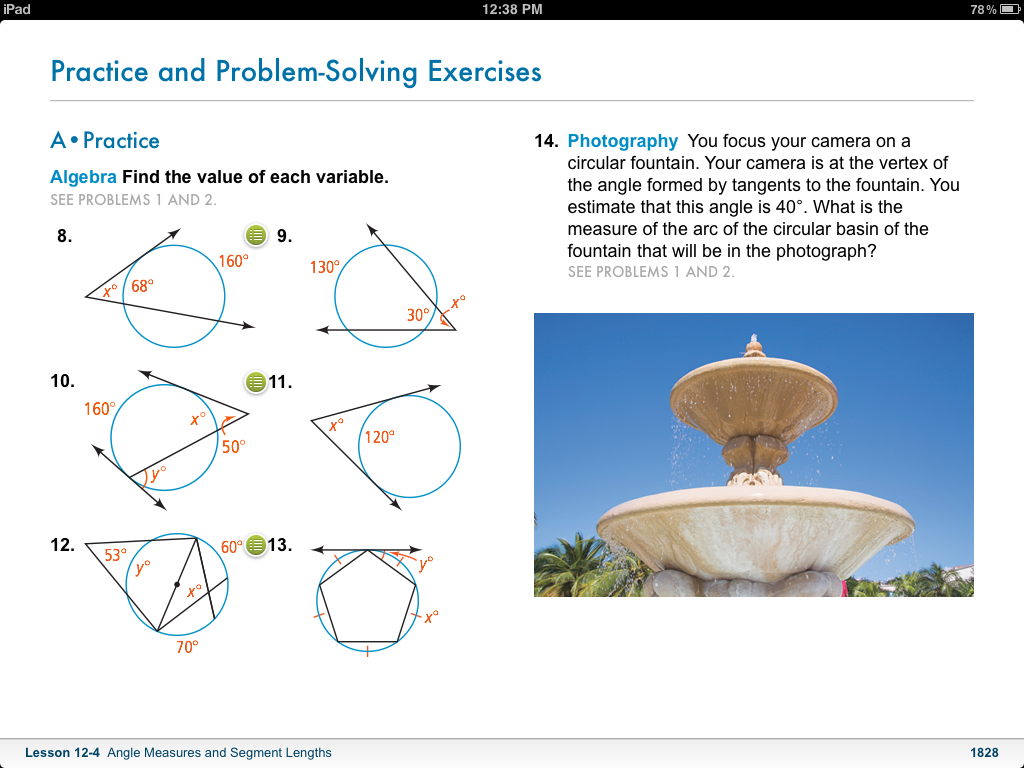
Here is a picture of a fountain from Pearson’s Common Core Geometry iBook. (Full disclosure: I consult with Pearson.)
Given ten tries, you’d never guess the question connected to that image: “What is the measure of the arc of the circular basin of the fountain that will be in the photograph?”
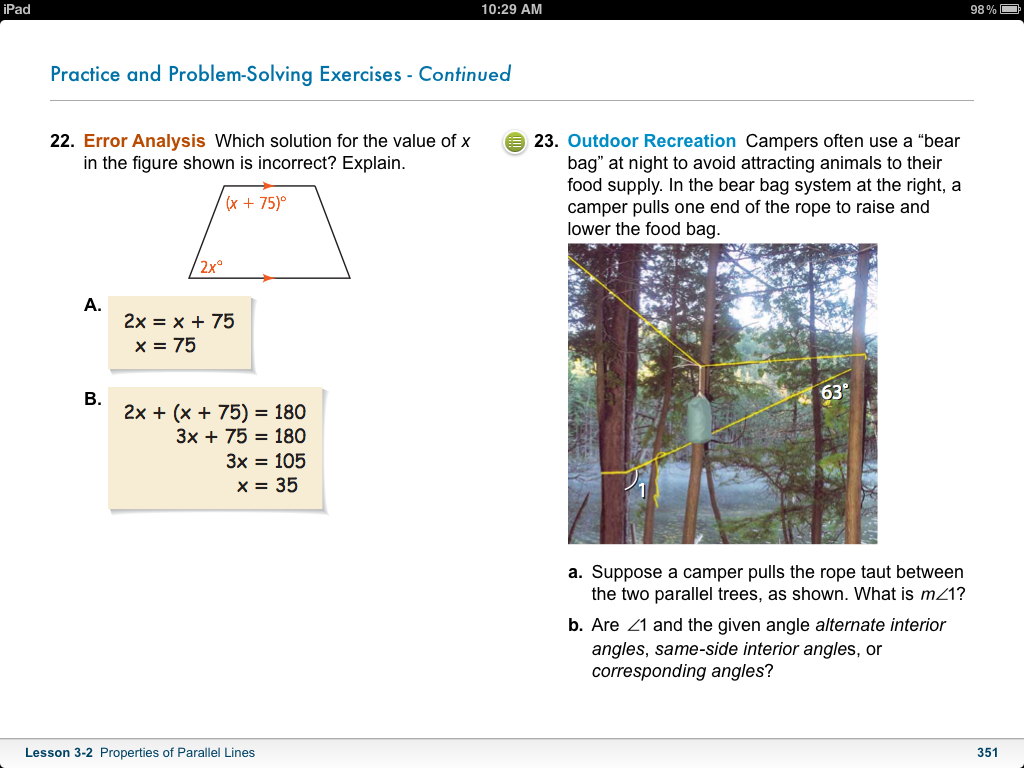
Same with this line from problem 23 on page 351:
Campers often use a “bear bag” at night to avoid attracting animals to their food supply.
It is followed by:
Are angle one and the given angle alternate interior angles, same-side interior angles or corresponding angles?
Not only will those questions fail to interest many of my students but they’re also unnatural and disconnected from the context to which they are attached. The fountain doesn’t want that question. The bear bag has no use for its question. Students notice that disconnect. Some have fully internalized that disconnect and concluded that math is some alien, otherworldly thing they’ll survive and then forget as quickly as possible.
What Do We Do?
Not this:
Over at Dan’s site people have been discussing these last set of questions and we find, naturally, Dan promoting his brand of “Make the prompt scream the question you are looking for” …
I hear it too often in emails, tweets, and conversations after conference sessions:
“I asked them what questions they had and they asked the one I was looking for!”
Just ask it.
“It took some time but I prompted them a little and they asked the question I wanted them to focus on!”
Just ask it.
“They guessed the question I wanted them to ask!”
Just ask it.
Just ask the question. My point has never been that you should never ask questions rather that you should ask questions with some certainty they will be interesting and seem natural to your students.
How can you tell in advance that a question will be interesting or seem natural to your students? Ideally, I’d have a room full of students I could run ideas past – an on-call focus group. I’d punch a button and they’d snap to attention. Then I’d introduce a context and a question and they’d give me a thumbs up or down. (Standard disclaimer: math is a context.) Maybe they’d suggest other, more interesting questions. That would be great – all of it – but I don’t have those students on call. I have you guys instead, and that’s way, way better than nothing.
But just because the football player runs through tires on the scrimmage field doesn’t mean he runs through tires on game day. See? 101questions is our scrimmage field. It isn’t the game itself.
BTW: Avery Pickford has some smart writing along these same lines.
Previously: Unnatural Currents
Featured Comment
Mylene:
Inquiry-based science teaching sometimes gets bogged down in similar games of “guess what the teacher wants you to say.” Â Almost as frustrating as known-answer questions are these, which I shall start calling “known-question answers.”