Month: October 2012

Total 18 Posts

[3ACTS] Split Time

Here I am tinkering with Google Maps again.

This is the kind of application of proportional reasoning you can find in abundance on 101questions. What’s remarkable about it is the e-mail I received that kicked it off:

My workouts during the indoor season are based on 200 meter split times (since most indoor tracks are 200 meters around), but our local track is only 160 meters around. So if I wanted to be running a 35 second 200, what would I have to run 160 in?

You have here a math teacher who applied proportional reasoning to his own life, who recognized what he was doing, and who then took steps to reconfigure that experience into a task so that his students could experience and resolve the same dilemma.

Math teachers use math. Our challenge is to preserve those experiences for our students.

Building A Better Taco Cart

And by “taco cart” I mean “digital math curriculum.”

I made Taco Cart out of videos and photos. I’m comfortable making math curricula out of videos and photos but I’d rather build them out of code.

Here’s the Taco Cart I wish I had made. Implicitly, here, I’m admitting I’m in over my head. I need a new set of skills or a new set of collaborators.

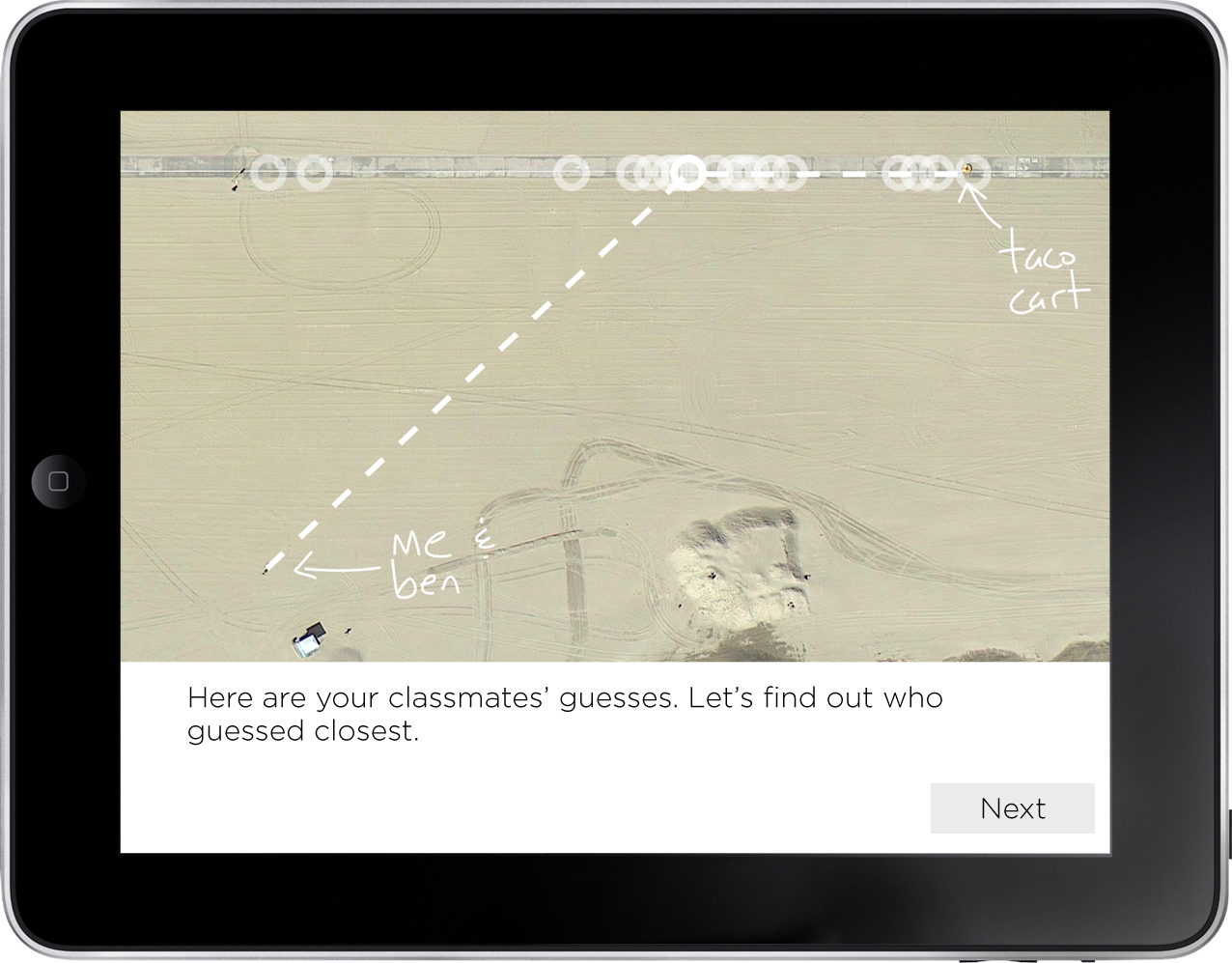
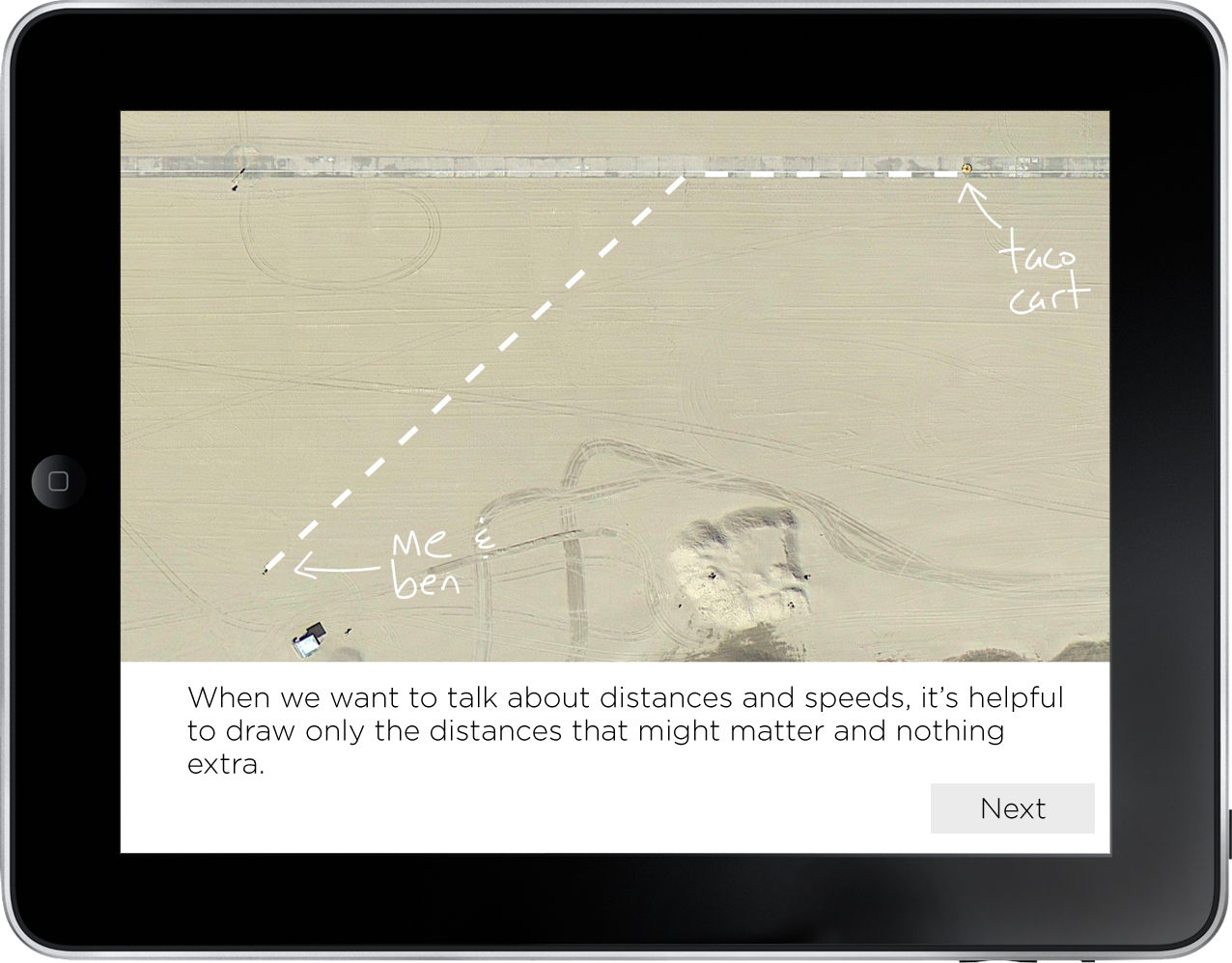
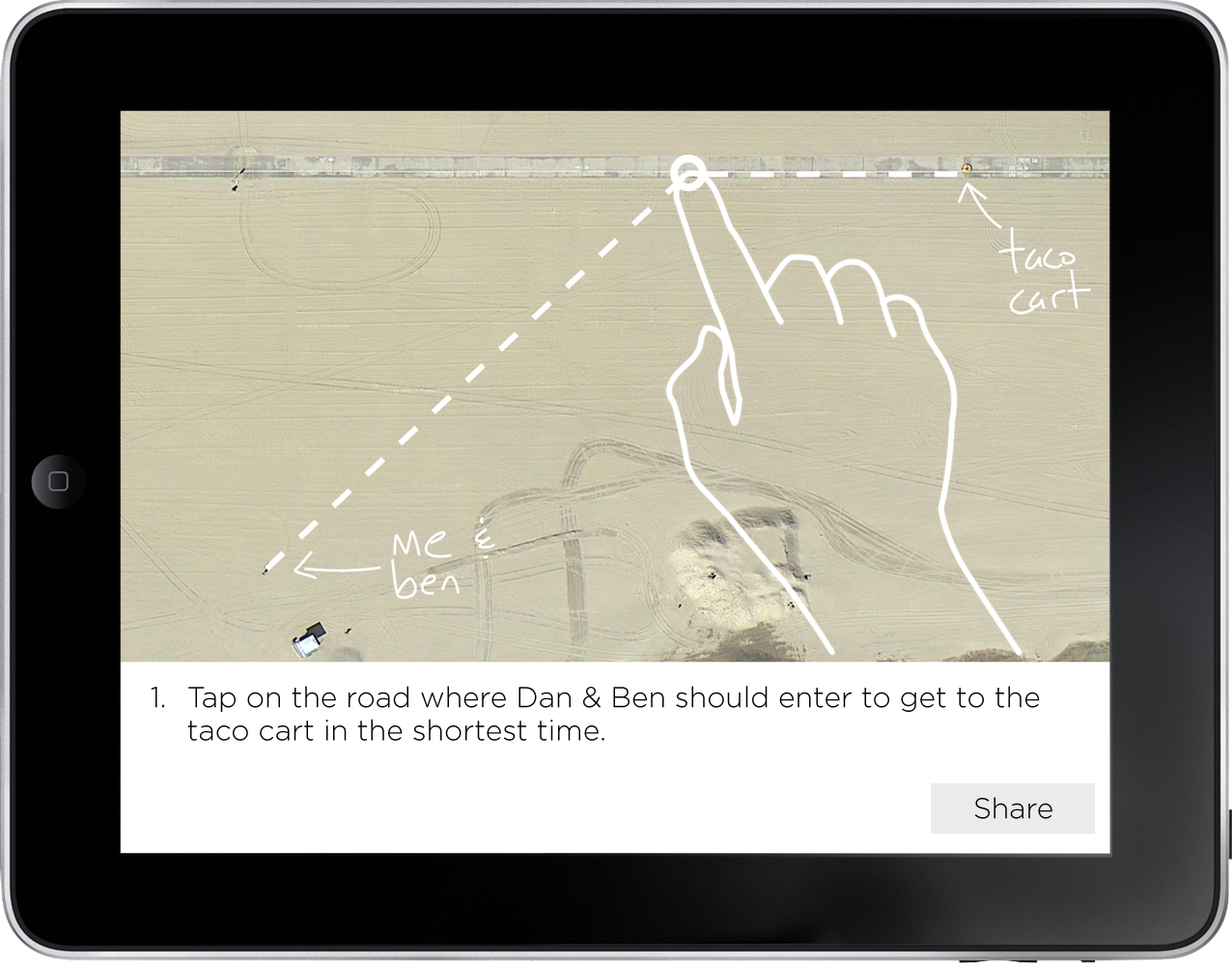
Currently, I’m asking students to guess where Ben and I should enter the roadway to get to the taco cart as fast as possible. But how do they register that guess? Do they point to it? Do they make a mark on a printout of the scene?

Let’s give them tablet computers, instead, and let them slide their fingers down the road until they’re happy with their guess.

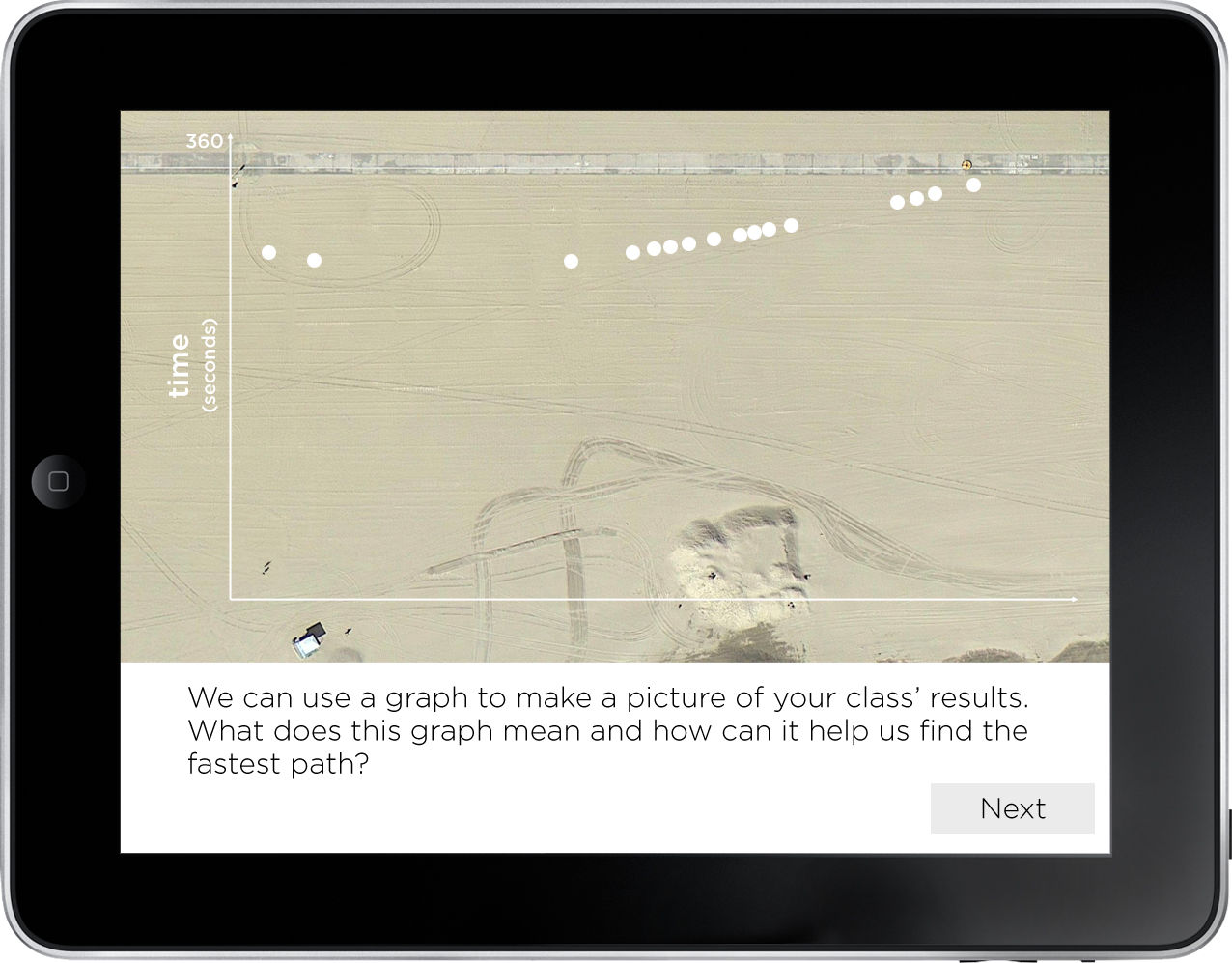
Then they see all their classmates’ guesses. Ideally those guesses are all attached to faces or names somewhere so you can see how your best friend or the girl you have a crush on guessed. This ratchets up their perplexity. Who guessed closest?

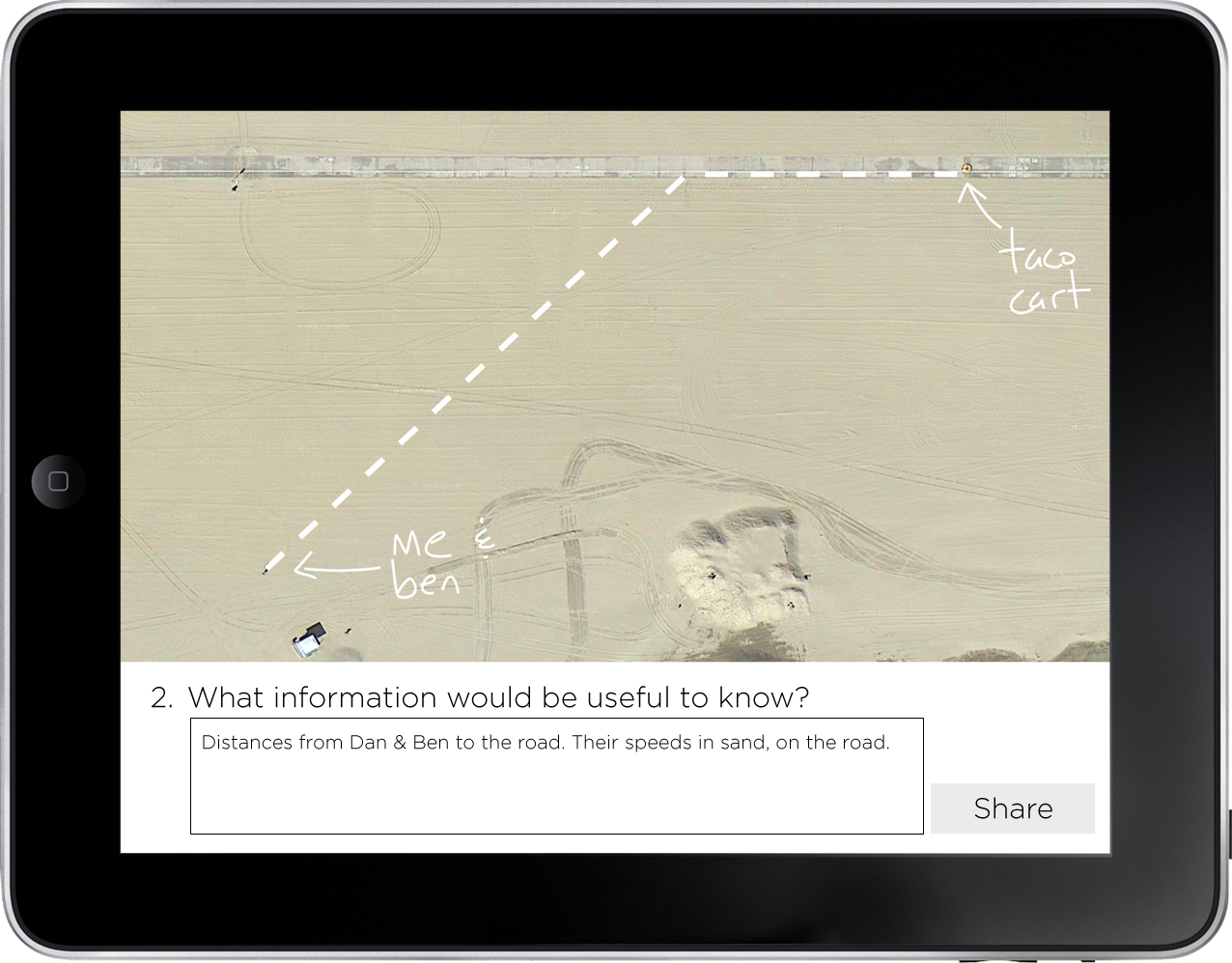
Then we ask them what information would be useful. This is abstraction. We’re giving the students a chance to extract the essential features of the context.

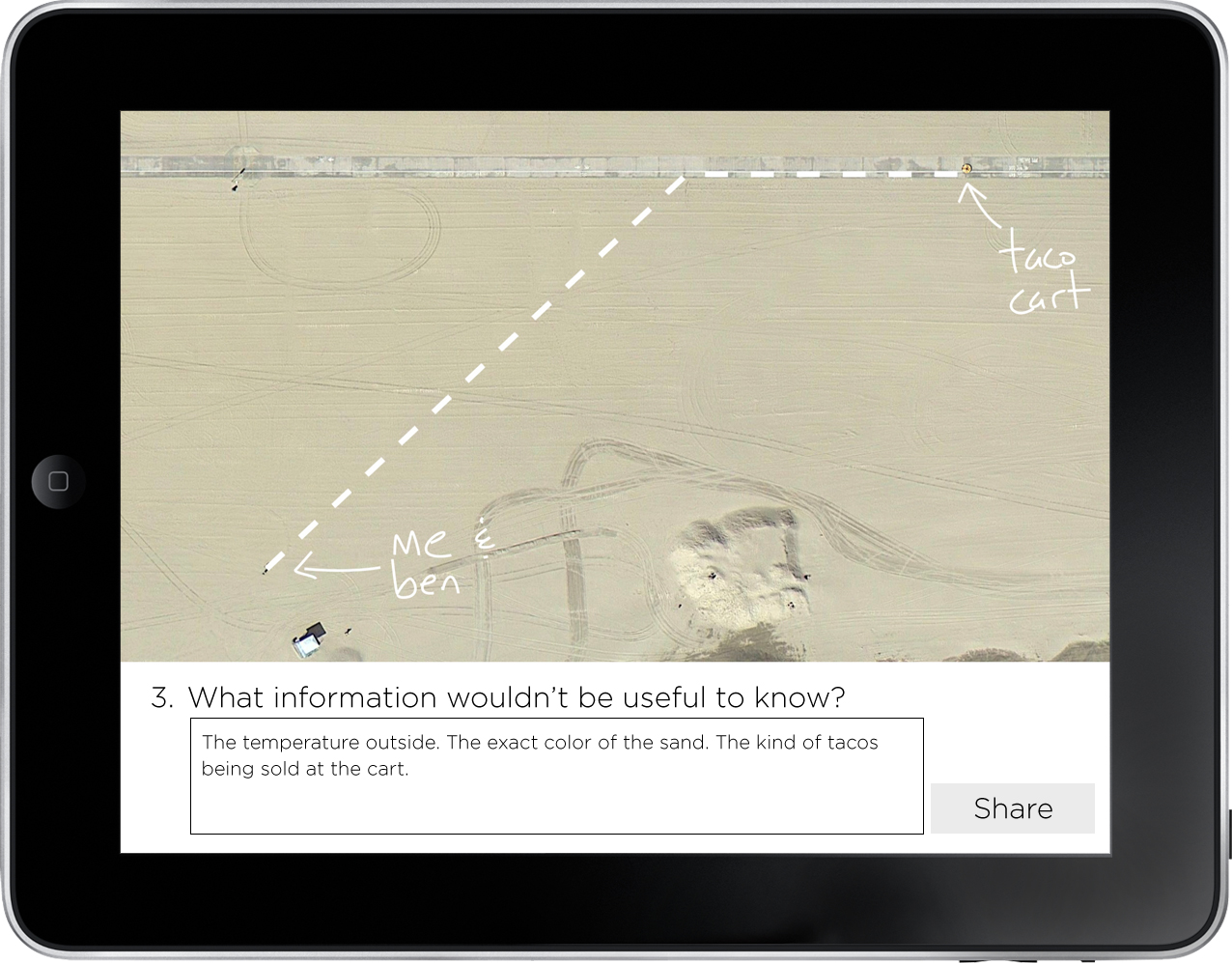
We ask them to discard the inessential features of the context.

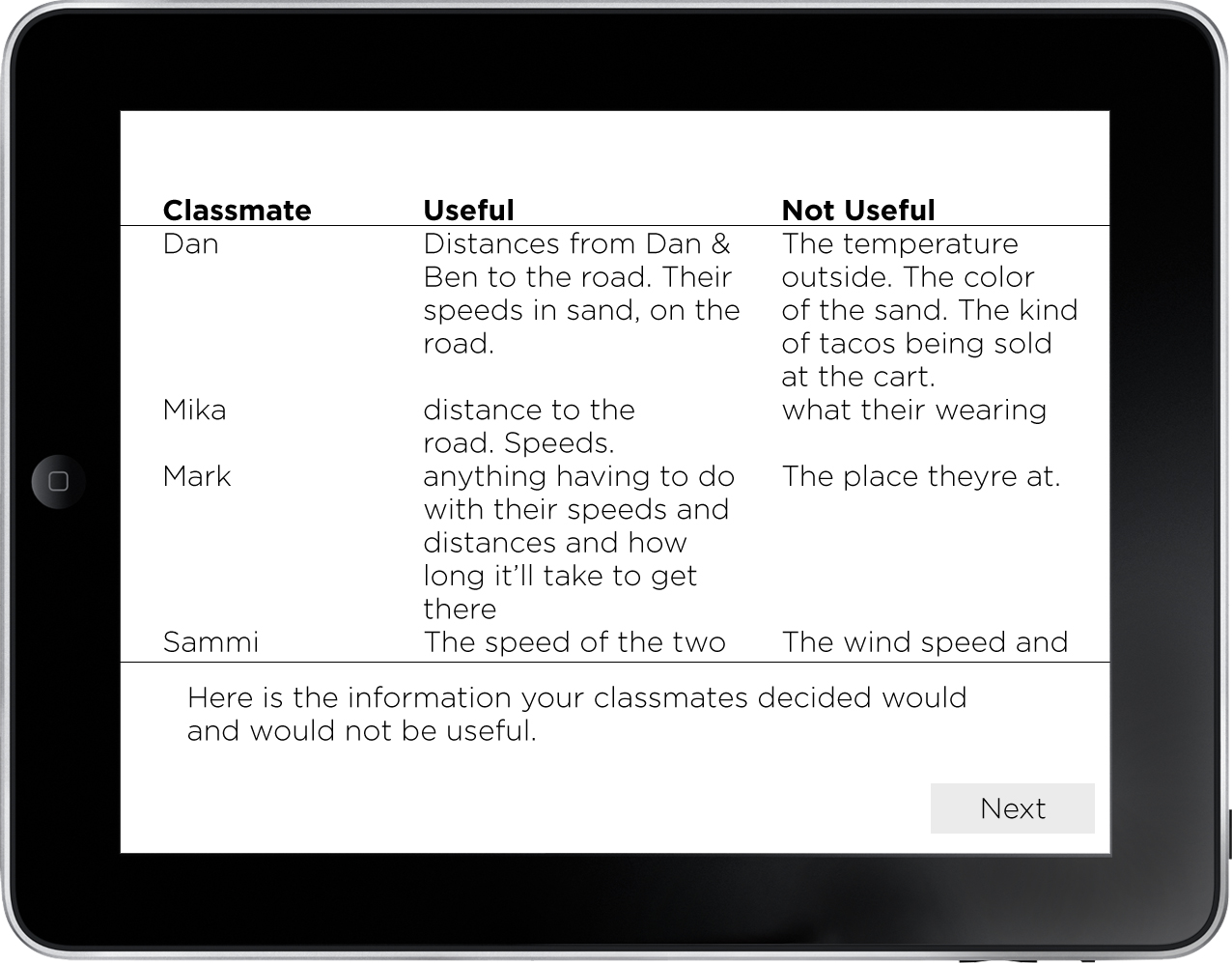
The tablet summarizes the class’ responses. The teacher can use this information to seed a brief discussion.

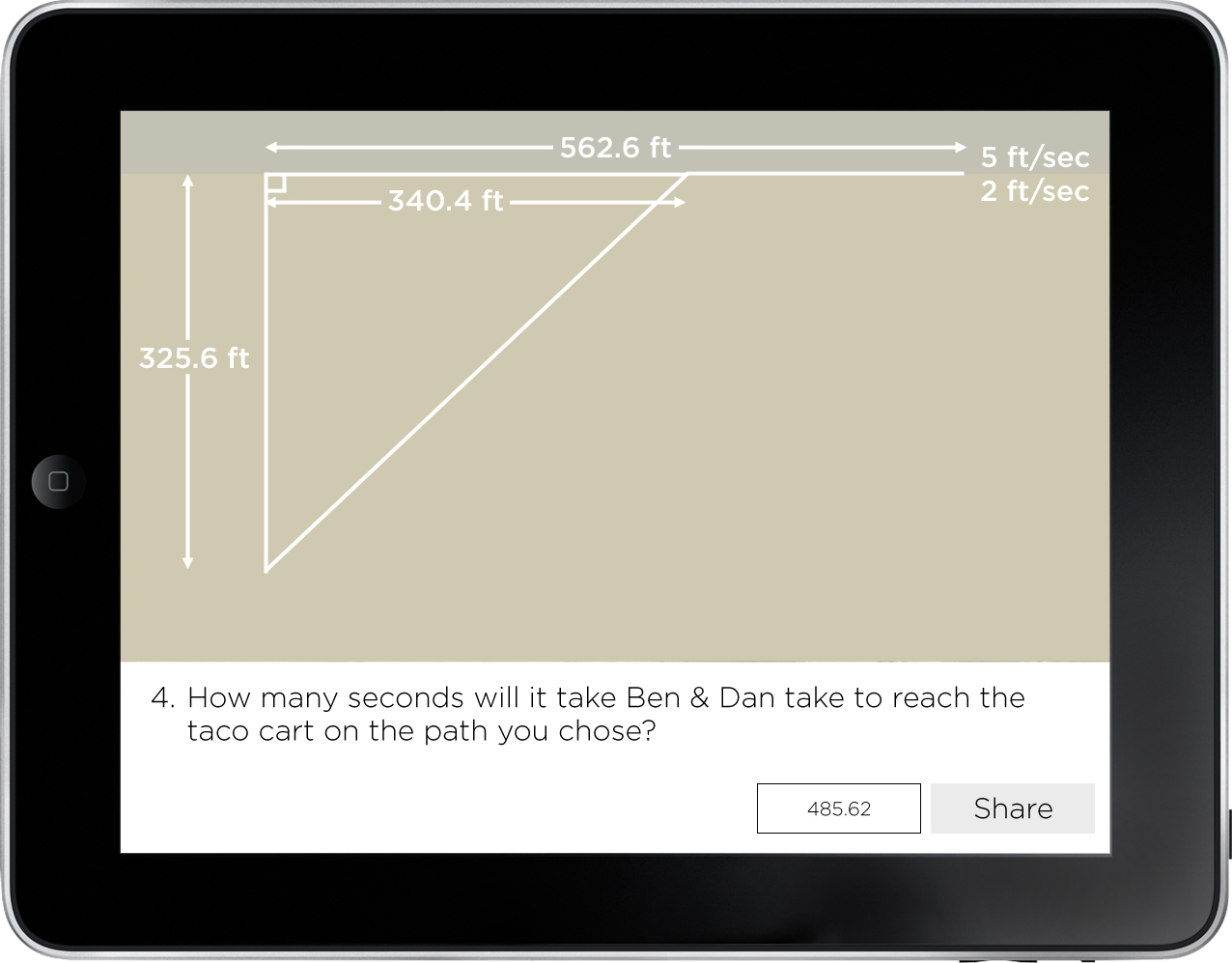
What happens next is violent. We’re going to vaporize the world. We’re going to strip away the sand. We’re going to destroy the buildings. We’re going to wipe Dan and Ben and the taco cart off the map and replace them with points and lines. If you’ve studied math at the university level, it’s possible you’ve lost touch with the violence inherent in mathematical abstraction.

So we scaffold that process briefly. We prepare the student. We say, “We’re going to get rid of a bunch of stuff you said was inessential and represent the rest as neatly as possible.”

Now this is interesting. Each student is given her own task, a task that she, herself, picked. “You guessed that this would be the fastest path,” we say. “Go ahead and figure out how long your path would take.”

This is more fun than evaluating the duration of a generic path and it’s easier than differentiating the generic path and solving for its minimum. It isn’t all that much more difficult for the teacher to check either because everyone is performing the same calculation, just on a different value.

Everybody enters their results. The tablet checks them for correctness and then displays them.

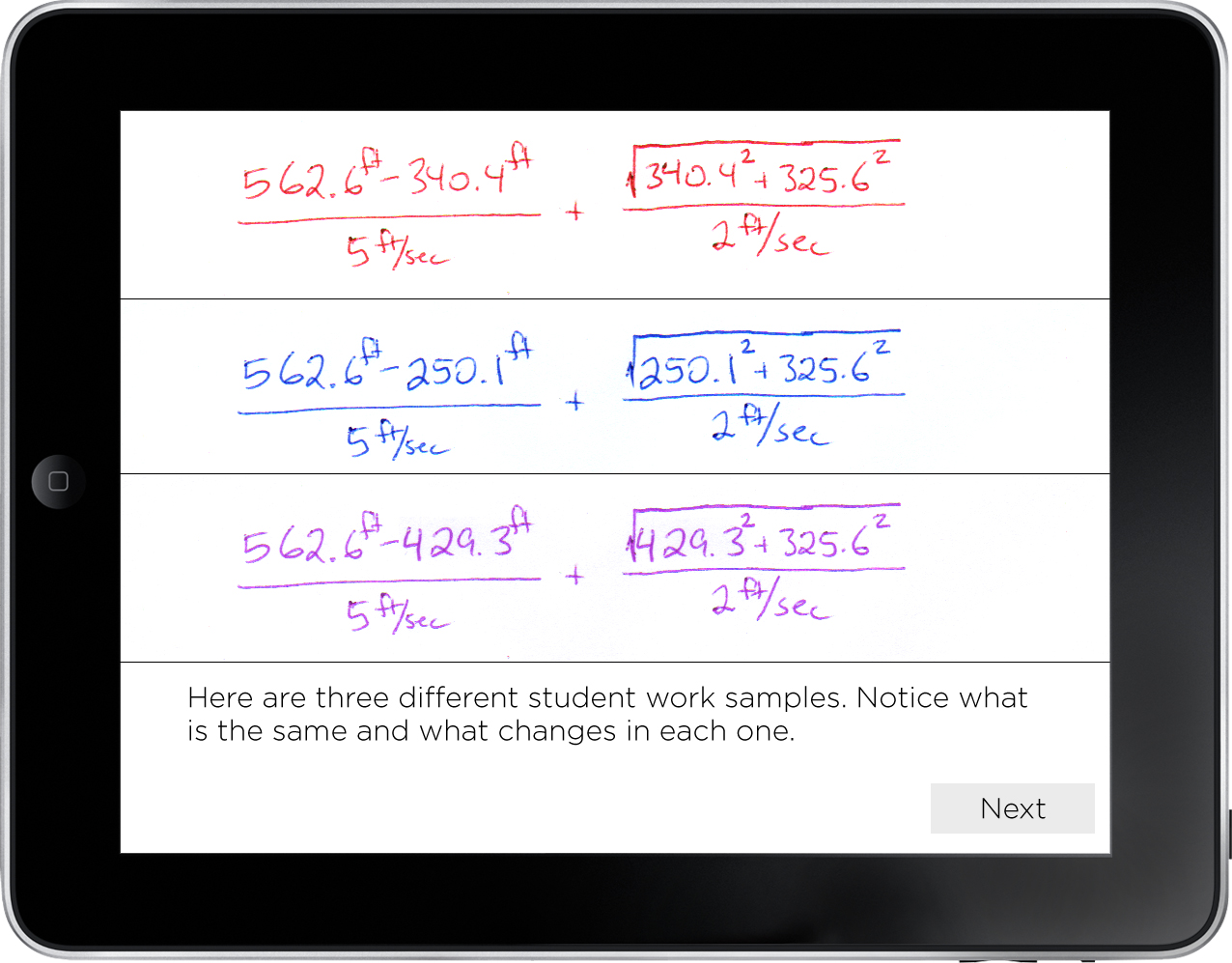
Remember that everybody is doing the same calculation on a different value? [BTW: Christopher Danielson is right that I overstepped myself here.] That means it’s abstraction time again.

We pull out three student pages (never mind that these are all from the same person) and we ask the students to notice what changes and what doesn’t.

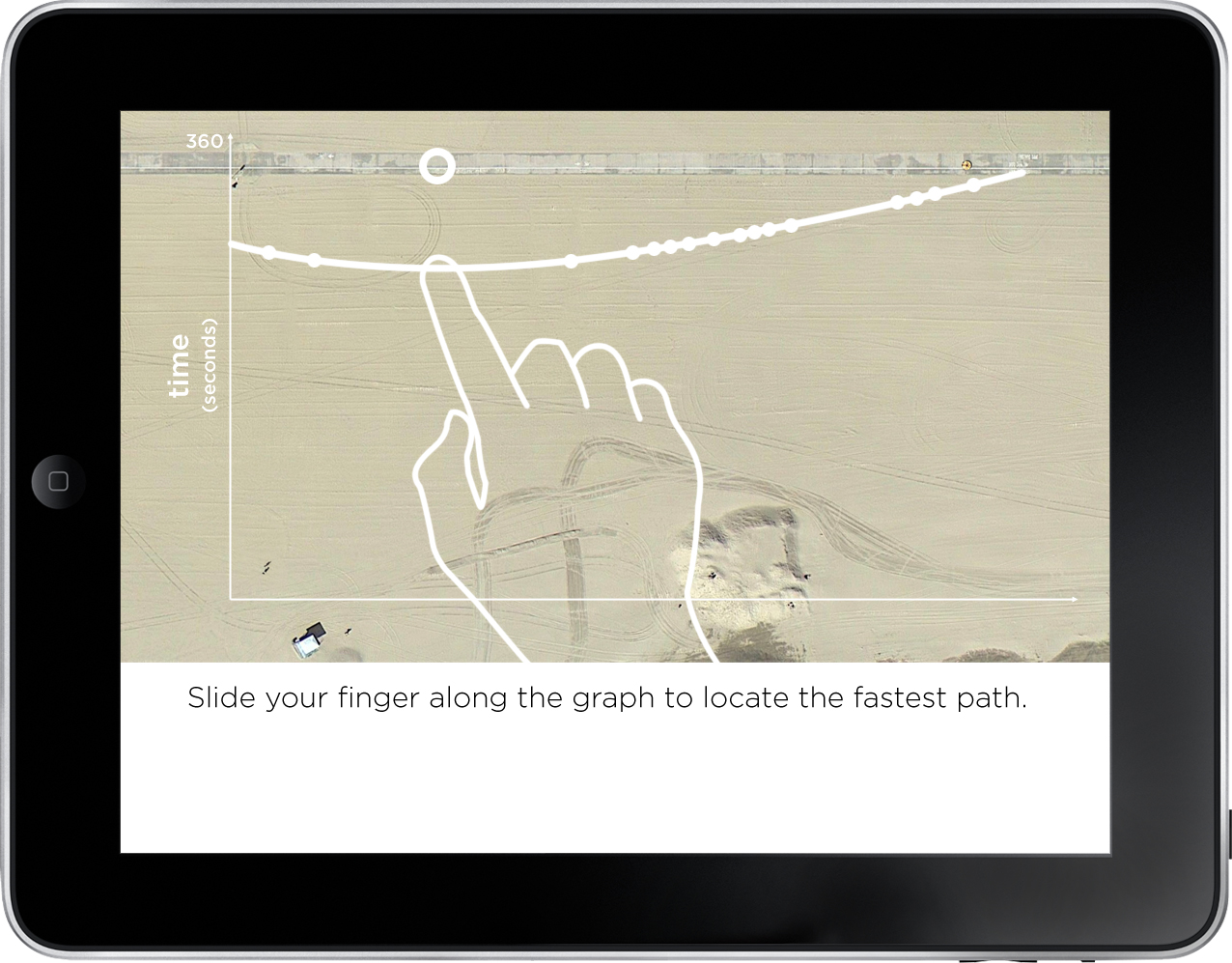
We turn the thing that changes into a variable. But why? Because math teachers need the work? Because math teachers amuse themselves with this notation? No. Because it lets us try any value we want really quickly. What are the highest and lowest values we should try?

The student slides her finger along the graph and the path adjusts with it. The tablet snaps to points of interest like minima and maxima and displays the value of the graph at those points.

From here we’d play the video that shows that answer. The tablet would find out which student guessed the closest initially and throw some love on her.

A Few Closing Notes Before I Ask Your Opinion About This Kind Of Curriculum

  • On the upside, this task attempts to clarify abstraction for students and make that process participatory. It involves the entire ladder. Students pick their own math problem. Students are guessing. They’re deciding what information is useful and useless. ¶ Look at the original task and imagine how many more students are included in this re-imagining. ¶ The task is also social in a way that’s difficult to achieve without 1:1 technology. The tablet collects and represents the entire class’ guesses in real-time. A teacher can’t do that.
  • On the downside, I’m not sure what the teacher does in this sketch. At different times, I wobble between having the textbook function as the teacher and having the textbook simply maintain a steady course through the problem. If I taught this problem, I know I’d handle a lot of the exposition (ie. “Here’s why we use variables.”) myself, in conversation with students. But what should the textbook do? ¶ Also, we didn’t differentiate the function and solve for the minimum. We formulated the model and solved it graphically. Does that still count as math?

Now you go.

2012 Oct 11. Dave Major went out on spec and put a lot of this into code. It’s exciting.
Two PD Opportunities

One, I’ll be chatting with three-act mavens Chris Robinson and Andrew Stadel in the Global Math Department Wednesday 10/10 8:00PM Central Time. Here’s the agenda.

Two, I’ll be offering two sessions in San Francisco on Monday 10/14 for Integrate|Ed along with a pile of other really great educators. Details here. Tickets are ordinarily $275 but if you type “vendor sponsorship” in the coupon code blank you get it for $75, which is kind of an insane discount.

2012 Oct 11. Here’s the recorded version of the Global Math Department discussion.

Great Classroom Action

Rachel Rosales on Correlation Station:

Today in prob/stats we started our unit on bi-variate data. Completely hijacking an idea from one of my new twitter friends, @druinok, I had the students work through a variety of stations requiring them to do different types of data collections.

Julie Reulbach on Integer Blackjack:

I got this amazing game from Denise at Let’s Play Math. It is played like Blackjack because the kids are dealt 2 cards, and can say “Hit Me!” to get up to 4 cards. They love, love, love it.

Damon Hedman on Possible Or Not:

I first saw this a few years ago at Shodor Interactivate. I think it is a good way to start thinking about functions. My favorite part is having students make up stories for each graph.

Helaina Thompson on Tennis Ball Artistry:

Cornally introduced the project as simply: “Hey! Let’s fill the room with tennis balls. I want you to need a machete to get to your seat.” The students then looked over the Colossal post and there was no stopping them.

2014 Apr 25. More correlations from Jen Campbell’s #NCTMNOLA talk. And Jared Derksen.

These Horrible Adaptive Math Systems

Annie Murphy Paul, describing systems that attempt to adapt to what you know and don’t know about math:

Tyler breezed through the first part of his homework, but 10 questions in he hit a rough patch. “Write the equation in function form: 3x-y=5,” read the problem on the screen. Tyler worked the problem out in pencil first and then typed “5-3x” into the box. The response was instantaneous: “Sorry, wrong answer.” Tyler’s shoulders slumped. He tried again, his pencil scratching the paper. Another answer – “5/3x” – yielded another error message, but a third try, with “3x-5,” worked better. “Correct!” the computer proclaimed.

S.H. Erlwanger [pdf] forty years ago:

Through using IPI, learning mathematics has become a “wild goose chase” in which [Benny] is chasing particular answers. Mathematics is not a rational and logical subject in which he can verify his answers by an independent process.

See if this describes your adaptive learning startup:

A basic assumption in [your startup’s name here] is that pupils can make progress in individualized learning most effectively if they proceed through sequences of objectives that are arranged in a hierarchical order so that what a student studies in any given lesson is based on prerequisite abilities that he has mastered in preceding lessons.

I don’t have anything against personalization per se. But the technology that enables that personalization defines and constrains the math we can personalize. Currently it defines that math very, very narrowly.

Individualization in [your startup’s name here] implies permitting him to cover the prescribed mathematics curriculum at his own rate. But since the objectives in mathematics must be defined in precise behavioral terms, important educational outcomes, such as learning how to think mathematically, appreciating the power and beauty of mathematics, and developing mathematical intuition are excluded.

Look, if you’re building one of these systems, you have to read and understand Benny’s Conception of Rules and Answers in IPI Mathematics. Ask questions here. Let’s figure this out. We’d all love for you to make some interesting new mistakes. Right now you’re just repeating mistakes that are forty years old.

BTW. In Education’s Digital Future last night, I said I felt the next Kasparov v. Deep Blue competition would be between a grandmaster teacher and an adaptive learning engine. Give them both some written student work. Which one can accurately identify what the student knows and doesn’t know and what to do next?

I said this in a small group and a couple of technologists razzed me. One said that he doesn’t even get that kind of feedback in the lecture halls at Stanford, which is totally fair, though that isn’t the model I’m defending.

Another said, “Actually, computers are already better.” He told me that adaptive systems can tell you the best time of the day for you to study, how much time you spend on problems, the answer you choose most often when you’re stuck, and a bunch of other metrics that are simple enough to parse from a student’s clickstream. Of course, not one of them addresses the student’s most pressing question, “Why am I getting this answer wrong?” So, like Benny, the student clicks a different answer and the wild goose chase begins again.