In case you missed it, Justin Reich and I are co-sponsoring the #mtt2k prize and the eligibility window for applications closes August 15. Upload some commentary on a Khan Academy video to YouTube and tag it #mtt2k. You could win a few hundred dollars to take the missus or the mister to the boardwalk before school starts.
If you couldn’t make it through the setup (a Khan-style explanation of Angry Birds) here is the punchline:
Okay, wait. Obviously, Khan Academy would never lecture about Angry Birds. But what makes Angry Birds different from math and science? Angry Birds makes it easy to play, experiment, get feedback, and learn. I’m not saying lectures and explanations are never necessary in math and science – or in Angry Birds, for that matter. When I couldn’t get past that one really tricky level, I went online and found a walkthrough. But the walkthrough – the explanation – wasn’t the first thing I did when I experienced Angry Birds. So why does Khan Academy make an explanation the very first thing a student experiences with a new topic in math. When we put the explanation first, we get lousy learning and bored students.
Comments open until I come to my senses.
17 hours later. Comments closed. I couldn’t handle it. Sorry.
Comedian Louis CK, on bypassing ticket retailers to sell seats directly to fans through his website:
Well, it’s all so interesting. It’s all so interesting. It really is. I love knowing why I was able to sell out in one town, and why I wasn’t in another town. I love knowing what goes into everything–the economics, the technical aspect, and how to create the ideas in the show. It’s great. If you can have access to all of that, why would you not want to know? I just love learning. I think learning is how you live. The verb of my life is learning.
There are people who find failure interesting. Those people’s failures are often more interesting than their peers’ successes. Their lives also tend towards success even though the prospect of a successful life motivates them less than the prospect of an interesting one.
By Dan Meyer •
August 8, 2012
• Comments Off on The Math Edublogosphere’s Welcome Mat
Sam Shah, chalking up another reason to love the math edublogosphere:
For a few weeks now, I have had this idea bouncing around in my head. A new blogger initiation! All it involves is writing four blogposts. There will be no hazing of any kind, except for the kind where we all say how much we think you’re awesome. That’s a form of hazing, right? Like happy hazing?
It’s a great idea and I can’t wait to read the summaries. If you haven’t created your own faculty lounge online, now is the time. Sign up by August 14.
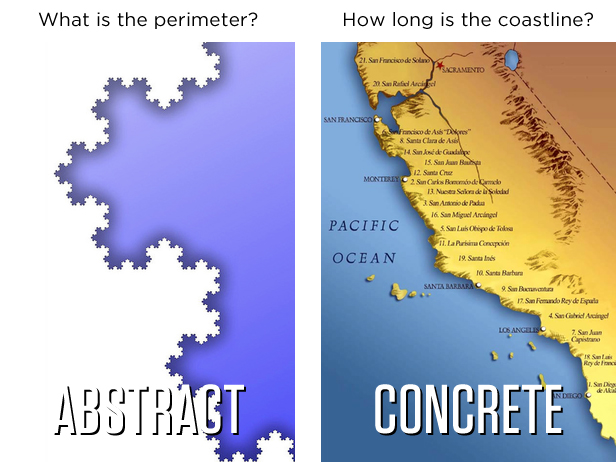
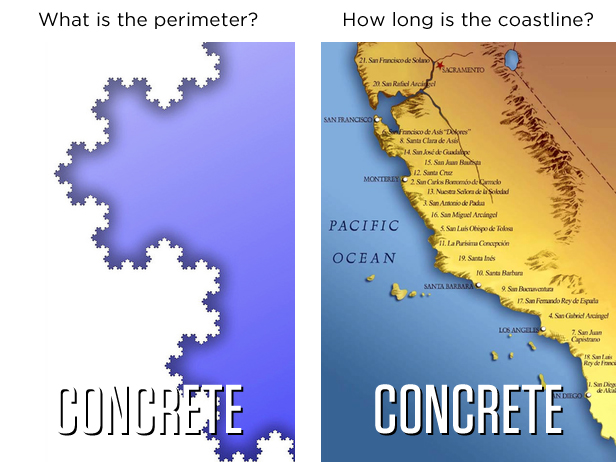
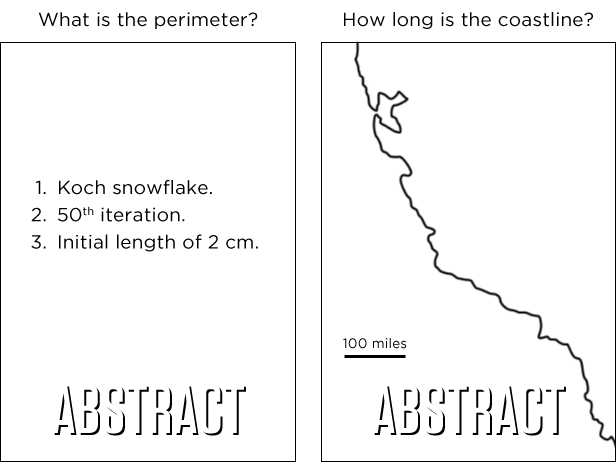
But both of those images have information that is extraneous to the question Bryan poses about them. Color information is irrelevant in both, for instance, so you get rid of it. You don’t need the names of California’s missions or the name of the ocean to its west. Both images are in need of abstraction. Therefore they are both concrete.
Or at least they’re more concrete than what we get after we ask ourselves:
What information is important?
How do I represent it?
This points to the highly subjective nature of the adjectives “abstract” and “concrete.” They’re often statements of preference (eg. “I prefer concrete to abstract” or vice versa) and they’re both relative terms. Everything is more abstract and more concrete than something else on the same ladder. But we’re looking at two different ladders here, not one.
So here is a task that occupies maybe two rungs on the ladder of abstraction:
You bought some 40-cent pencils and some 70-cent pens. There were 10 of them in total for 460 cents. How many pencils and ballpoint pens did you buy?
At this altitude, it’s difficult to apply your intuition to a solution. The important information has already been identified. You’ll decide how to represent that information (symbolically, perhaps, with variables and two simultaneous linear equations) and what to do with that representation (manipulate those equations, solving for both unknown variables). But that’s the extent of the task ladder.
So watch and marvel, as I have, at video of a skilled Japanese teacher reconstructing that task ladder to include more rungs above and below what few currently exist. I have watched it five-or-so times since Steve Leinwand introduced it in his April talk at NCTM. I encourage you to do the same. For the sake of our conversation here, though, I have created a smaller excerpt of just the teacher’s questions:
Here are those questions and some commentary. The questions are listed in chronological order, like a script, but I’m sure you understand we’re starting at the bottom of the ladder:
This is what we’re going to study today. What is this?
You bought some 40 yen pencils and some 70 yen ballpoint pens. There were 10 of them in total for 460 yen. How many pencils and ballpoint pens did you buy?
The task is introduced.
A table?
Do you think the table would help you?
Do you understand what the table is?
Rio, do you think the table would be useful?
Well then, if we’re going to make a table, we need some labels, don’t we?
What kind of table?
Do we need a label like this?
Do you understand this?
What else do we need as a label?
Do we still need something else?
How about this? “The total price.”
What do you mean 0-10?
You mean no pencils?
And how many ballpoint pens?
This is one of my favorite moves in the lesson. A similar task in the United States might explicitly direct students to create a table. It might provide a table with several rows pre-filled. In both cases, the problem would be abstracting itself. It would be answering the question, “How do I represent the information that’s important?” for the student. It would be locking the process of abstraction inside a black box, far from the student’s view. And then twenty years later we’ll marvel when that student, now grown, complains that “algebra always seemed too abstract.”
But the Japanese teacher isn’t sending his students off to discover the abstraction. Yes, the students are making most of the crucial choices here – from the selection of a table to the labels of the table to the domain of the table – but the teacher steps in after each of those choices and makes them totally explicit.
The choice to include “0 pencils” in the domain of the table, for one example, is far from obvious. So when a student suggests it, the teacher underscores that suggestion over and over again, doing everything but sending a skywriter up in the air to write “YOU MEAN NO PENCILS?!” above the school in smoke.
Well there are many combinations of the numbers right?
Seika, can you tell me any examples of the combination?
3 pencils and 7 pens. Did you make the same combination?
Is it correct?
Are there any mistakes on the board, please tell me?
But before we see that, there already is an answer, isn’t there?
What is the answer?
This pair?
Is it similar with your notebook?
The teacher asks his students to calculate the table by hand. In another bright move, he passes out the table’s 11 columns to different students who calculate and return them. Now those columns are pinned to the board, arranged in no particular order.
He notes that they have solved the problem. One of the columns contains 460 yen. That’s the combination of pens and pencils they’re after. The task seems complete.
But the ladder continues upward.
Can someone arrange the cards and make the table easier to see?
Why did you arrange the cards like this?
But why?
It’s easier to see?
The order of numbers?
For example, if I change the cards like this, is it wrong?
This is the answer, is that all?
He’s still picking at the abstraction!
Two girls come up and arrange all those haphazard columns into ascending order in a table. And he asks them, “Why did you arrange the cards like this?” He doesn’t let up. He takes one column and sets it out of order. “Is it wrong?”
No, it’s just less useful. A student says, “It’s easier to see.”
What’s easier to see?
The student explains that when we arrange the table in order, the change in total price is hard to miss. When they’re out of order that change is hard to see.
How does our method match the Easy / Fast / Accurate rule?
Is it fast?
It is easy?
Is it accurate?
How can we solve the problem more quickly?
Now we’re abstracting over new variables: speed, ease, and accuracy. The students decide unanimously that their method is accurate. They’re mixed on ease and no one thinks it’s fast. So now we’re ready for a faster, easier method for a new problem.
You bought some 60 yen colored pencils and some 80 yen markers. There were 12 of them all together. The price they cost was 820 yen. How many colored pencils and markers did you buy?
What is the title of today’s lesson?
What amazing work from such meager beginnings.
A few final notes before we dive into your commentary:
Titles. What’s with titling the lesson at the end of the day? Anyone know what’s going on there?
Technology. Blackboard. Chalk. Teacher voice. Student voice. Paper. Pencil. It’s multimedia in the most literal sense of the word. (Tentative hypothesis: it’s very difficult to work on the ladder of abstraction if your tasks are limited to one medium.)
Tables. A table is a representation of a context’s most important information. It’s an element of an abstraction with which math teachers are extremely comfortable. I think we find it easy to assume, particularly at the secondary level, that what’s obvious to us about these representations is also obvious to our students. I love how every single aspect of the table in the video is up for negotiation and debate – its labels, the inclusion of zero values, the fact that you probably oughtta put something in ascending order. Nothing is taken for granted.
Time. At the end of class, the teacher notes that, wow, that took a lot of time. It turns out a deep understanding of abstraction doesn’t come for free.
BTW: Michael Pershan offers an excellent analysis of Khan Academy as it relates to high-performing Japanese classrooms like this one. He closes with an alternate vision for Khan Academy that’s provocative. You’ll especially enjoy it if you find this #mtt2k business too mean-spirited. Commentary about that video belongs on that video’s YouTube page, though. All comments about it here will be shot on sight.
Totally at the effectiveness of leaving the title to the end. The students not only see it because the content of the lesson is played out if front of them, but there’s a pretty clear agreement that the title of the lesson fits. One of the students even says, “Cool.” How often do you get a student saying cool when you *start* a lesson by writing the title on the board.