[cross-posted to the 101questions blog]
We’re one week into 101questions and the early feedback has been encouraging. For a certain kind of warped individual (ie. my kind of individual) the experience seems to be, in a word, addicting. It’s also fun to find a non-trivial Swedish contingency jumping aboard. The more effective use we make of visuals, the more we can include learners who speak English as a second language, if they speak it at all.
After a week, 500+ registered users have uploaded 300+ photos and videos which have provoked 10,000+ questions across all users, including a number of unregistered users I haven’t counted. (The analytic component of site administration is right in my wheelhouse, as you can see.) We even have a registered troll, which means we’re halfway to a full-fledged online community.
Here’s a description of where 101questions came from, the problems it tries to solve, and a few notes on where it might go.
Where It Came From
I piloted the idea online in webinars and face-to-face in workshops. I tweaked the constraints and the implementation and arrived at an exercise that teachers found both challenging and fun, which seemed like the right combination. Teachers liked rating photos and videos as perplexing (or not). That same feedback on their own photos and videos helped them improve their eye for perplexity.
I introduced it on Twitter as #anyqs. You’d post a link to a photo or video (hereafter called “the first act”) and ask for questions. That implementation was good for a time, but ultimately very problematic.
Problems 101questions Tries To Solve, In Order Of Importance
Here’s the biggest:
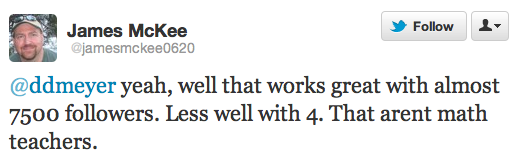
The feedback to your first act is proportional to the quantity of your Twitter followers.
I have the most followers of anyone who has contributed to the #anyqs tag. I also get the most responses to my photos and videos. That correlation extends all the way down to people with a dozen followers who get very few responses in spite of their work being thoroughly perplexing. That’s a pity.
At 101questions, your first act goes into a huge pile along with mine and both of ours are served up randomly to other users until it gets 100 responses.
People post whatever they want and tag it #anyqs.
I’m talking about full web pages, long, meandering videos, Flash applets, etc. There is a place for all those things, but they all miss the design of the exercise: one photo or one minute of video.
At 101questions, your attempt to upload anything outside of those constraints will get you an invitation to revise and resubmit.
Tweets are fleeting. Perplexity should endure.
We don’t have a record of all the perplexing photos and videos you’ve posted on Twitter. Many of the #anyqs participants likely couldn’t dredge up their own contributions. I’ve saved all of them locally, but that takes a lot of diligence and they’re basically lost to the wind for everybody else. Along those lines, it’s also hard to know if someone has already posted a particular first act.
At 101questions, your contributions are stored in a database and logged in your profile. (Here’s mine.) The application also checks to see if a particular link has already been uploaded and, if so, points you to it. There is a bookmarking feature. You can save first acts for later.
It’s hard to know if you’re bored by my first act or if I just missed you.
I wish there were a “Skip It, I’m Bored” button attached to my #anyqs submissions on Twitter. If responses to my first act are light, I may infer it wasn’t perplexing, but sometimes I wonder if I just queried my followers at the wrong time.
At 101questions, there is a “Skip It, I’m Bored” button.
There isn’t any way to filter for quality.
What was the best photo posted last month? Which people post the best material most consistently? Where can I find their photos and videos? How are we defining “best” anyway? Those questions can’t be answered within our Twitter pilot.
At 101questions, I’ve set up a metric called “perplexity” which amounts to the likelihood your first act will provoke a question. (Technically, it’s the number of questions that have been asked about your first act expressed as a percentage of total skips and questions. 75 means three quarters of everybody who has seen your first act have asked a question about it.)
People post material because it seems vaguely connected to a discipline, not because it provokes a question.
“Interesting” isn’t the same as “perplexing.” “Engaging” is a different animal also. It’s easier to dazzle a student with fireworks than to provoke her to wonder a question. When I’m unperplexed by someone’s #anyqs material on Twitter, I’ll often tweet back, “What question did that photo make you wonder?” In my perfect world, I’d see your own question alongside the first act you uploaded, but only after I submitted my own, so my question is raw and unbiased by yours.
At 101questions, the upload page has fields for a link and a title. Then a blank for your question.
It’s difficult to see other people’s questions about a first act.
If someone tweets a first act I find perplexing, I often want to know if it perplexed other people and, if it did, the questions they asked. That’s difficult on Twitter.
At 101questions, everyone’s questions are logged beneath each first act.
Where This Might Go
Tagging. Searching. Commenting. Top ten lists for “today” and “the last week,” not just “all time.” A mobile application. The ability to submit files from your phone or computer, not just links. Complete mathematical stories, not just the first act. If we’re working on circumference tomorrow, I’d like to go to 101questions, find a list of complete mathematical stories for “circumference” sorted from most perplexing to least, and then download it to my hard drive. Those features will be expensive to develop and sustain. The core feature – getting 100 responses to your first act – will always be free but I may invite you to pay community membership dues for access to the fancier stuff.
Way, Way Behind The Scenes
One of the most annoying features of edu-punditry is how quickly our gurus decide they’ve done absolute everything they can to help us understand and accomplish their vision for learning. They write their blogs, publish their books, tweet their tweets, and give their speeches. Having decided they’ve done everything possible to help us wrap our brains around ideas that are obvious to them, their last recourse is to snark, sarcasm, hectoring, and irrelevancy.
In reality, their messages can almost always be clarified, made easier, more fun, and less expensive. I want nothing to do with that culture of punditry. I can be clearer. I can find new metaphors. I can publish in more media. And I can create tools to make these practices easier. That’s 101questions.