Year: 2012

Total 137 Posts

[3ACTS] Pixel Pattern

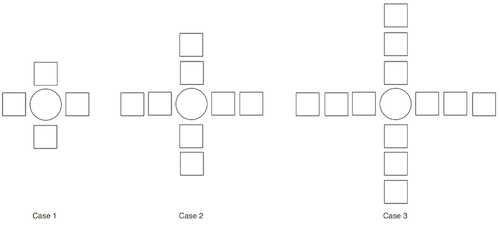
You’ve heard of pile patterns? There are variations but generally you have three snapshots of a growing shape like this:

Questions follow regarding future piles, past piles, and a general form for any pile.

I wanted to know what this old classic would sound like with newer equipment. Would video add anything here, for instance? Here is the result of my tinkering:

Video adds the passage of time. I added a red bounding box to the video, which was an attempt to make the question, “Where will the pattern break through the box, and when?” perplexing to students.

I also added different colors, which allows students to track different things or ask themselves, “What color will be the first color to break through the box?” Different questions require different abstractions. If you care about total tiles, you’ll model the total. If you care about the breakout, you’ll model the width and height. Each one will require linear equations, which is nice.

Other notes:

  • The sequel asks about the “aspect ratio” of the growing shape which is a useful way to dig a little at limits.
  • Real-world math. Here again I’m thumbing my nose at our conviction that math should be real. This isn’t real in the sense we usually mean. If it interests your students, it will interest them because it asks questions that rarely get asked in a math classroom, questions from the bottom of the ladder of abstraction:
    • What questions do you have?
    • What’s your guess?
    • What would a wrong answer look like?
    • What information do you need to know?

The Smarter, Balanced Sample Items

The Smarter, Balanced Assessment Consortium:

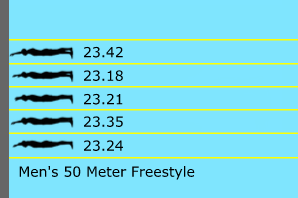
Five swimmers compete in the 50-meter race. The finish time for each swimmer is shown in the video. Explain how the results of the race would change if the race used a clock that rounded to the nearest tenth.

You should take a tour through the Smarter, Balanced Assessment Consortium’s released items, make an opinion about them, and share it here. California is a member state of SBAC, one of two consortia charged with assessing the Common Core State Standards, so I’m comparing these against our current assessments. Without getting into how these assessments should be used (eg. for merit pay, teacher evaluation, etc.) they compare extremely favorably to California’s current assessment portfolio. If assessment drives instruction, these assessments should drive California’s math instruction in a positive direction.

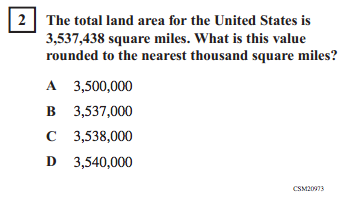
The assessment item above uses an animation to drive down its word count and language demand. It’s followed by an expansive text field where students are asked to explain their reasoning. That stands up very well next to California’s comparable grade five assessment [pdf]:

  • Elsewhere, we find number sense prized alongside calculation (here also) which is a step in a very positive direction. (ie. Our students should know that $14.37 split between three people is between $4 and $5 but it’s a waste of our time to teach that division longhand.)
  • I’ve been assuming the assessment consortia would run roughshod over the CCSS modeling practice but on the very limited evidence of the sample items, we’re in good shape.
  • The assessments do a lot of interesting and useful things with technology. (Reducing word count, at the very least.) I only found one instance where the technology seemed to get in the way of a student’s expression of her mathematical understanding.

I can’t really make an apples-to-apples comparison between these items and California’s current assessments because California currently has nothing like this. No constructed responses. No free responses. No explanation. It’s like comparing apples to an apple-flavored Home Run pie.

Featured Comment:

Candice Frontiera:

Next thing to explore: Technology Enhanced Item Supporting Materials [zip]. [The “Movie Files” folder is extremely interesting. –dm]

What Do Adaptive Math Systems Really Know About What You Know?

First, Michael Goldstein:

Khan Academy alone gives the following information: time spent per day on each skill, total time spent each day, time spent on each video, time spent on each practice module, level of mastery of each skill, which ‘badges’ have been earned, a graph of skills completed over number of days working on the site, and a graphic showing the total percentage of time spent by video and by skill.

Second, Jose Ferreira, CEO of Knewton:

So Knewton and any platform built on Knewton can figure out things like, “You learn math best in the morning between 8:32 and 9:14 AM. You learn science best in 40-minute bite-sizes. At the 42-minute mark your clickrate always begins to decline. We should pull that and move you to something else to keep you engaged. That thirty-five minute burst you do at lunch every day? You’re not retaining any of that. Just hang out with your friends and do that stuff in the afternoon instead when you learn better.”

I don’t have a lot of hope for a system that sees learning largely as a function of time or time of day, rather than as a function of good instruction and rich tasks. It isn’t useless. But it’s the wrong diagnosis. For instance, if a student’s clickrate on multiple-choice items declines at 9:14 AM, one option is to tell her to click multiple-choice items later. Another is to give her more to do than click multiple-choice items.

These systems report so much time data because time is easy for them to measure. But what’s easy to measure and what’s useful to a learner aren’t necessarily the same thing. What the learner would really like to know is, “What do I know and what don’t I know about what I’m trying to learn here?” And adaptive math systems have contributed very little to our understanding of that question.

For example, a student solves “x/2 + x/6 = 2” and answers “48,” incorrectly. How does your system help that student, apart from a) recommending another time in the day for her to do the same question or b) recommending a lecture video for her to watch, pause, and rewind?

Meanwhile, these trained meatsacks have accurately diagnosed the student’s misunderstanding and proposed specific follow-ups. That’s the kind of adaptive learning that interests me most.

Featured Comments

Chris Lusto:

But then we’d need like an entire army of trained meatsticks, each assigned to a manageably small group of students, possibly even personally invested in their success, with real-time access to their brains and associated thoughts, perhaps with a bank of research-based strategies to help guide those students toward a deeper understanding of…something.

That seems an awful lot like a world without clickrates, and I’m not sure it’s a world I want to live in. Or maybe I’m just cynical between 11:30 and 12:00, on average, and should think about it later.

Dan Anderson:

A big advantage with meatsacks over computers is the ability of a human to look at the work. Computers can only indirectly evaluate where the student went wrong; they can only look at the shadow on the ground to tell where the flyball is going. Meatsacks can evaluate directly where the student is going awry.
1,400 Rectangles

Some math teachers were sharing dinner following last week’s Northwest Math Conference when Marc Garneau said something truly implausible:

If you have a class of students draw a rectangle, they’ll combine to create the golden rectangle.

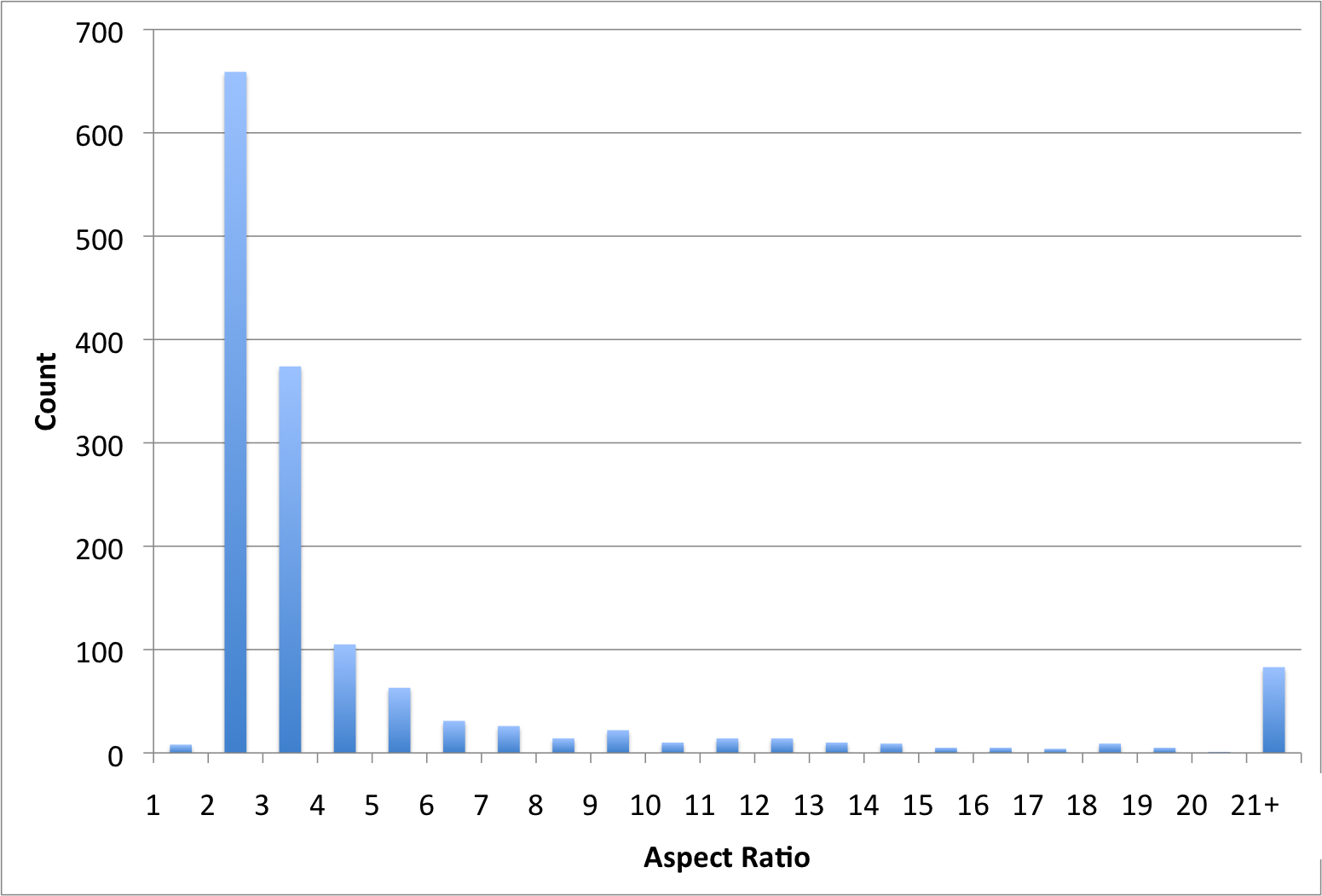
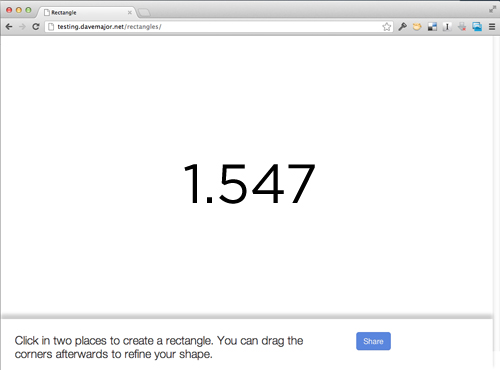
Truly implausible, but Marc stood by it, along with at least one other member of our party. Dave Major set up a web page so we could collect data. You all obliged us with 1,400 rectangles, about a third of which I’ll show you in this video:

Mean: 6.16; Median: 2.087; Standard Deviation: 18.296. So, no, not the golden rectangle. And now Marc owes me a new car.

a different dave wrote:

I predict that the shape of the rectangles is going to be very heavily influenced by the shape of the canvas provided.

Not that either. Now a different dave owes me a new car too.

Here’s all the data. Tell us something interesting about them we don’t already know.

The Necessity Principle

How could we improve this task?

Fuller, Rabin, and Harel (2011) [pdf] define “intellectual need,” “problem-free activity,” and offer several ways to improve that task in one of the best pieces I read last summer:

When students participate in mathematical activities that stimulate intellectual need, we say that they are engaged in problem-laden activity. Unfortunately, many students are engaged in problem-free activity, in which they are driven by factors other than intellectual need and, as a result, do not have a clear mental image of the problem that is being solved, or indeed an understanding that any intellectual problem is being solved.

The piece features:

  • Dialog between teachers and their students that results in “problem-free behavior” and “social need.” There’s something in here for everybody. Everybody – myself included – will feel a twinge of recognition reading one or more of those exchanges.
  • Great suggestions for how to mend those scenarios, for queueing up intellectual need and problem-laden behavior.
  • Five categories of intellectual need. The need for certainty, causality, computation, communication, and connection. You can lean on any of those categories and watch several great lesson ideas fall out.

Featured Comment

mr bombastic:

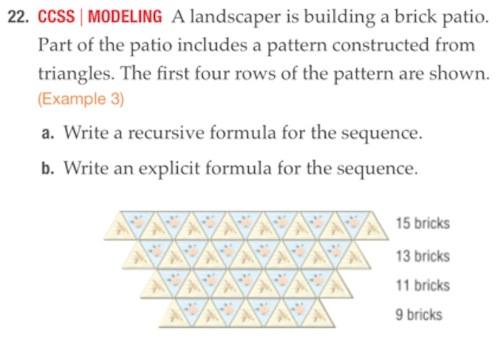
The recursive part in the original question is especially annoying in that it sends the message that math is used to take something that is totally obvious (two more brick in the next row) and somehow make it seem complicated.