a/k/a Dave Major Goes Bananas
Shorter: Dave Major and I are experimenting again with what math textbooks could look like on devices that are digital and networked. Our most recent experiment is Ice Cream Stand.
Longer: Last September, Kate posted this image to Twitter attached to the tweet, “Worst geometry problem ever: can’t be solved until after you solve it.”
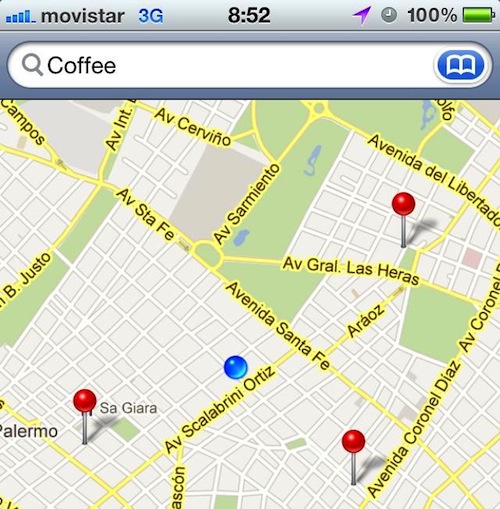
Clever bit, right? Classic Kate.
We could print that out and have students use a compass and straightedge to construct the circumcenter (the point that’s equidistant from all three coffee shops). That’d be a fine summative assessment. Very “real world,” etc.
But if you’d like to use Kate’s tweet to motivate the need for the circumcenter, to give students a reason to care about the circumcenter, we’ll need to start much lower on the ladder of abstraction. We’ll need to throw out formal vocabulary and formal operations for a few minutes. We’ll need to start with intuition.
So we changed the domain from coffee to ice cream. We changed the environment from a roadway (a complicated space) to a park (an open space). And we gave students a few easy choices. “Which ice cream stand would you pick, given where you’re standing right now?”
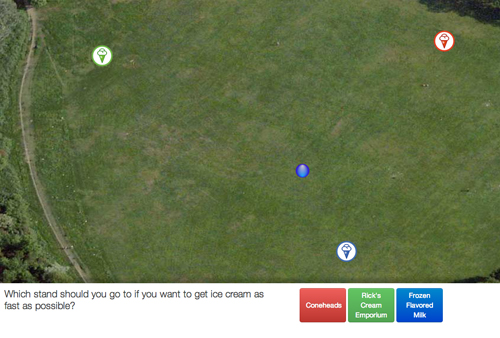
Students see that they’re basically painting the field one dot at a time.
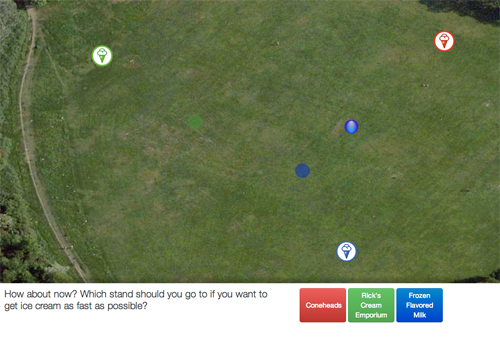
So we ask them to extend that metaphor and paint the entire field so that someone else can see which stand is the closest no matter where they are in the park.
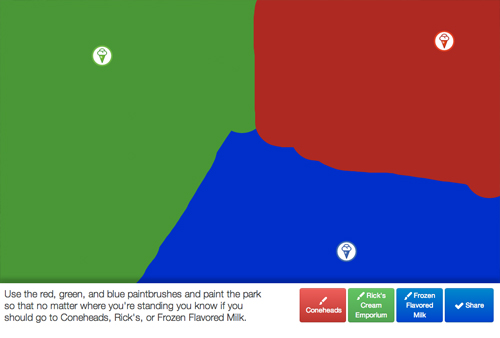
This is a task that a lot of students can complete regardless of their mathematical knowledge. It’s expensive, but not impossible, to provide this task on paper. It’s impossible to do on paper what comes next.
We combine the entire class’ park paintings.
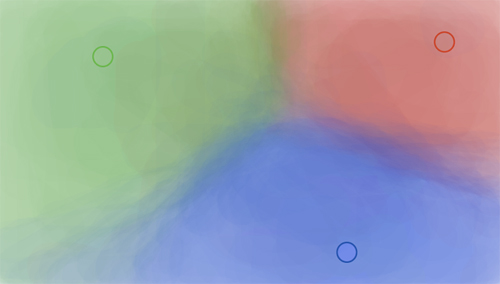
That’s a composite from three dozen people on Twitter.
Dave and I then asked students for some preliminary thoughts about how we could calculate the right painting. But that’s where we finished. The point is, students now want to know, “Who’s right? Who’s closest?” And what’s weird is that our intuition validates the math to a degree.
That is to say, you can see areas where Twitter agreed with itself. You can see areas where Twitter disagreed with itself. When you construct the circumcenter from the perpendicular bisectors, you’ll find that they overlay rather neatly on the areas of disagreement.
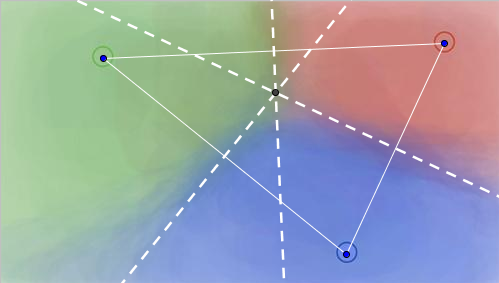
That’s the ladder of abstraction. It isn’t impossible to climb it with print-based tasks, but a digital networked device makes it a lot easier.
Open Questions
- Q: Where does this activity go next? We could add some expository text about the circumcenter. We could leave that to the teacher. We could calculate which student took the best guess in her painting of the field. A huge open question throughout these projects is, “What role does the teacher play here?”
- Q: Another huge, open question is, “What happens to the first student who runs through this activity?” Her composite painting is just her own painting. Dave and I are developing activities that exploit the network effect. They get better and more interesting when more students use them. So again: what happens to the first student through?
BTW. Dave Major wrote his own post about this project.
Featured Comments
Alexandre Muniz:
The burning question I have after looking at this is, why is the average line a bit wrong? (Especially the blue/green line.)
Evan Weinberg:
The line of uncertainty shows where the intuitive power of the brain breaks down. This is where the power of mathematical tools can step in to hone in on a more precise answer. What strikes me here is that the mathematical tools don’t do that much better of a job.
Jason Dyer:
If you allow the first student through to see the picture as it gets revised (via a reload button or some auto-update), I don’t see a terrible problem (except for the usual classroom dilemma of what you do with any student that finishes fast).