The Task
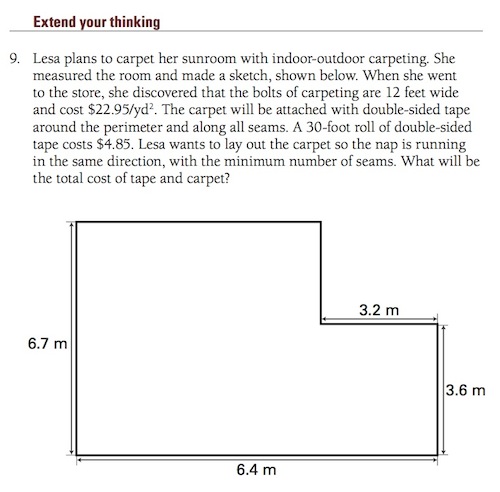
This task comes from MathWorks, which, as I understand it, is intended for Canada’s vocational track math students. I purchased PDFs of the curriculum in Saskatchewan because it featured a lot of interesting applications of secondary math, even if the print medium did those applications no favors.
What I Did
- Not a lot. The last makeover took it out of me and it’s summer. Let’s do something a little simpler.
- Put students in the shoes of the person who might actually experience this problem. Perhaps that person is a homeowner. The homeowner either doesn’t have a carpet or has a carpet in need of replacement. She knows only one thing at this point: “I want carpet.” She wonders several things at this point: “How much will it cost me?” and “How much time will it take me?” and “How will I do it?” are probably high on the list. What she doesn’t have yet are all these facts, figures, and dimensions the problem includes.
- Add intuition. Our homeowner might try to ballpark the cost of the installation before she does anything else. Let’s ask students to do that.
- Raise the ceiling on the task. We need to extend this task at the top end for students who need the challenge.
Let me run this by you.
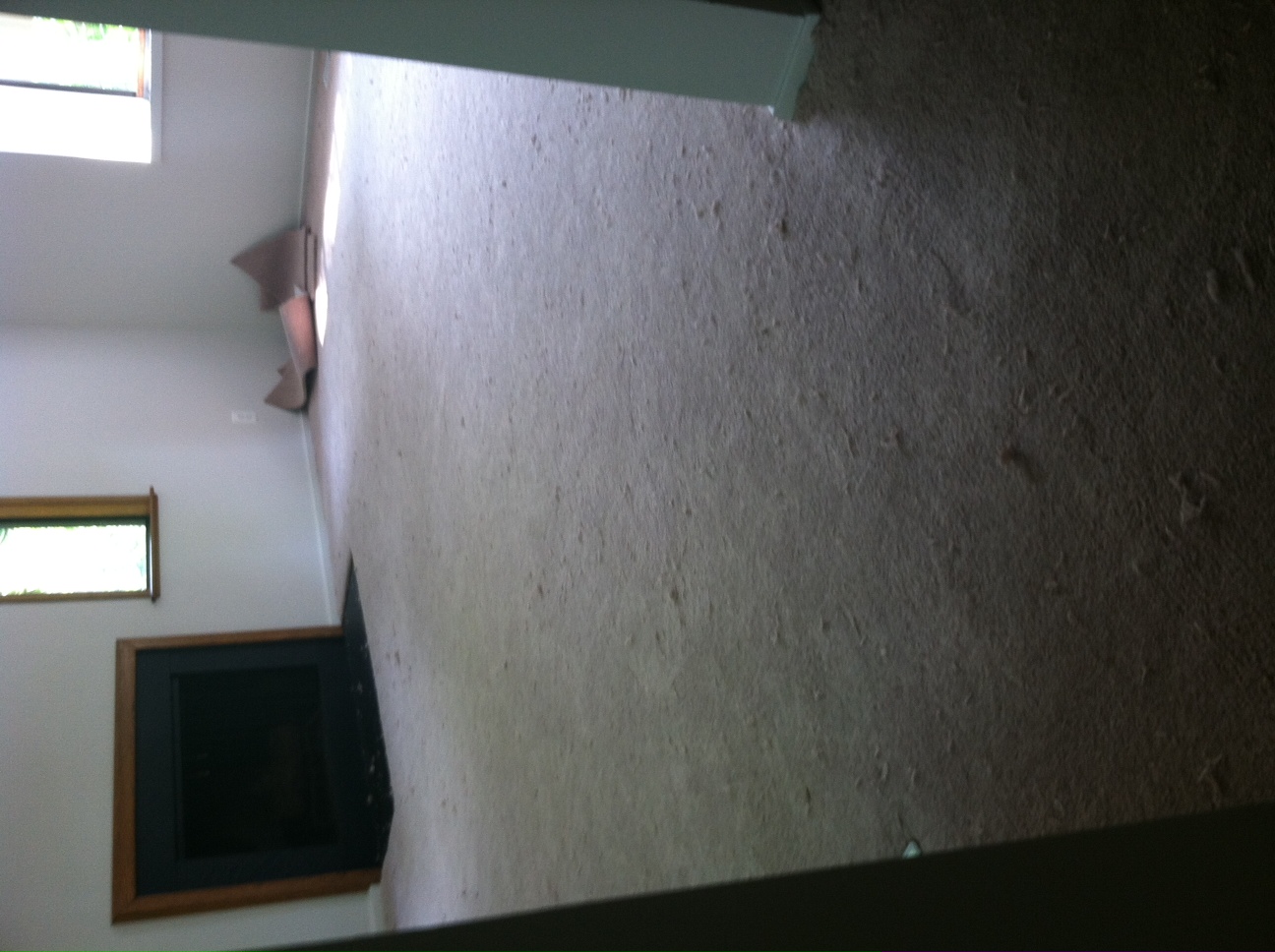
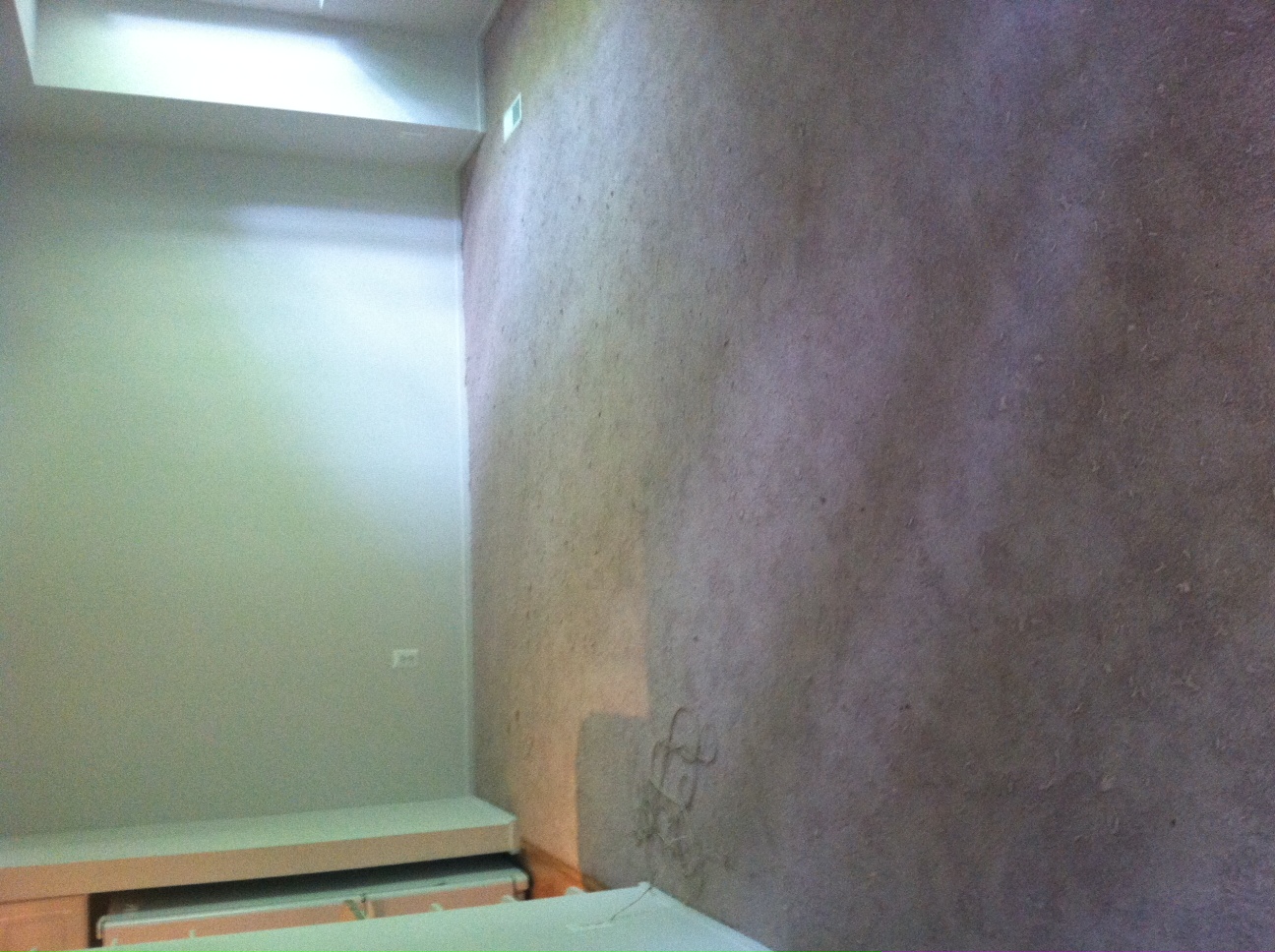
Shoot some quick video of a room in a house that has a similar design —Â composite rectangles. If it’s emptied of furniture so much the better. (Anybody moving this summer? Get at me.) Tell students, “We need new carpet in this room. Can you give me a guess how much it’ll cost?” Some of them won’t have a clue, but we’d like them to take their intuition as far as it’ll go, even if that’s just to say, “It’s definitely going to cost less than $10,000.”
Then ask them to brainstorm in groups: “What information will be important here? What skills will you need?” Because that’s the question our homeowner is likely asking herself and we’re trying to put our students in her shoes. (Also because the first task in “modeling” according to the Common Core is to “identify essential variables.”)
I have no trouble imagining the student response here because my own knowledge base for home handiwork is pretty much comparable.
- What kind of carpet are we buying?
- How much does it cost?
- How much does it cost to install?
- How do you get carpet?
- Are there any other costs we’re forgetting?
I’m sure I’d be (pleasantly) surprised by what students ask for. At this point, offer them information they want. Teach them about carpet installation. Show a YouTube video. (Or have them research all of the above online, though I’m not inclined to sacrifice the time myself.) Basically give them the same information given in the task, only after they’ve had a minute to think about why they’d need it and how they’d get it.
I’d probably pass out a floor plan of the room without dimensions. An interesting observation the original task glides past is that you don’t have to measure every single side of the room. You can measure some and use them to find the others. So ask them what sides they’d want or what’s the fewest sides they’d need?
As students work, some will need more of your help and others will finish quickly. My first attempt at an extension problem for the latter group is to switch the known and unknowns of the original problem. So previously we gave students dimensions and we asked for cost. Now give them cost and ask for dimensions.
“Tell me about a scenario where the total bill for the carpeting job was $1,000,000.” They can change anything they want.
What You Did
Over on the blogs:
- Algebra’s Friend clues in on the mismatching units.
- Evan Weinberg asks his students to make a controversial choice between two options, which is a useful way to begin a problem.
- Jonathan Claydon has some fun with the shape of the room.
- Bob Lochel takes on the issue of domain-specific knowledge by having his students model the act of carpeting a room.
- Mark Leadbetter is comfortable with the mixed units but also tackles the domain-specific knowledge.
- Chris Robinson submits a problem for #MakeoverMonday that may be beyond repair. This made me realize I’m looking for “tragic” problems rather than “failed” problems. Which is to say, problems whose greatness has been overwhelmed by its inner demons, problems with wasted potential.
Over on Twitter:
- Stuart Price throws in the towel.
- Haiwen Chu links up a fascinating anthropological study on the mathematics carpet layers actually use.
- Chris Adams and I may be on the same page, but Twitter’s brevity has me unsure what “let them figure it out” means in practice.
Call for Submissions
You should play along. I post Monday’s task on Twitter the previous Thursday and collect your thoughts. (Follow me on Twitter.)
If you have a textbook task you’d like us to consider, you can feel free to e-mail it. Include the name of the textbook it came from. Or, if you have a blog, post your own makeover and send me a link. I’ll feature it in my own weekly installment. I’m at dan@mrmeyer.com.
2013 Jul 2. Jennifer Orr sends in two pictures we can all use.