One of the most fascinating pieces to come out of the winter break was this segment from PBS NewsHour’s John Merrow on the Rocketship charter network.
The video distills into ten minutes all the most interesting angles on Rocketship – its high parent involvement, its high teacher salaries and professional development, its morning “launches,” and the segment pays special attention to Rocketship’s “Learning Labs,” which Merrow describes as “lots of computers and kids, no teachers.” (Watch that part of the segment.)
This aspect of a lot of charter and for-profit schools should make us all very uneasy. Rocketship can afford to pay its teachers more because, for one hour each day, the students are plugged into computers, boxed into cubicles, and tutored intermittently by low-skill, hourly-wage workers. Rocketship spruces up its lab with lots of primary colors but it can’t shake comparisons to a call center.
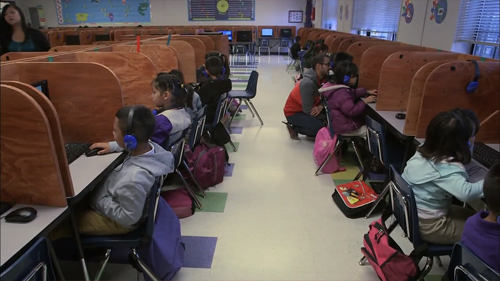
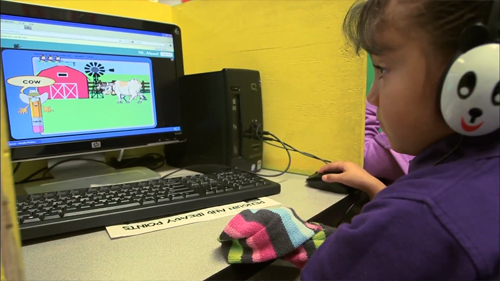

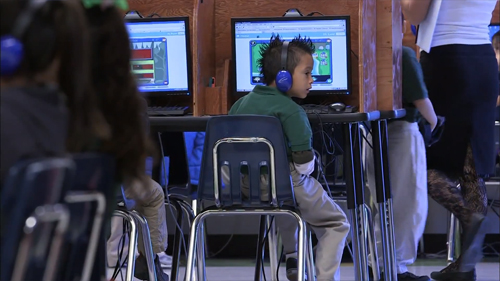
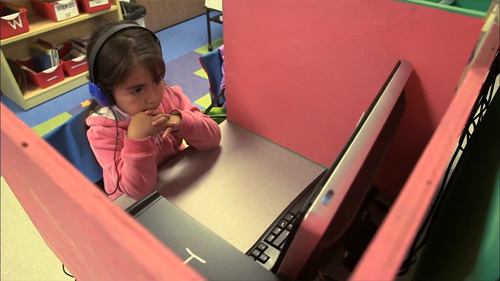
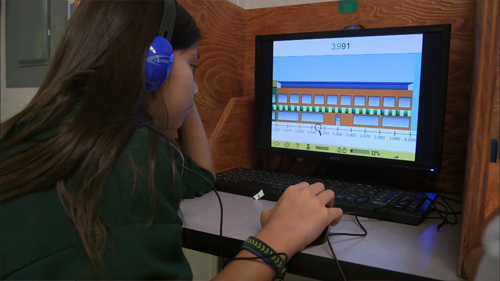

This is “differentiation,” says John Merrow, and it’s true that the students are working on different tasks, but at what cost? The students don’t interact with their peers or their teachers. The math program, ST Math, isn’t bad but computers constrain the universe of math questions you can ask down to those which can be answered with a click and graded by a computer. The promise of personalization, of perfectly differentiated education, has forced Rocketship to make dramatic concessions on the quality of that education. It’s a buffet line where everyone chooses their own flavor of the same gruel.
Merrow’s documentary team wasn’t persuaded of the Learning Lab’s merits:
The Learning Lab saves schools lots of money but there’s just one problem: they’re not really working. A problem we saw is that some students in the lab do not appear to be engaged. They sit at their computers for long periods of time, seemingly just guessing.
What’s remarkable is that the Rocketship staff is also unpersuaded of the Lab’s merits. One principal says, “If I had to guess, I’d say you come back in a year, you won’t see a Learning Lab.” Another says, “Next year we’re thinking of bringing the computers back to the classroom.”
This isn’t any kind of small pivot, something Rocketship can gloss over with a sunny press release. Throughout Merrow’s segment, the teachers, the principals, and the charter CEO all spoke of their commitment to innovation. We should commend them for innovating away from technology when it’s ineffective, especially given their particular location (Silicon Valley) and time (2013). That just isn’t easy.
BTW: Mike Caulfield suggests that personalization is hostile to the kind of whole-class conversation we know to be valuable:
Indeed, structured classroom discussion has one of the highest effect sizes in Hattie, much higher than mastery learning. But it’s really difficult to have a classroom discussion (or group activities that foster student discussion) without some level of shared experience and knowledge. I’m curious if this fact might lie behind much of the surprising failure of computerized adaptive learning systems.
2013 Jan 09. Edsurge got Rocketship CEO John Danner on record. The Learning Labs are staying:
Online learning is integral to our model…The Learning Lab is not going away, rather we are working to integrate its key components directly into our classrooms under the guidance of our incredible teachers and staff…I think Merrow probably just happened to focus on an isolated incident and wanted to bring it up as it is always a valid concern with online learning. We continue to work on the data integration piece and this pilot doesn’t change the importance of that. Our teachers continue to get more robust data from the Learning Lab and are eager for us to work towards a fully integrated and real-time system.
2013 Jan 25. MindShift reports that Rocketship is, indeed, moving the computers back to the classrooms.
Featured Comments
I read something from the http://edtechnow.net/ blog recently that really struck a nerve — a quote from William Cory, Assistant Master of Eton, who wrote in 1861:
“You go to school at the age of twelve or thirteen and for the next four or five years you are engaged not so much in acquiring knowledge as in making mental efforts under criticism.”
It’s that ‘mental efforts under criticism’ piece, that structured classroom discussion where your thoughts are challenged where higher order learning takes place.
It’s important to assess thing like this not only in terms of how effectively they teach math, but also in terms of what they teach children *about* math. The learning lab teaches children that math is a solitary activity, wherein one clicks at things on a computer until the computer approves.
Not only should we be concerned about what students are learning about math based on this experience but what they are learning about computers as well. I’m sure the majority of schools are not doing a much better job of offering elementary students the opportunity to use computers as more powerful tools rather than skill-practice machines, but most don’t have kids doing so quite this much. If we want students who will explore, innovate, challenge ideas, we have to help them see more possibilities than simply answering questions and being told right or wrong.
One simple filter, Jungian type, tells us that over half of all children aren’t going to be energized by an hour at a computer screen. Extraversion and Introversion in personality type terms involve how we are energized. All of us can do both, but one is preferred and the other is draining. Further, even if the Introverts like the computer lab, they still need the stimulation of discussion, learning to express their ideas and question those of others. Since a good portion of school is still set up for more Introverted activities, adding interventions that require more Introversion makes it a very, very long day for the Extraverts—and they just might start talking and moving when you least want them to.
“The learning lab teaches children that math is a solitary activity, wherein one clicks at things on a computer until the computer approves.”
Perhaps not TERRIBLY different from the way many math classes operate, if you simply substitute “teacher” for computer in the second instance so that we have, “Math classes teach children that math is a solitary activity wherein one writes or says the answers to computations until the teacher approves.”
Out of character, writing this sort of stuff is *hard*. It’s hard for actual live human beings to understand how students are modeling the math in their head and respond accordingly. Poor Jennifer [DreamBox’s computerized teacher-avatar – dm] just repeats her instructions. If I were a student who didn’t understand place value, I might walk away from this unsure about my own multiplication facts, that were good.
Jennifer might help me more if she knew about some common errors (and maybe that sort of thing is going on in the background, invisible to the student?). Like Dan, I don’t want to be a luddite, and if the computer is better than people, we should go for it. But computers have a long way to go.
Much of teaching is empathy — being able to see the world through the eyes of a person who doesn’t know the things you know. It’s being able to communicate with someone who sees the world differently than you do. There are a thousand ways that live, in person communication can cultivate and encourage that empathy in teachers. For programmers who are at arms length, cultivating that empathy is double difficult and important.
Jennifer just asked me if I’d like to continue working, ’cause it took me a while to write this. I think my answer would be “no”?
So just as you imagined this hypothetical student in a DreamBox lesson, I think it’s valuable to imagine this same student entering a classroom without the support of a technology like DreamBox:
The multiplication standard algorithm is a fifth grade Common Core standard, so let’s assume the student is a fifth grader who doesn’t understand place value. This student transfers into a new school and math class on the day after the teacher introduced the algorithm. Does the teacher know the student doesn’t understand place value? If not, how will that information be acquired? Once it’s known that the student lacks place value understanding, should the teacher continue teaching the algorithm lesson even though the student is clearly not ready for it? If not, what does the student do during math class?
Too often, the student is taught the algorithm right then because there are simply too many logistical and resource constraints that limit what even the best teacher is able to do in that situation. It’s no certainty that the student will meet grade level standards by the end of the year, and the inherent challenges of this reality end up being a huge strain on both teacher and student. I’m empathetic to both of them. And the tens of thousands of others in the same situation. These are the teachers and students we’re trying to help.