This is a series about “developing the question” in math class.
I’m proud of Graphing Stories. That was the first math lesson that drew in any serious way on my video editing hobby. That was the first math lesson that alerted me to the enormous value in sharing curriculum with teachers on the Internet.
I’m unhappy with the project now. I look at it and see the product of a math teacher who is eager to get to the answer of how to graph a real-world relationship and less interested in developing the question that leads to that answer.
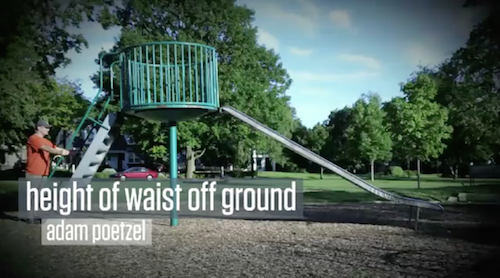
If you watch Adam Poetzel’s graphing story, in which he slides down a playground slide, here’s what you’ll see:
- A title announcing the quantity we’ll be recording: “height of waist off ground.”
- A gridded graph that shows the scale you’ll use. It runs up to 10 feet.
- A video of Adam sliding.
None of this is Adam’s fault, of course. That’s my editing.
Here’s how I’ve been doing a better job developing the question lately in workshops.
- I play the video of Adam sliding.
- I ask participants to tell their neighbors everything they saw. “Don’t miss a detail,” I say, and I’m always surprised by the details participants recall.
- I play the video again and I ask the participants to tell their neighbors their answer to the question, “What quantities could we measure throughout the video?” People suggest all kinds of possibilities. Speed, distance from the left side of the screen, height, temperature.
- Then I tell them I’d like them to focus on Adam’s height. I ask them to tell their neighbors in words what happens to his height over time.
- We share some descriptions. People compliment and critique one another. Then I point out how difficult it is to describe his height over time in words alone.
- Only then do I pass out the graphs.
The difference is immense. It takes an extra five minutes but participants are much better prepared to make the graph because they’ve spent so much time thinking about the relationship in so many informal ways. So many more participants walk away from the experience feeling like valued contributors to our group because the questions we’ve asked require a wider breadth of skills than just “graph relationships precisely.”
That’s the benefit. Again the cost was only five minutes of class time.
The most productive assumption I can make about any question I pose to a student is that a) there are questions I could have asked earlier to develop that main question, b) there are interesting ways I can extend that main question. In other words, I try to assume the question I was going to ask is only a thin middle slice of the corpus of interesting questions I could have asked. Tell yourself that. Maybe it’s a fiction. Maybe you use the entire question buffalo every time. It’s a useful fiction in any case.
Next: Let’s make a resolution.
BTW: Kyle Pearce got here first.
Featured Comment