Year: 2014

Total 89 Posts

[Fake World] Real-World Math Proves Tough To Pin Down

tl;dr — “Real world” is tougher to measure than “interest” and less important overall. So rather than asking which of these three different versions of a word problem is more “real world” I asked a couple hundred people which is more interesting. Only the geometry treatment was significantly better than a coin flip at generating questions.

————————–

Here are some closing words about “real world” math, mostly distilled from your comments on the last post. As with previous investigations, I am indebted to the folks who stop by this blog to comment and make me smarter.

Real-World Math Is Hard To Define

What other conclusion can we draw from the dozen-or-so definitions of “real-world math” I found here and on Twitter?

  • It depends on whether we’re talking about the world of procedures, concepts, or applications. [Karim Ani]
  • A problem simulating a project / job / task being performed by someone performing their normal job duties, such as the example of the contractor building a pool to meet municipal code. [Ben Rimes]
  • A problem involving objects or tasks that would be considered an experience students are likely to have in the “real world.” [Ben Rimes]
  • If it came from a math teacher it’s basically not real-world, unless it was a math teacher doing something in the outside world leading to an interesting problem in mathematics. [Bowen Kerins]
  • An observation / question that would be interesting to humans outside a math class. [Kate Nowak]
  • Something is “real” to a student if it’s concrete, attainable, comprehensible. [Michael Pershan]
  • Something is “real” to a student if it has a non-mathematical purpose. [Michael Pershan]

Real-World Math Doesn’t Guarantee Interest
140314_1

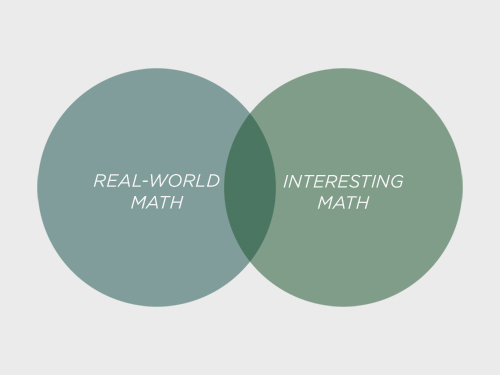
David Taub argued the whole question confused “interest” with “real world.” M Ruppel listed other criteria for judging the value of a question, one of which was “kids want to solve it.”

Their arguments may seem obvious to you. They aren’t obvious to the three people who emailed me here or these presenters at the California STEM Symposium or Conrad Wolfram or the New York Times editorial board.

As Liz said, “Real world is just a means to an end. The goal is interest.” We should reject simple explanations of student interest.

So Which Version Is More Interesting?

Asking which of these three versions (candy, geometry, text) of the same math problem is more “real-world” was a pointless task since basically everyone has a different definition of “real-world” and it doesn’t guarantee interest anyway

So let’s ask about interest instead.

I used Mechanical Turk (and Evan Weinberg’s invaluable Internet skills) to show a random version of the problem to 99 people. I asked them if they had a question or not.

Of the three treatments, only the geometry treatment was statistically better than a coin flip at generating questions. (Here’s the experiment and the data.)

Then I showed another 80 people the same three treatments and asked how interested they were in the equal area question as measured on a Likert scale from -3 to 3, including 0. (This measured interest another way. Perhaps a question didn’t occur to you impulsively but once you heard it you were interested in it.)

Here again only the geometry treatment had an interest rating that was significantly different from “neutral.” (Experiment and data.)

Why the geometry treatment? I don’t know. It’s more abstract than the candy treatment, which features objects from outside the math classroom. 88% of the people I surveyed in the first experiment answered “within the last year” to the question “When did you last use math to solve a problem in life, work, or school?” That’s a math-friendly crowd. It’s possible that a class of elementary schoolers would find the candy treatment more interesting and that a coffee klatch of research mathematicians would tend towards the text treatment.

I don’t know. I’m just speculating here that real world is a pretty porous category. And for the sake of interesting your students in mathematics, it’s more important to know their world.

2014 Mar 26. Fawn Nguyen asked her eighth grade geometry students which version they preferred.
Dear Mathalicious: Which Of These Questions Is “Real World”?

An ongoing question in this “fake world” series has been, “What is real anyway, man?”

Are hexagons less real-world to an eighth-grader than health insurance, for example? Certainly most eighth graders have spent more time thinking about hexagons than they have about health insurance. On the other hand, you’re more likely to encounter health insurance outside the walls of a classroom than inside them. Does that make health insurance more real?

I don’t know of anyone more qualified to answer these questions than our colleagues at Mathalicious who produce “real-world lessons” that are loved by educators I love.

I’m sure they can help me here. Here are three versions of the same question.

Version A

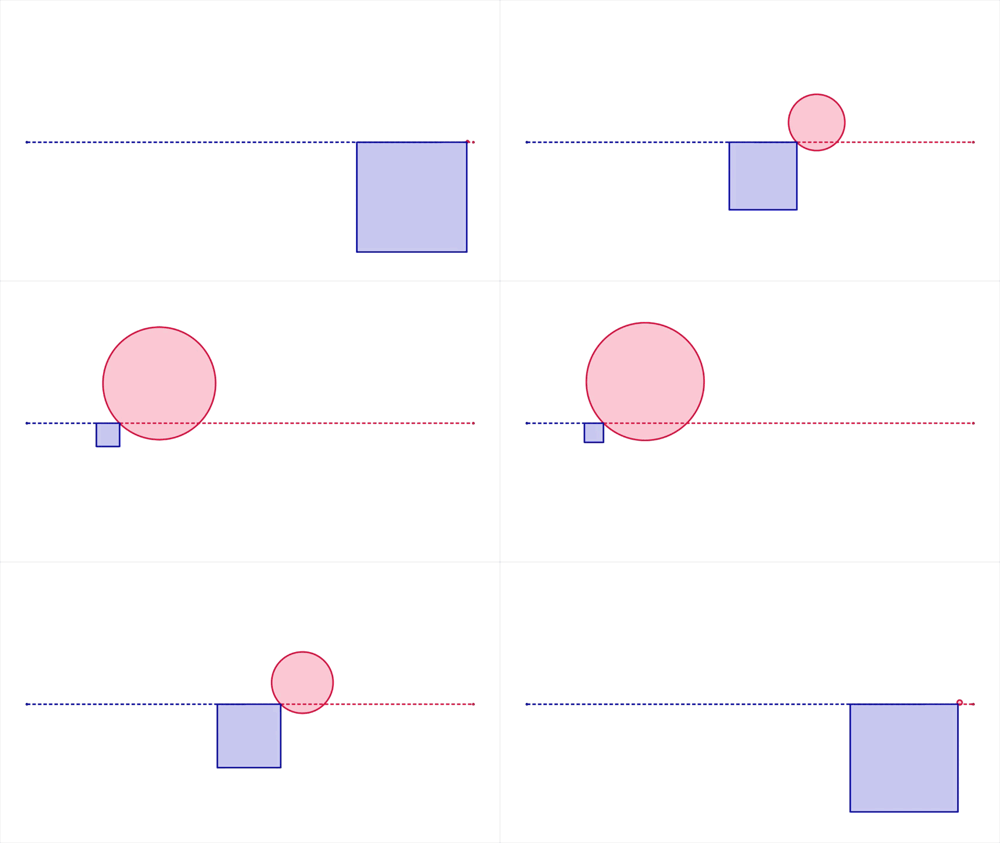
Given an arbitrary point P on a line segment AB, let AP form the perimeter of a square and PB form the circumference of a circle.

Find P such that the area of the square and circle are equal.

Version B

medium

When do the circle and the square have equal area?

Version C

low

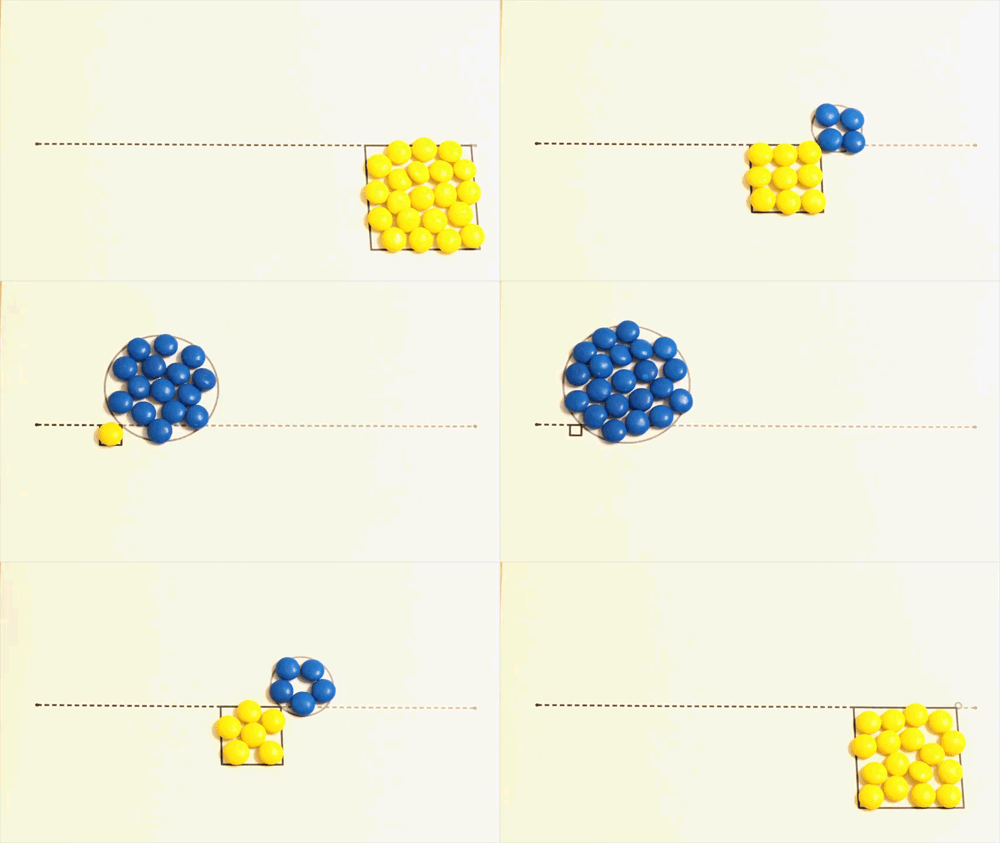
Where do the circle and square have the same number of candies?

Version D

[suggested by commenter Jeff P]

You and your friend will get candy but only if you find the spot where there’s the same number of candies in the square and the circle. Where should you cut the line?

Version E

[suggested by commenter Mr. Ixta]

Imagine you were a contractor and your building swimming pools for a hotel. Given that you only have a certain amount of area to work with, your client has asked you to build one square and one round swimming pool and in order to make the pools as large as possible (without violating certain municipal codes or whatever), you need to determine how these two swimming pools can have the same area.

Version F

[suggested by commenter Emily]

Farmer John has AB length of fencing and wants to create two pens for his animals, but is unsure if he wants to make them circular or square. To test relative dimensions (and have his farmhands compare the benefits of each), he cuts the fencing at point P such that the area of the circle = area of the square, and AP is the perimeter of the square pen and PB is the circumference of the circular pen.

Dear Mathalicious

Which of these is a “real world” math problem? Or is none of them a real-world math problem?

If anybody else has a strong conviction either way, you’re welcome to chip in also, of course.

Featured Mathalicians:

Featured Comments

David Taub:

These are the two ideas that seem to be confused here are just “real world” and “interesting”. There seems to be an inherent assumption that they are somehow related when I doubt they even should be. Sometimes they will overlap, and sometimes not, but it is a bit random and quite personal in my opinion.

Kevin Polke:

I caught the maintenance staff at my high school using “real-world math.”

Ben Rimes:

The problem probably lies in the many ways that one could define “real world”.

What qualifies as “real world”?

  • A problem simulating a project/job/task being performed by someone performing their normal job duties, such as the example of the contractor building a pool to meet municipal code?
  • Is a problem involving objects or tasks that would be considered an experience students are likely to have “real world”(dividing up the M&Ms to be equal size)?
  • Actual evidence of math in the “real world “(video or otherwise) being applied as a part of someone’s job (the maintenance staff example above from @Kevin Polke) could qualify, or perhaps the application of math to a problem that is foreseeable in that person’s job duties.

I think it’s best to take the more pluralistic viewpoint on this one, as it would be quite a task to attempt to statically define the exact nature of “real world” math, as there are always countless more examples lining up to disprove whatever narrow definition you choose.

Liz:

“Real world” is just a means to an end. The goal is interest.

M Ruppel:

What matters for a ‘good task’ is not whether it’s real, it’s whether
1) its meaning is clear right away
2) kids want to solve it
3) have the mathematical tools to solve it (even if not very sophisticated tools)

Bowen Kerins:

I’ll say again though: I don’t really care if a problem is real-world. There are so many great problems that aren’t, and so many terrible problems that are. I don’t think it carries huge added value. Everyone decides what’s “real” to them (as Jeff P said). Right now for my kid, 7-5 and 5-7 being related to one another is plenty real, even though there is no connection yet to physical objects or money or any of that.

Featured Tweets

2014 Mar 26. Fawn Nguyen asked her eighth grade geometry students which version they preferred.
Four Great Resources For Math Teachers, Now Free

From our friends at the Shell Centre:

The aim of Shell Centre Publications has always been to ensure that a number of seminal works in the field of mathematical education remained available. We have now reached the point where our most popular items are out of stock, and have come to the decision that it is time to stop storing and selling physical books. Digital distribution is the best way to keep these works available, so in the coming months, we will be making many of the publications on our list available, for free, as PDF downloads.

These books are just great. The Language of Functions and Graphs, in particular, has a couple of career’s worth of great activities, lesson plans, and essays on teaching functions. Highly recommended.

[via Michael Pershan]

Why Joe Schwartz Blogs

Joe Schwartz:

I’ve been teaching for over 25 years and this is the best way to document what it is that happens in classrooms. A friend looked at my blog and then said to me, “Now I get what it is you really do.” Of course we can never actually capture all the moments, both large, small and in between, but I think all of our blogs together can do that. And in the climate we find ourselves in today I think that is very important.

Joe’s blog is one of my favorite recent subscriptions. You should subscribe.

It’s really hard to find dedicated elementary math teacher bloggers for a lot of really good reasons. In particular, they generally teach everything so why would they specialize their blogging. All of this makes Joe’s blog invaluable.

Two good starters:

Why Do You Blog: Then Vs. Now?

I’m reposting Michael Fenton’s question here, less because I’m interested in you seeing my answers and more because I’m interested in seeing yours. Ignore his five-year qualification. If your motivations for blogging have changed over any stretch of time at all, let us know why.

In 2009, I blogged because:

  • I wanted a record of what I taught and believed about teaching that I could reflect on and laugh at later in my career.
  • I needed a community. I taught in a rural district with five other math teachers (two of them married). Fine educators, but they were in different stages of their career and had answered a lot of questions I was just starting to ask. I needed people.

In 2014, I blog because:

  • I want more interesting questions. In 2009, I was asking questions about worksheet design, PowerPoint slides, and classroom management. By articulating my questions and noticing which of them created vibrant discussions and which of them fell with a thud on the bottom of an empty comments page, over five years I have moved on to some questions that make my work a joy to wake up to every day. eg. What do computers buy us in curriculum design? What does good online professional development look like? What does it mean for students to think like mathematicians and how do we scaffold that development? What is the “real world” anyway and what does it buy us in math class?
  • I need to stay connected to classroom teachers. I’m fast approaching the date where I’ll have been out of the classroom for longer than I was in it. Which scares the hell out of me and keeps me asking for advice from real life classroom teachers on this blog and reading, like, five hundred thousand teacher blogs every day.

A readership is more essential to my goals now than it was then. If you guys aren’t tuning in and pushing back at my ideas and offering your own, those ideas get a lot dumber. (In 2009, by contrast, I had 120 students to let me know when my ideas were dumb.)

So a lot of what I do in my blogging lately is try to send you signals that I read and value and act on your responses. (See: the recent confabs; featured comments; putting the word out on Twitter that there’s an interesting conversation brewing, etc.)

Perfect encapsulation of all of the above: this week’s circle-square confab, which featured 62 comments from a pack of great teachers, creative task designers, and math education researchers.

That’s why I blog now. Why do you?

Featured Comments

John Stevens:

I started blogging way back in 2012 because I needed a way to reflect. I was in a very, um, rough patch in my teaching career and needed a way to get some thoughts out there. I was reading all kinds of other blogs and seeing what others were doing, stealing material from people left and right. Therefore, my blog was a way to thank people for giving me cool stuff.

Fast forward to 2014 and things have changed. I’m still reading blogs and stealing left and right, but I’m also trying to give back a little. As information kept pouring in, I started to get some ideas of my own. Sure, some of them are awful, but I’m proud of Barbie Zipline and some others. At this point, it’s still a 70/30 take/receive deal, but I’m all for it.

Bree:

I feel like I’m currently struggling to answer this question — which is probably why my blogging rate has been downwards of around once a month these days.

Shelley:

So many of the good teacher moves are invisible, and as I begin to blog I aim to capture some of the techniques that I have used to engage students. I often pass along worksheets and activities for teachers to use, but sometimes what I really want to pass along are the questioning techniques used throughout the lesson, along with a structure to ensure that students are discussing mathematics instead of working in isolation. Blogging allows for this extra commentary.

Michael Pershan:

When I started blogging, I desperately needed to validate my experiences. I was teaching in big ol’ NYC, but at a private school with just one other math teacher. I needed to know: Was my teaching weird? Was I actually figuring things out about teaching, or just headed down my own idiosyncratic path? I wanted to say things that made sense to other people, so that I could be really sure that they made sense to me.

Also:

My blog is for figuring things out, so that someday I’ll be able to help teachers and kids out in a real way.

Chris Hill:

I used to blog because I felt like I was coming up with some innovative lessons and I was learning some new approaches.

Recently I haven’t blogged because I’ve been handicapped into traditional direct instruction lessons (through resources and student culture). Maybe when I’m not in a different school every year (or when I’m excited about the school where I teach) I’ll start blogging again.