Year: 2016

Total 89 Posts

Gas Station Ripoff

Here are three gas station pumps. Which ones are trying to rip you off? Can you tell just by looking?

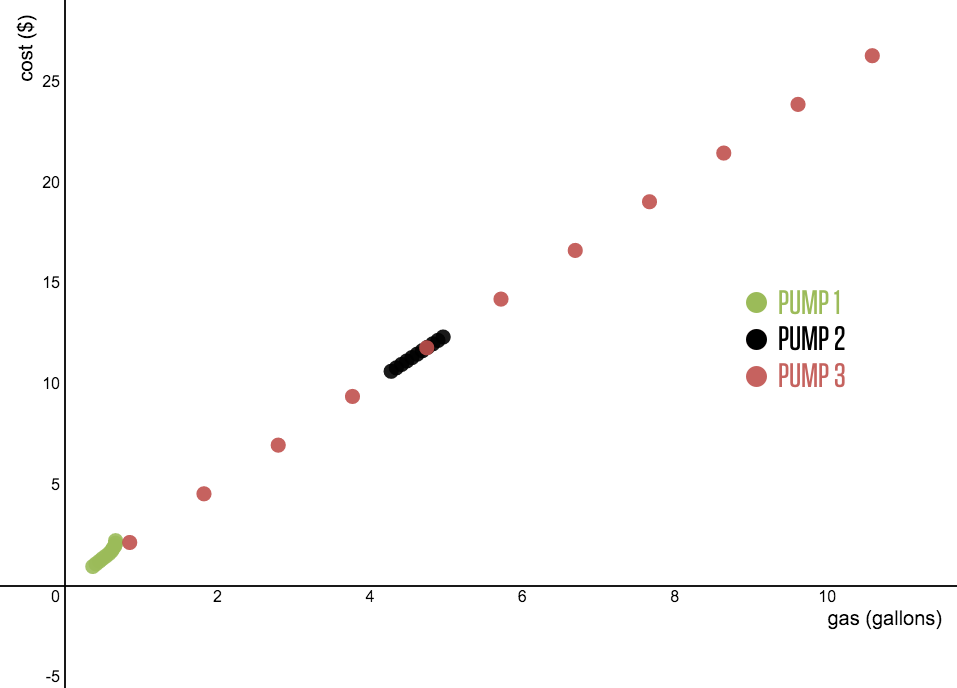
After your students have that debate and share their reasons (expected: “the third is a ripoff because it’s moving faster”) invite your students to collect data for each pump and enter it at Desmos. Here we’re establishing a need for a graphical representation. It may reveal patterns that our eyes can’t detect.
160321_2lo

The third act helps clarify the underlying trends. The third pump is spinning faster, but the price and the gas still exist in a proportional relationship. The first pump, meanwhile, pumps less gas per dollar the longer it runs.

I am indebted to William G. McGowan and Sean Berg, whose NCTM 2016 session description included the words “gas pumps have been hacked,” and there went my weekend.

Their description reminded me how important it is to expose students to counter-examples of the relationships they’re studying, protecting against over-generalization. (ie. “Everything is proportional. That’s the chapter we’re in!”) I’m becoming fascinated, in general, by problems that ask students to prove that a mathematical model is broken rather than just apply a model that works.

[Download the goods.]

Featured Comment

Scott Farrar:

I’ve written before about expanding teaching to the “neighborhood” of the special case. If we always show the highlight reel, students never get appreciation for how special and how powerful the ideas are. So I like that this lesson is about finding the non-proportional “ripoff” as it stands out in contrast to the “normal/expected” proportional relationships. (Ironically I would have said that proportionality is the special case, and nonproportionality is the ‘normal’— before thinking about what we expect as consumers. ‘normal’ is all subjective!)


Silicon Valley v. The Liberal Arts

Freddie deBoer’s latest post is your weekend must-read:

Yet on the level of thinking of our Silicon Valley overlords, aspects of my cognitive abilities that are absolutely central to my educational success are taken to have literally no value at all. In educational research, perhaps the greatest danger lies in thinking “that which I cannot measure is not real.” The disruption fetishists have amplified this danger, now evincing the attitude “teaching that cannot be said to lead to the immediate acquisition of rote, mechanical skills has no value.” But absolutely every aspect of my educational journey – as a student, as a teacher, and as a researcher – demonstrates the folly of this approach to learning.

I’ve said it many times, though people never seem to think I’m serious: years studying literary analysis, now widely assumed to be a pointless and wasteful activity, have helped me immensely in acquiring the quantitative, monetizable skills that ed reformers say they want.

I applied to film school out of high school and spent a large fraction of my university math education reading screenplays and writing about movies. The coffin eventually closed on those aspirations, but my interest in narrative and storytelling has permeated every aspect of my teaching, research, and current work in education technology.

Freddie deBoer’s argument, both as I read it and experience it, isn’t that a liberal arts education makes a productive life in STEM whole. It’s that a liberal arts education makes a productive life in STEM possible.

Featured Tweet

Ignore The Adjectives. Watch The Verbs.

Last spring, Mathematics Teacher published my paper on mathematical modeling. In this month’s issue, they’ve published a response from Albert Goetz [$].

Goetz worries that our collective interest in mathematical modeling risks granting the premise of the question, “When will we use this?” Math doesn’t have to be useful, argues Goetz. It’s beautiful on its own terms.

An emphasis on modeling–seeing mathematics as a tool to help us understand the real world–needs to be tempered by an approach that gives some prominence to the beauty that abounds in our subject. I want my students to understand how mathematics can explain the world–there is beauty in that notion itself–but also to see the inherent beauty and magic that is mathematics.

Agreed. But I no longer find adjectives helpful in planning classroom experiences, whether the adjective is “beautiful” or “useful,” “real” or “fake,” each of which is only in the eye of the beholder. Instead I focus on the verbs.

Mathematical modeling comprises a huge set of verbs that range from the very informal (noticing, questioning, estimating, comparing, describing the solution space, thinking about useful information, etc.) to the very formal (recalling, calculating, solving, validating, generalizing, etc.). One of the most productive realizations I’ve ever had in this job is that all of those verbs are always available to us, whether we’re in the real world or the math world.

Existence Proofs

“Math world” is the only adjective you could use to describe these experiences. When students find them interesting it’s because the verbs are varied and run the entire field from informal to formal.

Trick your brain into ignoring adjectives like “real-world” and “math-world.” Those adjectives may not be completely meaningless, but they’re close, and they mean so much less than the mental work your students do in those worlds. Focus on those verbs instead.

Related Reading

Real Work v. Real World

Featured Comment

Howard Phillips:

We shouldn’t overlook the usefulness of using this part of math to model that part of math. I see calculus as a way of describing and analyzing curves, including their curvature. I see analytical geometry as a way of representing “pure” geometry. I even see algebra as a way of modeling numerical patterns. Modeling is not just about the real world.

[3ACTS] Nissan Girl Scout Cookies

Treatment #1

A small rectangular prism measures 7 inches x 2.3 inches x 4.6 inches. How many times could it fit in a larger rectangular prism with a volume of 39.3 cubic feet?

Treatment #2

Nissan is going to stuff the trunk of a Nissan Rogue full of boxes of Girl Scout cookies. Nissan lists the Rogue’s trunk space as 39.3 cubic feet. A box of cookies measures 7 inches x 2.3 inches x 4.6 inches. How many boxes will they fit in the trunk?

Treatment #3

Show this video.

  1. Ask for questions.
  2. Ask for wrong answers.
  3. Ask for estimates.
  4. Ask for important information.
  5. Ask for estimates of the capacity of the trunk and the dimensions of the box of cookies.
  6. Show the answer.
  7. Ask for reasons why our mathematical answer differs from the actual answer.

Hypothesis

Treatment #1 and Treatment #2 are as different from each other as Treatment #2 is from Treatment #3.

A layperson might claim that Treatment #2 has made Treatment #1 real world and relevant to student interests. But the real prize is Treatment #3, which doesn’t just add the world, but changes the work students do in that world, emphasizing formal and informal mathematisation.

“Real world” guarantees us very little if the work isn’t real also.

Design Notes

You can check out the original Act One and Act Three from Nissan.

I deleted this screen from Act One because I wanted students to think about the information that might be useful and to estimate that information. I can always add this information, but I can’t subtract it.

160301_2

I added a ticker to the end of the video because that’s my house style.

160301_1

I deleted a bunch of marketing copy because it was kind of corny and because it broke the flow of their awesome stop motion video.

I left the fine-print advisory that you should “never block your view while driving” because the youth are impressionable.

The Goods

Download the goods.

[via whoever runs the Bismarck Schools’ Twitter account]

When Delayed Feedback Is Superior To Immediate Feedback

Craig Roberts, writing in EdSurge:

Beginning in the 1960s psychologists began to find that delaying feedback could improve learning. An early lab experiment involved 3rd graders performing a task we can all remember doing: memorizing state capitols. The students were shown a state, and two possible capitols. One group was given feedback immediately after answering; the other group after a 10 second delay. When all students were tested a week later, those who received delayed feedback had the highest scores.

Will Thalheimer has a useful review of the literature, beginning on page 14. One might object that whether immediate or delayed feedback is more effective turns on the goals of the study and the design of the experiment.

To which I’d respond, yes, exactly!

Feedback is complicated, but to hear 99% of edtech companies talk, it’s simple. To them, the virtues of immediate feedback are received wisdom. The more immediate the better! Make the feedback immediater!

Dan’s Corollary to Begle’s Second Law applies. If someone says it’s simple, they’re selling you something.