At a workshop in Alameda County last month, I made my standard request for classroom teachers to help me make good on my New Year’s resolution. I assumed all the teachers there taught middle- or high-school so I said yes to every teacher who invited me. Later, I’d find out that one of them taught fourth grade.
As a former high school math teacher, this was NIGHTMARE MATERIAL, Y’ALL.
I mean, what do fourth graders even look like? I’m tall, but do I need to worry about stepping on them? What do they know how to do? Do they speak in complete sentences at that age? Clearly, what I don’t know about little kids could fill libraries.
I survived class today. I used a Graham Fletcher 3-Act task because I’m familiar with that kind of curriculum and pedagogy. (Thanks for the concierge support, Graham.) A few observations about the experience, which, again, I survived:
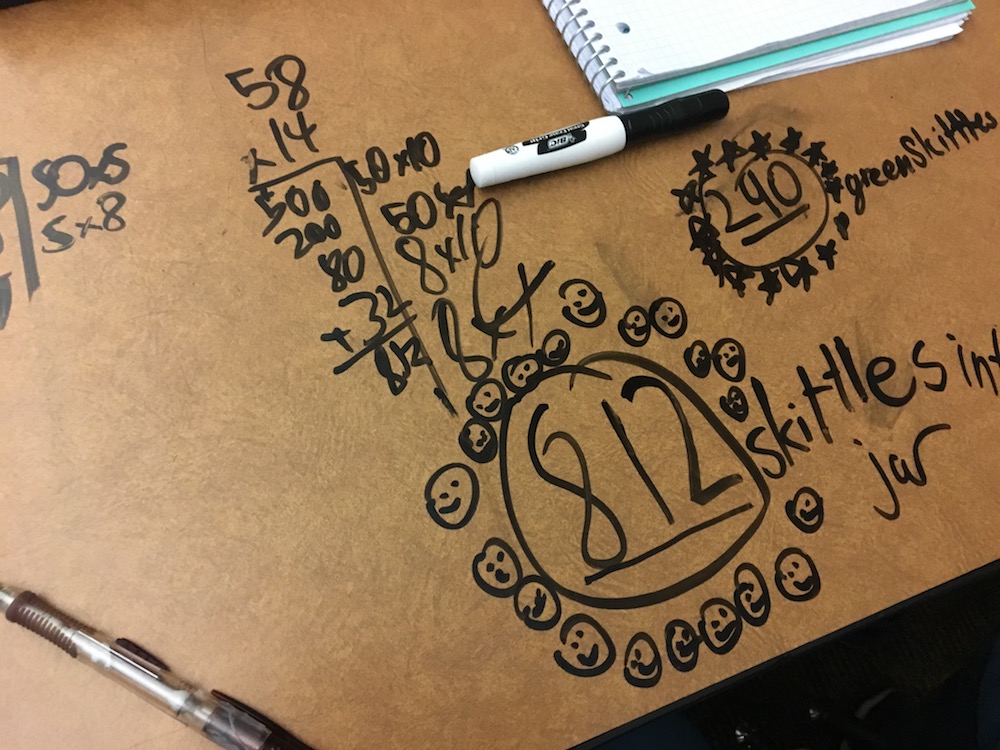
Children are teenagers are adults. Don’t let me make too much of my one hour of primary education experience, but I was struck hard by the similarities between all the different ages I’ve taught. People of all ages like puzzles. They respond well to the techniques of storytelling. Unless they’re wildly misplaced, they come to your class with some informal understanding of your lesson. They appreciate it when you try to surface that understanding, revoice it, challenge it, and help them formalize it. I handled a nine year-old’s ideas about a jar of Skittles in exactly the same way as I handled a forty-nine year-old’s ideas about teaching middle schoolers.
Primary teachers have their pedagogy tight. Ben Spencer (my host teacher) and Sarah Kingston (an elementary math coach) were nice enough to debrief the lesson with me afterwards.
I asked them if I had left money on the table, if I had missed any opportunities to challenge and chase student thinking. They brought up an interesting debate from the end of class, a real Piagetian question about whether a different jar would change the number of Skittles. (It wouldn’t. The number of packages was fixed.) I had asked students to imagine another jar, but my hosts thought the debate demanded some manipulatives so we could test our conjectures. Nice!
Also, Spencer told me that when he asks students to talk with each other, he asks them to share out their partners’ thinking and not their own. That gives them an incentive to tune into what their partners are saying, rather than just waiting for their own turn to talk. Nice! As a secondary teacher, I felt like a champ if I asked students to talk at all. Spencer and his primary colleagues are onto some next-level conversational techniques.
Primary students have more stamina than I anticipated. No doubt much of this credit is due to the norms Mr. Spencer has set up around his “Problem Solving Fridays.” But I’ve frequently heard rules of thumb like “children can concentrate on one task for two to five minutes per year old.” These kids worked on one problem for the better part of an hour.
The pedagogy interests me more than the math.
I think elementary math pedagogy is more interesting than secondary but I don't know if I can get excited about the math.
— Dan Meyer (@ddmeyer) March 19, 2015
This sentiment still holds for me after today. I just find algebra more interesting than two-digit multiplication. I’ll try to keep an open mind. Today was not an interesting day of math for me, though it was a very interesting day of learning how novices learn and talk about math.
I’m probably not wacky enough for this work. Mr. Spencer greeted his students by calling out “wopbabalubop!” to which they responded “balap bam boom!” Really fun, and I don’t think you can teach that kind of vibe.
Loads of algorithms, and none of them “standard.” Graham’s 3-Act modeling task asks students to multiply two-digit numbers. I saw an area model. I saw partial products. Students used those approaches flexibly and efficiently. They were able to locate each number in the world when asked. I didn’t see anyone carry a one. Everyone should settle down. This is great.
I expected the experience would either kill me or convince me I should have taught primary students. This one fell somewhere in the middle. I’m excited to return someday, and I was happy to witness the portability of big ideas about students, learning, and mathematics from adult education to high school to elementary school.
Featured Comment
I remember my first venture in elementary school after teaching ninth grade algebra and eighth grade math for four years. I was curious about younger students and my friend invited me into her third grade class. I can’t remember anything about the lesson I taught, but what I do remember is that I made a student cry. He had done something that I thought was inappropriate behavior and I must have responded pretty harshly. Hey, I was used to teaching older tough kids and I had never thought about modulating my response. It wasn’t my finest hour and I was devastated. My friend helped me through the experience and I even went back. After then I learned other ways to talk with younger students and became more and more fascinated about how they formed their conceptions . . . and misconceptions . . . about mathematical ideas. I’m hooked.