Dan Meyer

Total 1628 Posts
I'm Dan and this is my blog. I'm a former high school math teacher and current head of teaching at Desmos. He / him. More here.

The Blue Students

These are my people, my students this year. They’re averaging just a bit above a 1.5 GPA.
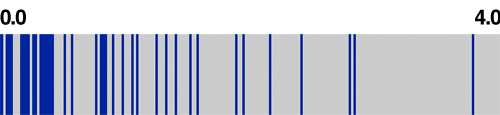
I tried to graft a structure onto this post but nothing stuck. Topical bullet points from the failed drafts:

  1. a description of what happens to the blue students next, of their regrettable slides further leftward and their occasional, triumphant slides rightward.
  2. tortured musings about correlation and causation. (ie. “if I take some credit for their progress, must I then accept some blame for dot dot dot et cetera.”)
  3. a description of effective motivators for my blue students, none of which include teacher approval, parent approval, disciplinary consequences, or perfect attendance badges at the end-of-year assembly.
  4. the economies of scale I can’t seem to access as a part-time teacher, two of which, however tacky the terms may seem in this context, are “word of mouth” and (even tackier) “branding.”
  5. really, how irresponsible and inaccurate it is to compare one class to the next and yet, wow, that was some group last year, the first and last group for whom I’ll ever take a summer school bullet.

The only draft that mattered was this:

The blue students indulge none of my laziness. They tolerate none of my bad habits. There are all kinds of students at this school โ€“ gray students, we’ll call them โ€“ who will let me slide on all kinds of carelessness so long as I keep them moving toward graduation, college, and career.

But graduation, college, and career are all abstractions wrapped in scare quotes to my blue students. So they pummel my flabby pedagogy daily to the point that I’m burger. Lean burger. You can’t believe the gratitude I have for such a challenging year.
Good Morning America

I was on Good Morning America yesterday, one third of a segment called “The Art of Beating Long Lines.”

Click through to view embedded content.

Clever Hans

Ben Blum-Smith:

Take-home lesson: never underestimate your ability to fool yourself into believing your students understand something when really what they are doing is watching you. To force them to engage the material it is often necessary to restrict their access to you or systematically confound the signals they get from you.

I think this is a central issue for modern math teachers. We need to explicitly develop ways of question-posing and interacting with our classes and individual students that hide or disguise our intentions for how they are supposed to respond. This needs to be part of the core training of math teachers, much more than it already is.

A late link to some really great writing. Forward, retweet, reblog, subscribe, etc.

No-Drop Zones

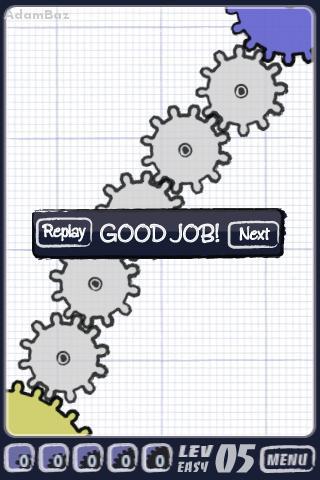
From the #iPhone-game-as-metaphor-for-curriculum-design hashtag, we have Geared, which I purchased because I’m almost completely obsessed with little spinny things, a purchase which I almost immediately regretted.

Two reasons:

  1. The early levels are ridiculously easy. Not a serious problem in and of itself. The same is true of Flight Plan, which you’ll recall I rather liked.
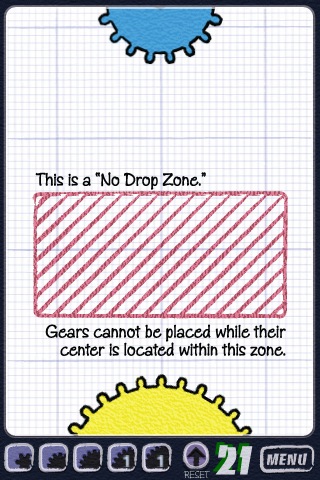
  2. But game play gets harder only over a series of completely nonsensical contrivances. You’re dropping gears into a system, blitzing your way through easy. Then on level 21, as the game flips to medium, you’re confronted with “no-drop zones.” That’s really it. Everything else is the same. You’re arbitrarily excluded from routes you know would otherwise work for reasons that have nothing to do with the function of gears.

There’s no good reason to criticize an iPhone game from this forum except for the robust metaphor it offers for conceptual growth in math. Few textbooks get this right โ€“ and I include here the ones that do a pretty good job of being less helpful:

whenever possible, introduce new skills and new knowledge as the solution to the limitations of old skills and old knowledge.

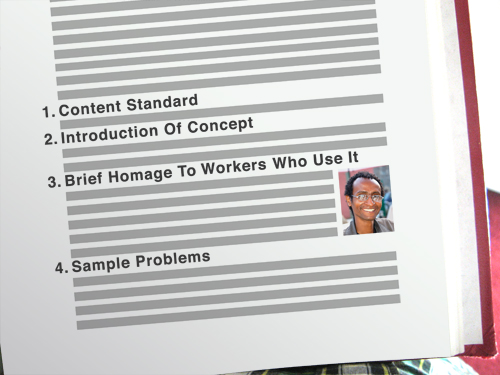
Typical:

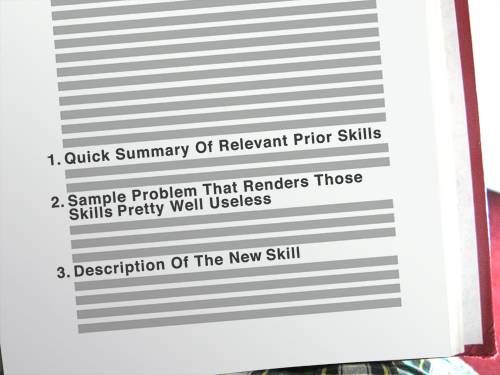
Better:

Please argue with me here but I don’t think my freshmen really care if career professionals use math in their jobs. This “career” concept is supremely abstract to most and therefore mostly useless to me as a motivator. I’ve found a much stronger motivator in a palpable sense of forward momentum, in a coherent skill set, in real, uncontrived challenges.

I’m teaching remedial Algebra for a fourth year now and the change I make to my curriculum far more than any other is to add this connective tissue.

You’re comfortable with a dot plot? Fine. Let’s put you in a place where a dot plot is tough to execute โ€“ say, a large data set with no mode and a huge range. That’s annoying. Then bring in the box-and-whiskers, the histogram, or whatever. I try not to introduce the next concept simply because it’s the next chapter in the book or the next bullet point on a list of standards or because it’s “what we’re learning today.” In other words, I try to stay away from the no-drop zones.

Redesigned: Kyle Webb

Kyle Webb drops a WCYDWT video on circle area and perimeter:

Academic Green Circumference and Area Problem from Kyle Webb on Vimeo.

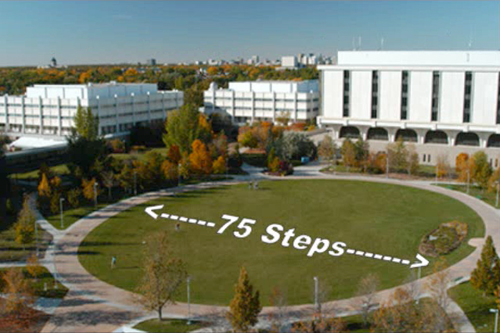
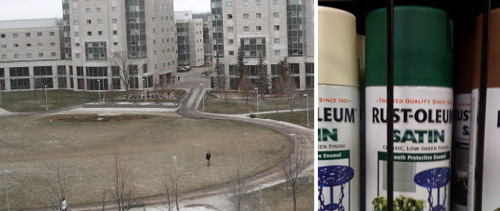
First, let’s pay respect to how fast the video moves, how it sets a scene and establishes a problem in just 14 slides and 57 seconds. Webb knows his audience and its attention span. Also, none of this is stock photography. Every photo selected is of high bandwidth and relates directly to the problem. After 12 seconds, we have three different views of the lawn. After 15 seconds, a panoramic shot. I’ll begin my redesign 23 seconds in, when he mentions the lawn is 75 steps across.

This is really, really close to my textbook’s own installation of the problem. The text would ask a question like “how far is it around?” or something with a real-world spin like “how large would the ice rink be?” (standing in for “what is the area?”) and then it would explicitly define the only variable we need: 75 steps. My students would identify the formula and then solve.

This kind of instructional design puts students in a strong position to resolve problems the textbook draws from the real world but in no position to draw up those problems for themselves. This kind of instructional design also yields predictably lopsided conversation between a teacher and his students.

The fix is simple but difficult: be less helpful.

Let’s start here: is circle area just something math teachers talk about to amuse themselves or do other people care? If they care, why do they care? How do we convey that care to our students? Maybe someone needs to fertilize the lawn. Maybe someone wants to spray paint the dead lawn green in the winter. Without this component, the answer to the question “how far is it around?” is little more than mathematical trivia to many students.

So put them in a position to make a choice, a tough choice that’s true to the context of the problem, a choice that math will eventually simplify.

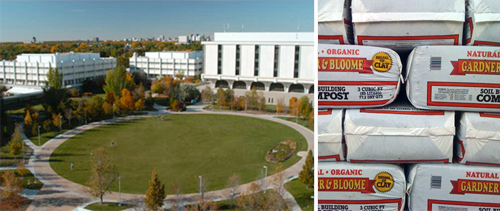
For instance: “how many bags of fertilizer should I buy to cover the entire lawn?”

Or, a little weirder: “how many cans of spray paint should I buy to cover the entire lawn?”

In both cases, we’re putting every student on, more or less, a level playing field. They are guessing at discrete numbers (ie. “fifty bags โ€“ no โ€“ sixty bags.”) and drawing on their intuition, which, from my experience, is a stronger base coat of for mathematical reasoning than the usual lacquer of calculations, figures, and formula.

This approach also forces students to reconcile the fact that the problem is impossible to solve as written. This is an essential moment. They need more information, but what? What defines a circle? Would it be easier to walk across the lawn’s diameter or around the lawn’s circumference? Which would be more accurate? Why is the radius difficult to measure? Did Kyle really walk through the center of the lawn or does he just think he did?

When you write “75 steps” on a photo, that conversation never happens.

My thanks to Kyle for jogging my thoughts here.