Dan Meyer

Total 1628 Posts
I'm Dan and this is my blog. I'm a former high school math teacher and current head of teaching at Desmos. He / him. More here.

Too Hot For USC

I was profiled for USC’s Master of Arts in Teaching program last month. The interview covered my (short) professional bio, advice for new teachers, along with a question asking me how awesome I thought my own master’s program was. I’m pretty sure they canned my interview off my qualified response to that last question but there were elements of the interview I liked (and haven’t ever discussed at this blog, like my lifelong struggle with Restless Leg Syndrome) so I am posting it here.

USC: What and where do you teach?

DM: I teach high school math โ€“ a mix of Algebra, Geometry, and remedial math. I teach math to a lot of students who don’t enjoy math.

USC: How long have you been teaching?

DM: I just finished my fifth year. The fifth year is much more fun than the first. There isn’t any comparison, really.

USC: What inspired you to teach?

DM: I never wanted to teach. Now I’m a third-generation fourth-generation teacher. [Mom informs me my great-grandfather taught in a one-room schoolhouse. –dm] Both from a spirit of childhood rebellion and because I saw my dad work incredibly hard to support my family on a single teaching income, this job was never my ambition. I wanted to make movies but I was exceptionally untalented at filmmaking, a fact which various film school admissions boards also confirmed. In my final year of a mathematics degree, I interned in a pre-calculus classroom where I found myself exceptionally empathetic to the struggle of the learner and moderately gifted to resolve that struggle. Therefore, teaching. Because I wasn’t terrible. Put that on a mug. Of course, I moaned for three years that my passions and abilities hadn’t aligned. After my second year I made another unsuccessful leap at filmmaking. After my third year, my passions and my abilities aligned a little more, and it was hard, after my fourth year, to imagine doing anything but teach.

USC: What classroom methods are most helpful in pushing students towards their goals?

DM: I started using a digital projector in my third year teaching. In terms of methodology, nothing before or since has affected student achievement more. Runners up, however:

  1. I assign one homework problem per night. The longer I have taught, the less time I waste on discipline, which has made it easier to get enough done in class to let us take the evening off.
  2. I measure student achievement on a series of skill rankings, which are fluid and updated weekly. This has struck me as more accurate than a series of comprehensive unit exams.

But that’s methodology. And functional methodology in a toxic classroom culture is a bullet train to nowhere. I have made a lot of intentional steps, then, to promote “curiosity” as a cultural value of my classes.

USC: What is the one thing you wish you’d known when you started in the classroom? (i.e. advice for new teachers).

DM: Your students will excavate with profound determination and speed every social anxiety you thought you buried. It will take them minutes to decide that you are insecure about your appearance. Do not wonder if they notice your post-adolescent pimple. They do. They will exploit these anxieties as often as you allow them to. Determine quickly what matters to you and rid your psyche of the rest. Interest yourself in your students as often and as genuinely as possible. Love this job. Love your students. I’m not kidding about that last one even though I’m positive my 21-year-old self would have scoffed at that kind of attachment. Take it from me, please: you do not want to be the teacher I was when I was 21.

USC: If you have a masters in education, what did your training teach you that was most helpful in preparing you to enjoy and thrive in a classroom today?

DM: I hold the teacher preparation program at UC Davis in high regard. My coordinator, Allan Bellman, selected a cohort of chatty, introspective educators who responded to their profound, daily incompetence by talking and talking and talking. And when we stopped talking, Bellman asked good questions that got us talking again.

The same school awarded me a master’s degree, for which I now receive a modest yearly stipend from my school district. In terms of “enjoying and thriving in a classroom today” or even in terms of “students learning more from their teacher” that money is not well spent. I enjoyed the program. It taught me to think about my practice in more academic terms. But I thrived in my job and enjoyed it not even a little bit more after I finished the program. Find a good community of good teachers. Find them online if you must. Read blogs. Write a blog. Tweet, as a last resort.

Notes From Foo

Also: Why WCYDWT?

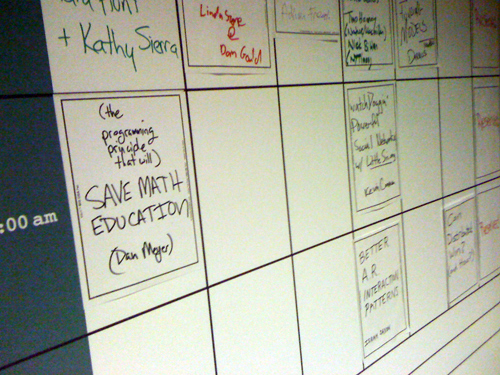
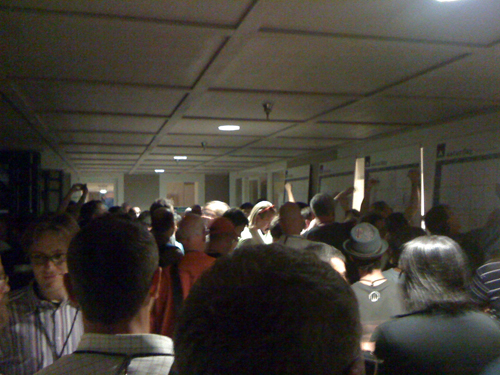
On the first night of Foo Camp, 250 attendees introduced themselves by name, affiliation, and three hashtags, and then descended on a gridded wall-tall conference schedule, scribbling down session titles, selecting venues, folding similar sessions into one another, scheduling roundtable discussions with people they had only met thirty minutes earlier over food.

The crowd was thick so I commandeered a Segway and steered it full-bore into the scrum, scattering people long enough to slide a session onto the closing day’s schedule: The Programming Principle That Will Save Math Education.

That’s three opportunities in three months (counting the webinar I’m conducting in October) that my patrons at O’Reilly have given me to throw a half-baked idea casserole at a bunch of really, really smart people and walk away with something quite a bit tastier.

The debate at an earlier session on the future of education was idealistic and high-minded with participants from all sectors trying to reach consensus (in sixty minutes) on merit pay, standardized testing, class size, unschooling, home schooling, charter schooling, public schooling, and probably several other intractable issues I’m now forgetting. I tried to approach my session, then, from two more assailable angles:

  1. math curriculum, which, for whatever it does right, doesn’t a) put students in any kind of place to apply mathematical reasoning to the world around them, or b) do anything to encourage patience with problems with complicated inputs and messy outputs, which is to say, most problems worth solving. Math curriculum, speaking generally, does the opposite of those two things.
  2. after we develop a model for good math curriculum, we don’t know how to share it.

The outcomes of merit pay and standardized testing will be decided in protracted, gruesome battles between various unions, legislators, and chancellors. The challenge of sharing good math curriculum, however, is one that the people attending my session โ€“ an intimidating array of talent, knowledge, and funding โ€“ could solve over lunch.

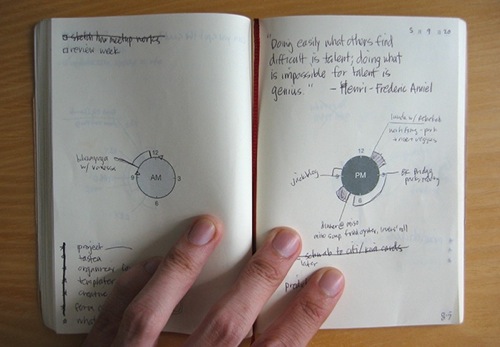
O’Reilly gave a blank notebook to the weekend’s participants. Not lined. Not quad-ruled. Blank. We talked about how you’d only give out lined or quad-ruled paper if you were sure the average attendee wouldn’t want to doodle.

I showed the participants how the Muji chronotebook shuns calendars and hour-blocks, opting instead for the least constrained approach to scheduling possible, a small clock in the middle of the page. This is the rule of least power, the programming principle that can save math education.

I won’t waste space here recapping my session notes. I drew heavily from these six posts:

  1. The Rule of Least Power: An Initial Approach
  2. Why I Don’t Use Your Textbook
  3. WCYDWT: Glassware
  4. WCYDWT: 2008 World Series of Poker
  5. Flight Control / Lesson Plan
  6. BetterLesson Reviewed

But I realized this: I flog WCYDWT media from whatever forum I’m offered not because I think WCYDWT media is the evolutionary pinnacle of math instruction. I do think WCYDWT is leagues better than the curricular norm, particularly compared to the kind of curriculum offered by the largest textbook publishers. More crucially, though, WCYDWT is the best model I know for classroom math instruction that can also leverage Internet distribution. I can use global publishing tools to infect other math teachers with these videos and photos. I can’t do the same thing with netbooks. I can’t do the same thing with physical manipulatives. I don’t know a better model of math instruction that I can also aerosolize so easily.

[Muji notebook photo credit]

The More Things Change

Journalism is probably the slowest-moving, most tradition-bound profession in America. It refuses to budge until it is shoved into the future by some irresistible external force.

[…]

“Those guys on the plane,” said [Brit] Hume, “claim that they’re trying to be objective. They shouldn’t try to be objective, they should try to be honest. And they’re not being honest. Their so-called objectivity is just a guise for superficiality. They report what one candidate said, then they go and report what the other candidate said with equal credibility. They never get around to finding out if the guy is telling the truth. They just pass the speeches along without trying to confirm the substance of what the candidates are saying. What they pass off as objectivity is just a mindless kind of neutrality.”

Timothy Crouse, Boys on the Bus, 1972, which, if your pocket calculator is out of reach, is almost four decades ago.

A Second Note On Modern Photography

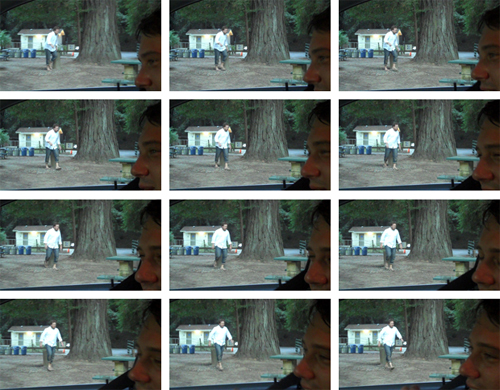
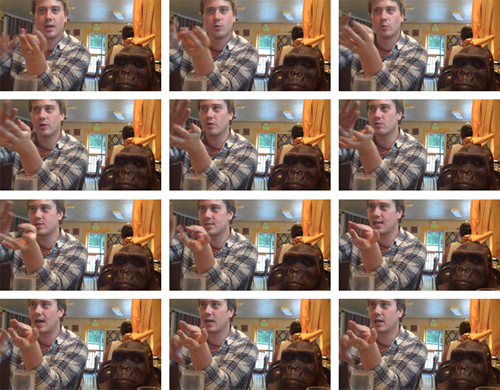
I use my point-and-shoot less and less for still photography and my FlipCam more and more. I realize that with the Flip I’m losing hundreds of thousands of pixels and a much better sensor but I’m also picking up a) portability and, most crucially here, b) a couple dozen more frames per second. Technological advances will eventually close the gap in quality but technological advances are useless to close the gap between the photographer I am and the photographer I want to be.

Check this out. Give a photography student less than a second of video. Twelve frames, maybe.

At what point is the composition balanced?

At what point does the gorilla become the subject?

I have found this kind of deconstruction to be a) essential to my growth as a photographer and b) impossible to achieve using a point-and-shoot camera (or any camera) with a shutter refresh rate of more than a second. That kind of lag has you comparing apples to oranges.