Dan Meyer

Total 1628 Posts
I'm Dan and this is my blog. I'm a former high school math teacher and current head of teaching at Desmos. He / him. More here.

In Defense Of Digital Media

Jason Dyer, responding to my NLOS cannon post:

Since I’ve done this over the summer with real life bottle rockets, a launcher that could be set at any angle, and a vertical target, I’m not finding the computerized version nearly as interesting. I’ve also run a simpler version of this in my classroom with wads of paper. Why must everything be digital? [emph. added]

Hopefully I’ve made clear by now my preference for pedagogy over technology. If digital media makes for inferior learning, then, by all means, let’s stuff it in a burlap sack and toss it in the river. My preference is also for the real thing over a digital simulation of the real thing. That said, there are three circumstances where digital media is preferable to the real thing:

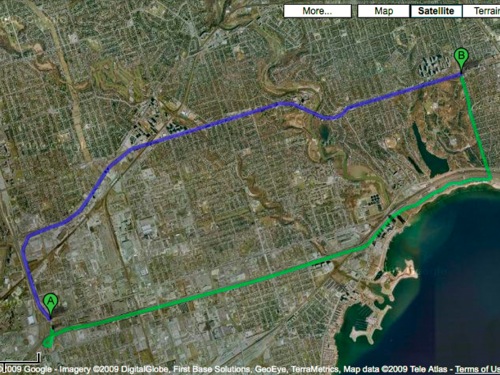
  1. The real thing is too expensive. I’d rather let every kid hold a photo of a measuring cup than spend $100 for a class set of measuring cups. It’s too expensive to take a class trip to the Yucatan Peninsula so perhaps we can forgive ourselves for showing photos of the Mayan pyramids instead. I’d much rather copy and paste Google’s satellite imagery into a Keynote presentation than charter a plane to take my kids up in groups.
  2. The real thing is too mathematically noisy for classroom use. Jason prefers a real demonstration of projectile motion using bottle rockets to my use of online simulators but that introduces acceleration and wind resistance– mathematical noise – into the system. Let’s not romanticize the real or the digital. They are both deficient. They both require a cost-benefit analysis.
  3. The real thing can’t be iterated precisely enough. I wanted to show my students several misses with “Will it hit the can?” – long, short, and to the side – and at least one success. If my students were live with me, on the scene, they would see many, many, many misses, most of which would be mathematically unhelpful. My students can also measure and manipulate digital media (by modeling a parabola in Geogebra, tracking motion in Logger or Tracker, etc.), something they can’t do with live events.

My Lesson Plan: The Door Lock

Michael Caratenuto:

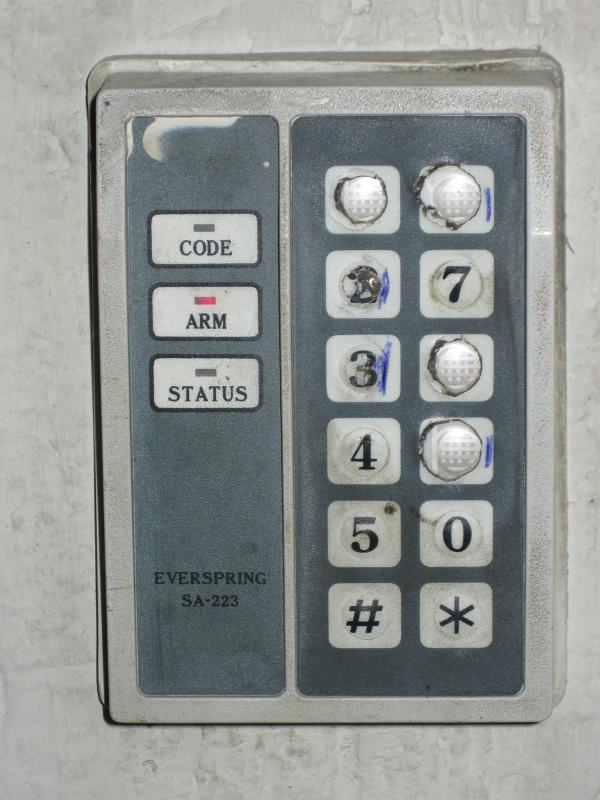
Personally, I think that this particular image lacks opportunities for inquiry. Perhaps if it was presented with other kinds of door locks leading students to come up with and answer the question, “which is the most secure lock?” [emph. added]

This is exactly right. The latest WCYDWT? installment has provoked the usual litany of Really Interesting Bite-Sized Questions, the sort of prompts that will play great in the Applications & Extensions & Assorted Mindblowers section of your lesson plan but which, on their own, aren’t a lesson plan. Those questions don’t provoke the kind of iterated, increasingly difficult practice that students need for skill development.

Again, this image on its own is insufficient. With some creative modifications, however, it will carry you through permutations. Here is that lesson plan in its broadest strokes.

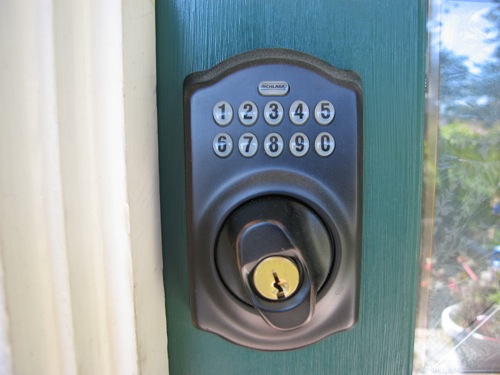
Start with the image.

Tell them the code is 1 digit long. Tell them the code is 2 digits long. Tell them it’s as long you want it to be. I respected the rule of least power here, which meant that when I took this photo I tried to stay out of the way of your lesson planning. Have them write down all the possible codes for n=1, n=2, n=3, etc. The increasing obnoxiousness of the task will motivate a formula for the general case. That’s arrangements.

Tell them the lock is a 4-digit lock. Now turn on the blue light.

Ask them to list the possible codes. You can iterate this a bunch of times until they have discovered on their own this tool that mathematicians call a factorial.

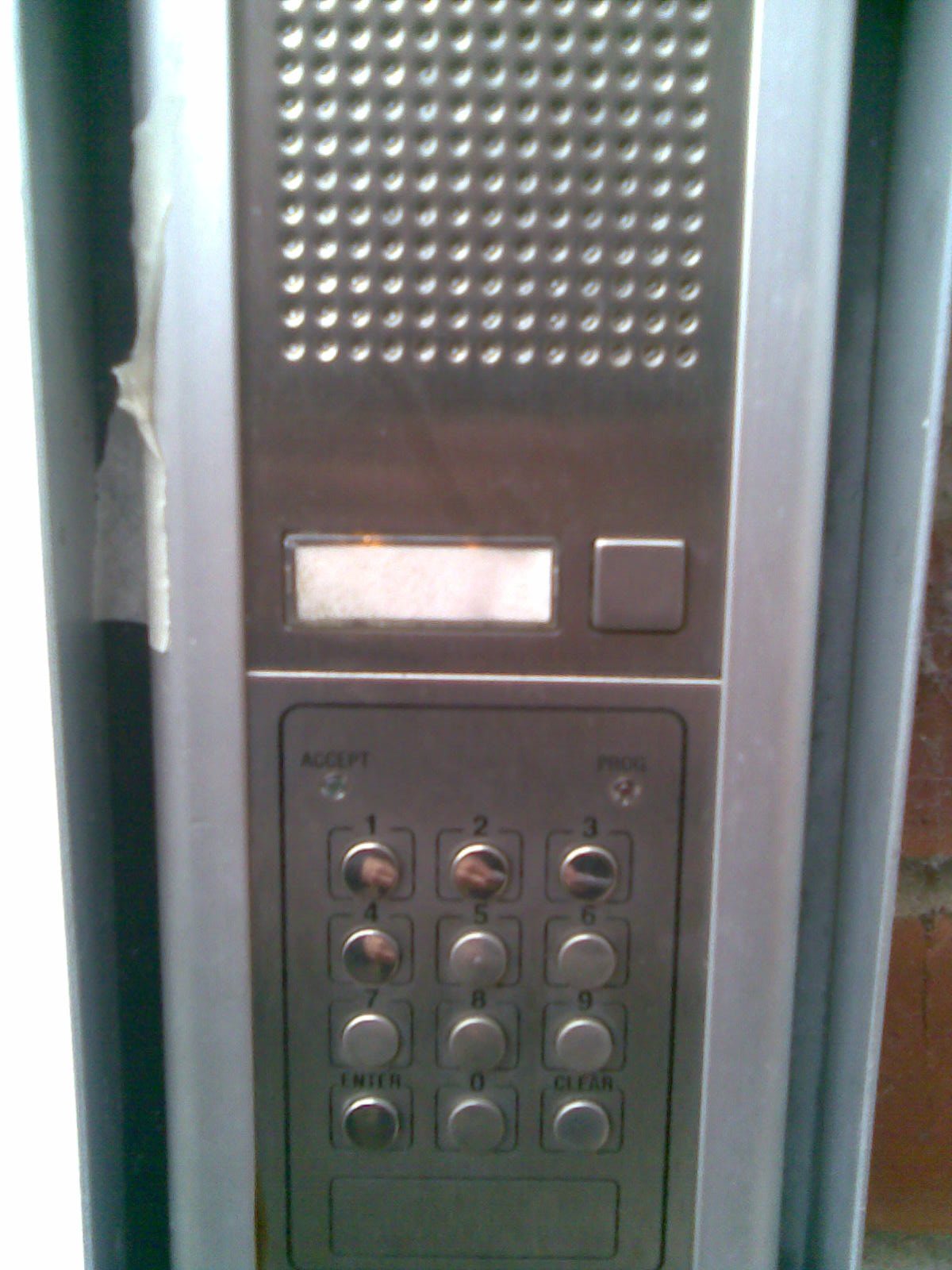
Remind them it’s a 4-digit lock. Then put up this image. It will be confusing, but only for a second. Ask them to list every possible code.

Iterate this with two and three buttons until they have generalized permutations. Then maybe you iterate the entire thing with another keypad lock.

Then maybe you dip into the comments of the original WCYDWT? post and help yourself to some very-interesting follow-up questions. I recommend Alex’s.

Let me close by saying how shocked I am at how little all of this costs.

[Update: Bruce Schneier has a good follow-up on information leakage. Two photos.]

[Update II: due to the peculiarities of many car door locks punching in “123456” tests both “12345” and “23456.” Consequently, there is a number string 3129 digits long that will test every five-number comination.]

[Update III: more information leakage.]

[Update IV: more information leakage.]

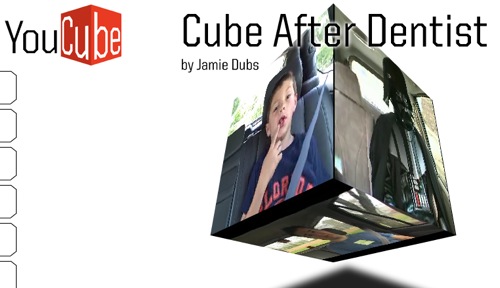
YouCube: The Latest In Cube-Based Storytelling Technology

I’m mixed. On the one hand, YouCube is a pretty interesting way to compare remixes of a thing (ie. David After Dentist) to the thing itself.

On the other hand, this strikes me as just another one of those tool that depends entirely on a teacher’s pre-existing digital storytelling skills but which also distracts her from developing those skills. (ie. Why learn how to make one video really well when you can put six average videos on a cube!)

What Can You Do With This: The Door Lock

Download high quality here. Here’s the pilot but I need to modify the prompt somewhat. Every math teacher reading this likely sees the mathematical potential in this image. Most could come up with a question right now like, “If this is a four-number combination lock, then how many combinations will you have to try to break in?”

Lately in these threads I get lists of those questions, which is great, but questions don’t constitute a lesson plan. So consider this the new prompt: what is the lesson plan? what will the students do? what is the best plan to provoke sustained, rigorous inquiry?

Let’s push this forward.

BTW: My lesson plan.

Yes We Can, Etc.

Kate Kowak is to math blogging what Barack Obama was to stump speeches:

My hope is that what we are witnessing here [with What Can You Do With This?] is a paradigm shift. At the intersection of problem-based lessons, digital projectors, blogging, and frustration with poor-quality textbooks, is blossoming a new way of bringing mathematical understanding to our kids. We don’t need to buy anything new, or anyone’s permission…just the structure, and the willingness to be observant and curious, and the humbleness to imagine that there might be a better way. I think this is just the beginning. I think this is going to spread like a fire.