I have reams of notes at this point, compiled over a month, scattered across two legal pads, all of them attacking the same issue from a dozen different sides: what kind of textbook would a veteran teacher use?
My First Baldly Unsubstantiated Assertion
Veteran teachers lean on textbooks far less than new teachers do, choosing to build their curricula, instead, from a patchwork of problems and applications and sequences they’ve determined through years of trial and error. Like other teachers in the first thread, I use textbooks for longer practice sets, but little else.
The question hassles me, then, what kind of textbook or supplement would veteran teachers use? This seems like a potentially interesting, potentially profitable, discussion.
My Second Baldly Unsubstantiated Assertion
New teachers teach procedure better than concept. Procedure is important – you’ll never hear me suggest otherwise – but procedural knowledge is a lot easier to teach than conceptual knowledge, which demands of the teacher both a broad and narrow understanding of (eg.) Algebra, an understanding which can clearly explain (eg.) why the constraints of single-variable equations eventually demand two-variable equations which then demand upgraded solution procedures, etc.
I’m not very good at this, I admit, especially in the upcoming second semester of Algebra, but I know that teaching procedure, scaffolding those skills, and differentiating their assessments, doesn’t interest me like it used to. (And it used to interest me a lot.)
I’m very interested in better conceptual teaching and, especially, in teaching conceptual curiosity.
My Third Baldly Unsubstantiated Assertion
My students’ curiosity will make them better and smarter and more capable people in the long run. I suspect this, unburdened by anything sturdier than anecdote, but I know it can’t hurt and I know that I am rarely happier as a teacher than when my students and I discuss a scenario through a mathematical framework that they wouldn’t ordinarily have given a second thought. (The Golden Gate Bridge raised its toll from $5 to $6 in September, for example. What can’t you do with that?)
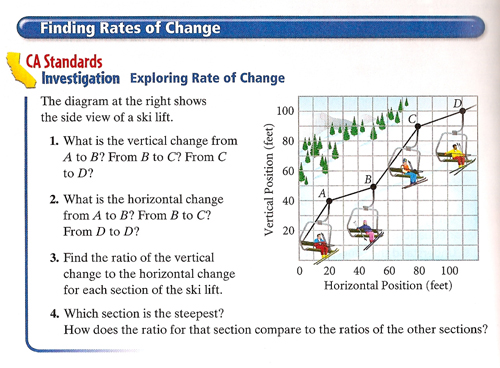
The fact is that dead-tree textbooks are at a disadvantage here. Like I said before, I am generally uninspired by my textbook’s perfunctory stabs at real-world relevance but even when the textbook stumbles over an interesting image (a ski lift, for instance) the nature of paper means they must apply the entire mathematical framework – the labeled points, the grid, the scaled axes, and the questions – before the student has even given the image a first glance.
They get the process exactly backward. They teach kids to support a math problem with a visual framework rather than teaching them to support visuals – the sort of images they’ll see long after they close their last math textbook – with a mathematical framework.
I can teach procedural fluency pretty well on my own but I need help teaching conceptual curiosity. I want to teach my students to ask questions for themselves and my textbook is no help. I need something else.
The Digital Archive Of Very Interesting Mathematical Media
I can’t put an exact price point on this hypothetical curriculum, but I promise I would pay a lot for a digital archive of very interesting mathematical media, high-resolution images and videos to propel long, rich, curious mathematical discussions and activities.
I want a DVD archive of (or online access to) innocent-seeming photos and videos, beneath each of which lurks meaty, curious mathematics. The publisher must include multiple versions of each digital artifact, each one identical to the last except for an increasingly rigid mathematical framework. (ie. the first clip is an unaltered long shot of a batter hitting a homerun in an empty stadium; the last clip is identical except the publisher has added measurements, labels, axes, a white line tracing the parabola, etc.)
The publisher would supplement the DVD with a small book of concise questions, the sort of visceral hooks we pursue in our What Can You Do With This? series.
What Would You Pay For This?
What would you pay for, let’s say, forty of these high-res digital artifacts and the relevant hooks, artifacts which students could download to their laptops or netbooks and play with, scaling a golden ratio rectangle all over a high-res image of the Parthenon, for example.
I would consider it a bargain at $80, but, I admit, this is my post.
A Postscript On Profit
The profit margin here should entice any publisher. You aren’t printing hundreds of student textbooks. Your printing costs are limited to a small run of color booklets. And some screen-printed DVDs, I guess, but we’re talking about pennies. This wouldn’t be a traditional standards-based textbook, though, so you can’t expect mass adoption. You’ll make your money on margin, not on volume.
Seriously: a good DSLR camera, a good HD camcorder, and a handful of travel vouchers. That’s your overhead.
A Postscript On Bundles
The shameful side to this proposal is that publishers have already budgeted money for this kind of supplement – the same bundled CD-ROMs which have driven textbook prices skyward.
Having just finished a textbook adoption process, sampling bundled materials from several publishers, I can report that in the rare case that these materials aren’t useless, they’re entirely cumbersome, locked down by web-access codes, DRM, proprietary Flash interfaces and constrained to printable textbook pages and videos of talking heads explaining rote procedural skills.
I’m pretty sure this kind of project would suffocate under the weight of any of the big four publishers (though I’d somehow convince myself to cash their checks). It would be great to see a smaller imprint take this on. Takers?