
or: Finally Understanding The Appeal Of These Student Response Systems
Aaron Pallas (nee Skoolboy) has been skeptical of the impact of reduced class size on student achievement for some time. This never made sense to me until last week.
I’m observing other classes on my prep period. It started out once a week, reluctantly. Now I’m in a new class every prep – half hour at a time – and really enjoying the experience. My note-taking has evolved as I’ve noticed trends and I have customized an observation form. I take photos and record audio (on my iPhone, natch) and keep all the media in GoogleDocs.
After I observe every class at my school, I’ll inevitably work all of my field notes into some kind of comprehensive post-mortem (the results are too interesting to simply file in a drawer and forget) but I have to point something out right now.
Part of my observation involves a dot plot of teacher position over the first thirty minutes of class. With two exceptions (so far) they all look like this:
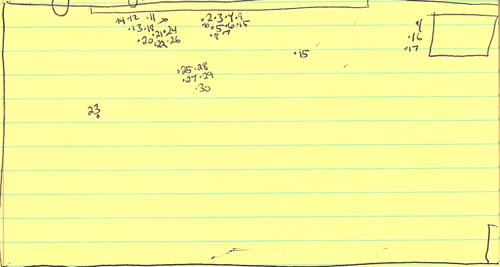
The sage on the stage is real, though she’s far more stage than sage. She’s tethered. She doesn’t leave the board. She doesn’t deviate from a tight route she’s defined between her teacher desk and the overhead projector.
She puts five problems up on an opener and models three separate skills in a lecture without once venturing out and examining student work. Not only does this construct an artificial wall between teacher and student but it makes checking for understanding very difficult.
What I’m saying is that reduced class size is useless if you’re still going to teach like you’re a lecturer in some intro course at some enormous public university.
And now enter student response systems, technology which enables this detachment, which tells teachers which students picked the right answer and which picked the wrong answer as formulated by the teacher but not which students picked the wrong answer as formulated by the student.
Get a wireless remote. Project a problem, something meaty with a lot of steps and maybe a couple of twists somewhere near the end, and then walk around – through the rows, not just around the periphery – noting common errors. Have a conversation with your students.
Because none of this intervention – I don’t think –Â makes any difference if you haven’t already asked your students, “How are you doing today?” But I dunno. Maybe just let them select the answer to that question with their student response systems.
BTW: Here’s my observation form.