a/k/a Because It Was There
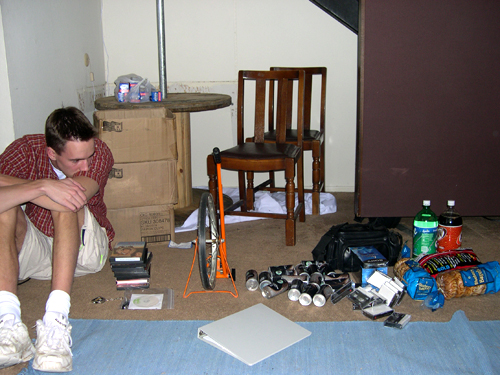
The Ingredients
[left to right]
-
me, twenty-two years old, anxious.
-
paperclips, 60,000, sponsored by OfficeDepot in exchange for (full disclosure!) t-shirt advertising.
-
a cable spool, begged off a Sacramento Municipal Utilities District back lot.
-
wax paper, lots, to keep layers of paperclips from tangling on the spool halfway through the task, because that is a very very disappointing thing.
-
a CD-R, burned with one essential Excel spreadsheet.
-
measuring wheel, ’cause no one cares about your paperclip chain unless you can measure it end-to-end.
-
a log book, signing me in and out of bathroom breaks.
-
Starbucks Double Shots™, nine, the most expensive component here, to push me through the 9PM to 6AM corridor.
-
Digital-8 cassettes, 24 hours worth, because Guinness requires nonstop video coverage.
- food
My Best Case
This is my best case for math education.
Not that, “hey kids! if you learn your fractions you, too, can accomplish something of very questionable value, like chaining paperclips together for 24 continuous hours.”
Rather, that math can uncomplicate the complicated, that an understanding of math leads to a richer understanding of the world.
For Example
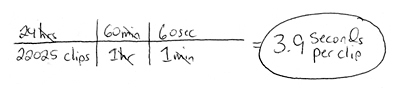
In 2000, Ms. Jeanine Van der Meiren of Belgium chained together 22,025 paperclips in 24 hours.
If you are innumerate, your best response here is “that’s a lotta paperclips.” Which is how most of my students responded to this prompt the last week of school. But if you are numerate at even a basic level, you have only one option here.
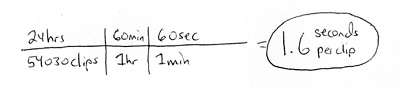
You have to answer the question: how fast is that?
The question is irresistible.
By Hand
Jeanine set the record with 3.9 seconds per clip!
Think about that.
Mime it.
Use your hands.
“Clip two three four … clip two three four …. ”
The numerate math student realizes that the record is really, really slow. If he is also a little socially disordered, his next steps are predetermined.
He has to break it.
In The Classroom
-
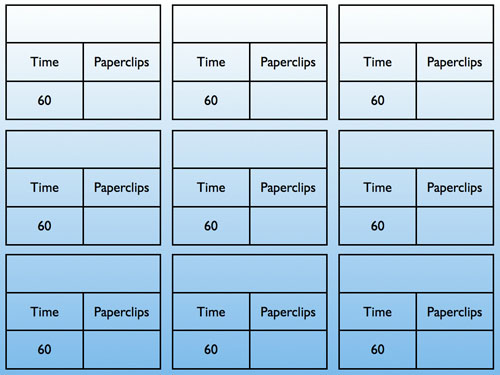
Groups of two or three.
-
Show them a few pictures and make sure they realize what a few gracious friends can do for you here.
- Count how many clips one person can chain in one minute.
- Ask: is that rate fast enough to bring Jeanine down? They will take one of three routes to get there (proportions, rates, unit conversion) but most groups will determine that yes, they could.
-
Discuss the assumption they’ve made, that they could maintain that monotony for 24 hours.
- Have another member take a turn for five minutes.
-
Play it dumb: “Oh man, Alyssa crushed Kyle by 47 paperclips right there!” Kyle will correct your error (indignantly) before you finish the sentence.
- Have them answer the question, then: who is faster and by how much?, pointing out that the answer isn’t, “Alyssa is faster by 47 paperclips.” because a paperclip isn’t a measure of speed.
California says you’re done with rates now. Nice.
Stretch This A Little Farther
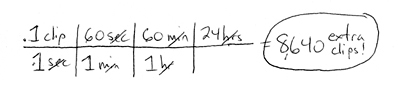
Suggest that Alyssa is faster than Kyle by .1 second per paperclip. She has trained just a little more and can chain ’em just a little faster. Ask if it matters.
It surprises no one that, yeah, any small gain positively explodes over 24 hoursThis is why I went through boxes of paperclips before the actual attempt, looking for the best way to chain two clips, looking for the best way to position the clips in front of me, looking to shave off any fraction of a second., but the exact increase is kind of shocking.
Now wrap your head around the relevance of rates to your life. If your boyfriend drags your self-esteem down by tiny increments daily, you’re going to stagger away from him after a year.
Get In / Get Out
It’s essential to know when to get out of a good story, joke, or learning moment. There was more to talk about but we didn’t, choosing instead to leave a few ends hanging.
One of those ends was a spreadsheet I cooked up for the occasion using formulas my students all know from our Feltron days.
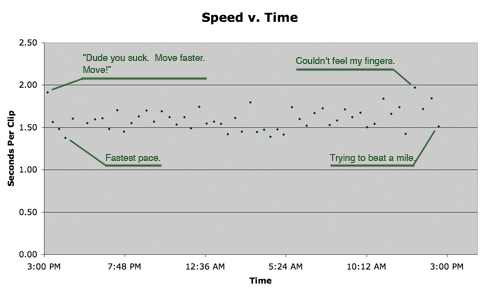
My former-housemate-now-commenter Steve would enter in a) my clip count and b) the current time, and my Excel sheet would tell me:
- my pace over the attempt so far,
- my pace over the last 1,000 paperclips,
- my expected total clips after 24 hours,
- my expected total chain length after 24 hours,
- the exact time, given my pace, I could expect to break Jeanine’s record.
See: I don’t know how you attempt this record without those last three. Without math, you’re just clipping in the dark, just sorta sure you’ll bring the record down before the clock expires, just sorta sure your pace isn’t steadily slackening.
What I’m saying is that basic numeracy makes everything a little less confusing and, at the same time, a whole lot more curious.
Which is why I teach.
For The Record