Dan Meyer

Total 1628 Posts
I'm Dan and this is my blog. I'm a former high school math teacher and current head of teaching at Desmos. He / him. More here.

How Do You Solve A Problem Like TMAO?

TMAO:

What gets me going is the pursuit of exponential student growth, and what keeps me coming back for more is the chance to hack away at the intensely complex pursuit of that growth. What stymies me, what blunts me, is the unraveling and solving of this particular puzzle. When the work becomes less about discovery and innovation and more about delivery and application, when the achievement becomes less shocked success and more the expected norm, when the cool thing you did to dramatically accelerate progress still accelerates progress but becomes less cool every time you do it, further and further removed from the spark-joy of innovation… I start checking for exits.

TMAO isn’t another canary in this coal mine of new teacher attrition. His kind needs an entirely different prescription. Ordinarily, I’d close comments and send you over to Room D2, but I’ve gotta ask the question here:

Where, in the vast sphere of education, do you deploy someone like TMAO, someone who is more satisfied by instructional innovation than by instructional implementation? How do you play to that teacher’s strengths? How do you keep him challenged?

‘Cause I can’t see it.

The Hyper-Observant Hack

John August’s advice to new, improving teachers screenwriters:

My advice for you is to dedicate one day a week to disassembling good movies. Take existing films (and one-hour dramas) and break them down to cards. Think of yourself as an ordinary mechanic given the task of reverse-engineering a spaceship. Figure out what the pieces do, and why they were put together in that way.

What was that thing you were saying about the intangible art of teaching?

Whatever I am as a teacher, I am a hyper-observant hack, stitching together the best I see around me, trimming back the brush. None of what you see here comes naturally.

To be fair to the teaching-as-calling crowd, August also writes:

If you were writing in for advice about how to be funnier or more charismatic, I would have probably let your email sit in the growing folder of unanswerable questions, because those are pretty much inherent qualities. [emph. added]

Which begs the question: what qualities of a teacher are inherent?

Show and Tell: The Rube Goldberg Edition

a/k/a Show and Tell: Week 34

Video

  1. Clustarack

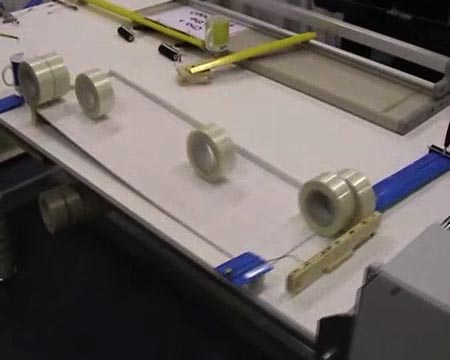
    A paper wad sets off a Rube Goldberg machine which, according to the behind-the-scenes featurette, required 98 takes. Something I Didn’t Know Yesterday But Which Makes Perfect Sense Today: in a Rube Goldberg machine, you want to schedule your most reliable elements at the end of the sequence so that failure comes swiftly and inexpensively.

  2. Creme That Egg!

    Another Rube Goldberg machine, half as expensive, twice as impressive. We’re almost to the point in my classes, here at the end of the year, where no one snipes, “Huh dude has no life huh” at the end of these videos. I have cajoled, encouraged, and begged them at various times throughout the year to recognize that this is practice. Rather than dumping his cognitive surplus into something passive, Joseph Herscher performed a feat which is โ€“ yeah โ€“ merely diverting, but which is practice, which will keep his intellectual/creative muscles limber and toned for the rest of his life. Most of my students know nothing of this. How many adults know anything of this?cf. Never once “in the real world” will you have to push 200 lbs. off your chest so why do (non-competitive) weightlifters bother?

Photo

  1. Sightseeing In Liberty City

    Grand Theft Auto IV‘s Liberty City adapts itself strictly from New York City. A photographer has compared sights and landmarks between the original and the clone. The results are mostly astonishing.

  2. Malaysian Sky Bridge

    I learned a new word today: gephyrophobiac. Which I am now, thank you, internets.

My Students Have My Mobile Number

Per the demands of an outdoorsy, running around-type review exercise, I gave my students my cell number two months back. Since then, I have received 23 unsolicited text messages. The first three were overly familiar, the sort you might call pranks, one of which read:

we’re your favorite students right. this is [name redacted].

These are the sort you just ignore. Accordingly, the next one read:

text back loser!!

The following twenty have each been scholarly, appropriately curious, and sent between a high school math teacher’s typical waking hours. They receive immediate response. A recent sample:

Whats the code for the Feltron project on excel, sum… Plus something?

Perhaps I dodged a bullet here. I’m pretty sure, though, that a lot of this was bound up in how I presented it: as an adult-type moment, access which they were free to squander if that’s how they wanted it, but which (I also told them) I had every reason to believe they’d enjoy responsibly.

Disincentive the negative. Reinforce the positive. Students are puppies.