Dan Meyer

Total 1628 Posts
I'm Dan and this is my blog. I'm a former high school math teacher and current head of teaching at Desmos. He / him. More here.

Rebooting Pseudocontext Saturdays

161014_1

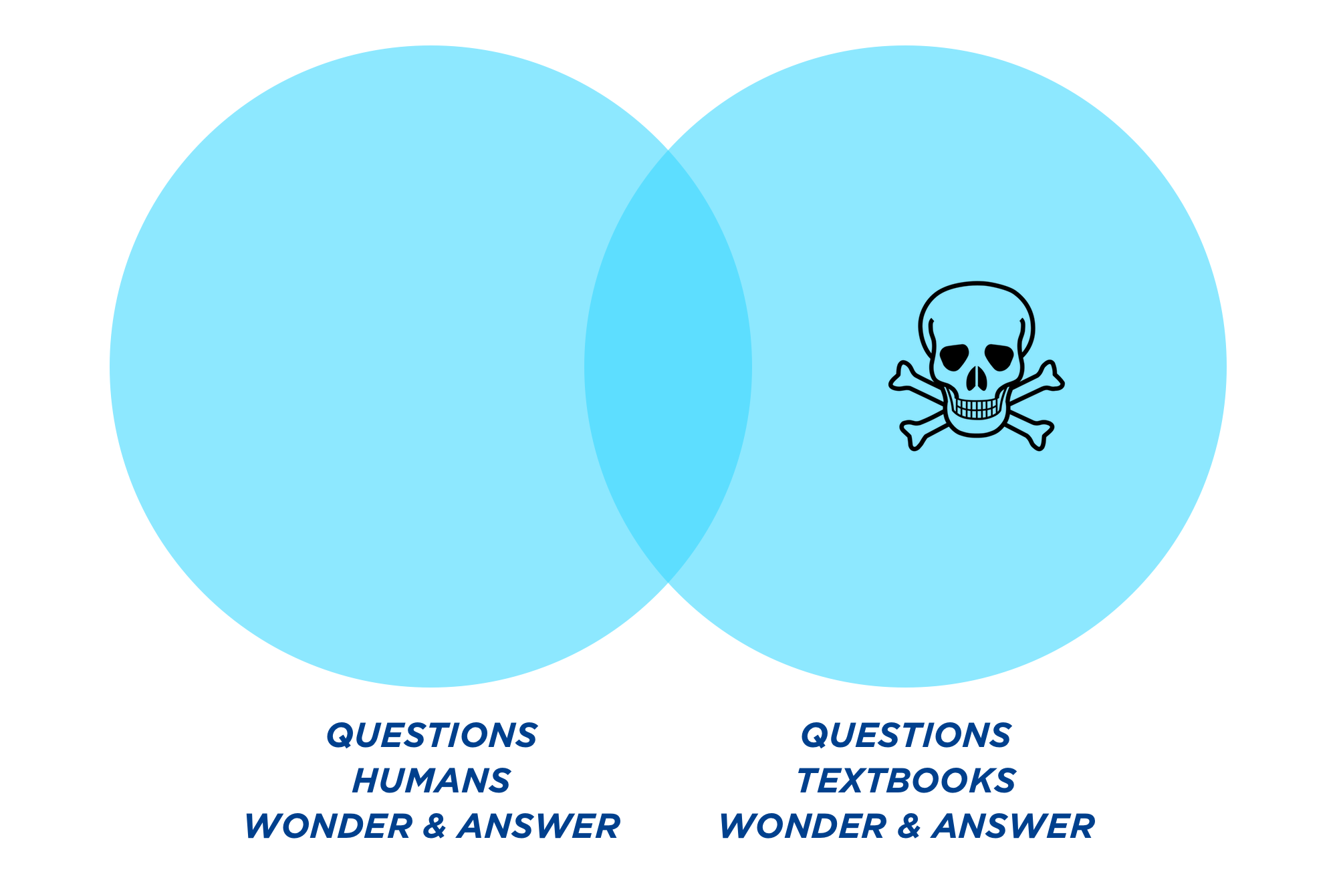
We create a pseudocontext when at least one of two conditions are met.

First, given a context, the assigned question isn’t a question most human beings would ask about it.

Second, given that question, the assigned method isn’t a method most human beings would use to find it.
161014_2

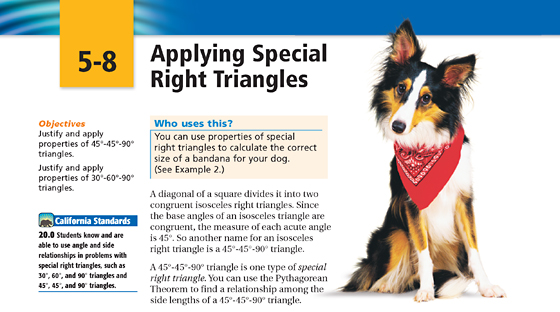
The dog bandana is the classic example. Given a dog, would most human beings wonder about the correct size of the bandana? Maybe. But none of them would apply a special right triangle to answer it.

Rules

Here’s the game. Every Saturday, I’ll post an image from a math textbook. It’ll be an image from one of the “Where You Will Use This Math!” sidebars.

I’ll post the image without its mathematical connection and offer five possibilities for that connection. One of them will be real. Four of them will be decoys. You’ll all guess which connection is real.

After 24 hours, I’ll update the post with the answer. If a plurality of the commenters picked the textbook’s connection, one point goes to Team Commenters. If a plurality picked one of my decoys, one point goes to Team Me. If you submit a word problem in the comments to complement your connection and it makes someone lol, collect a personal point.

Why?

  1. Fun. Teaching is a pretty serious occupation. It never fails to brighten my day when you all ping me with pseudocontext.
  2. Caution. My position is that we frequently overrate the real world as a vehicle for student motivation. I hope this series will serve to remind us weekly of the madness that lies at the extreme end of a position that says “students will only be interested in mathematics if it’s real world.” The end of that position leads to dog bandanas and other bizarre connections which serve to make math seem less real to students and more alien, a discipline practiced by weirdos and oddballs. Caution.

This Week’s Installment
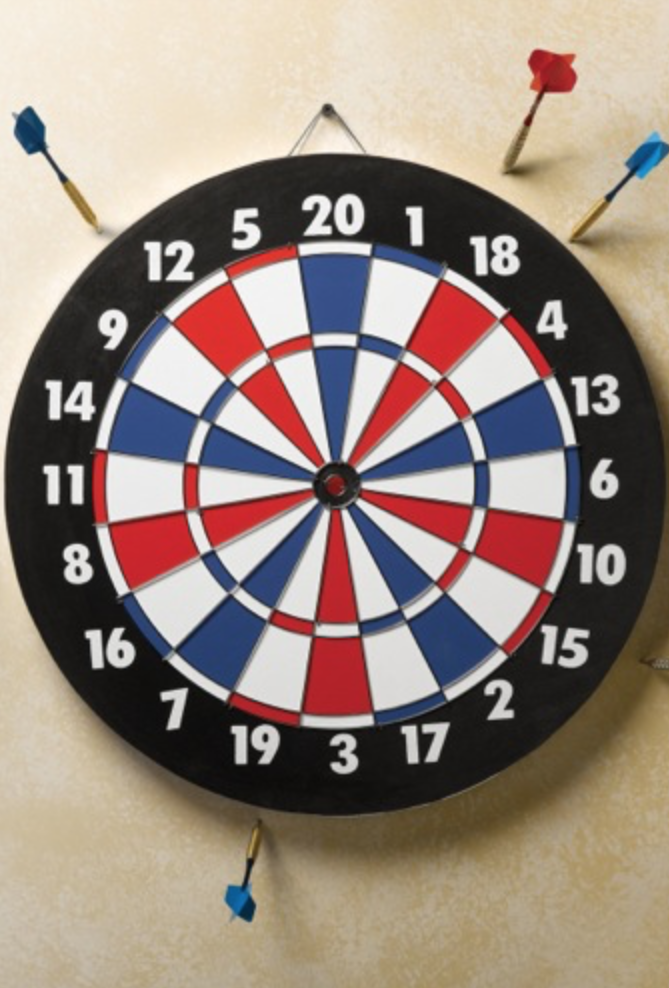
161009_2

[poll id=”2″]

(If you’re reading via email or RSS, you may need to click through to vote.)

I’ll update this post with the answer in 24 hours.

BTW. Don’t hesitate to send me an example you’d like me to feature. My email address is dan@mrmeyer.com. Throw “Pseudocontext Saturdays” in the subject.

Answer

Polls are closed. The commenters got rolled on this one, with only 3% having guessed the actual application. So one point goes to Team Dan.

Most commenters guessed “calculating probabilities,” which likely wouldn’t have been a pseudocontext. Humans wonder lots of questions about probabilities when it comes to darts, many of which are most easily answered with mathematical tools.
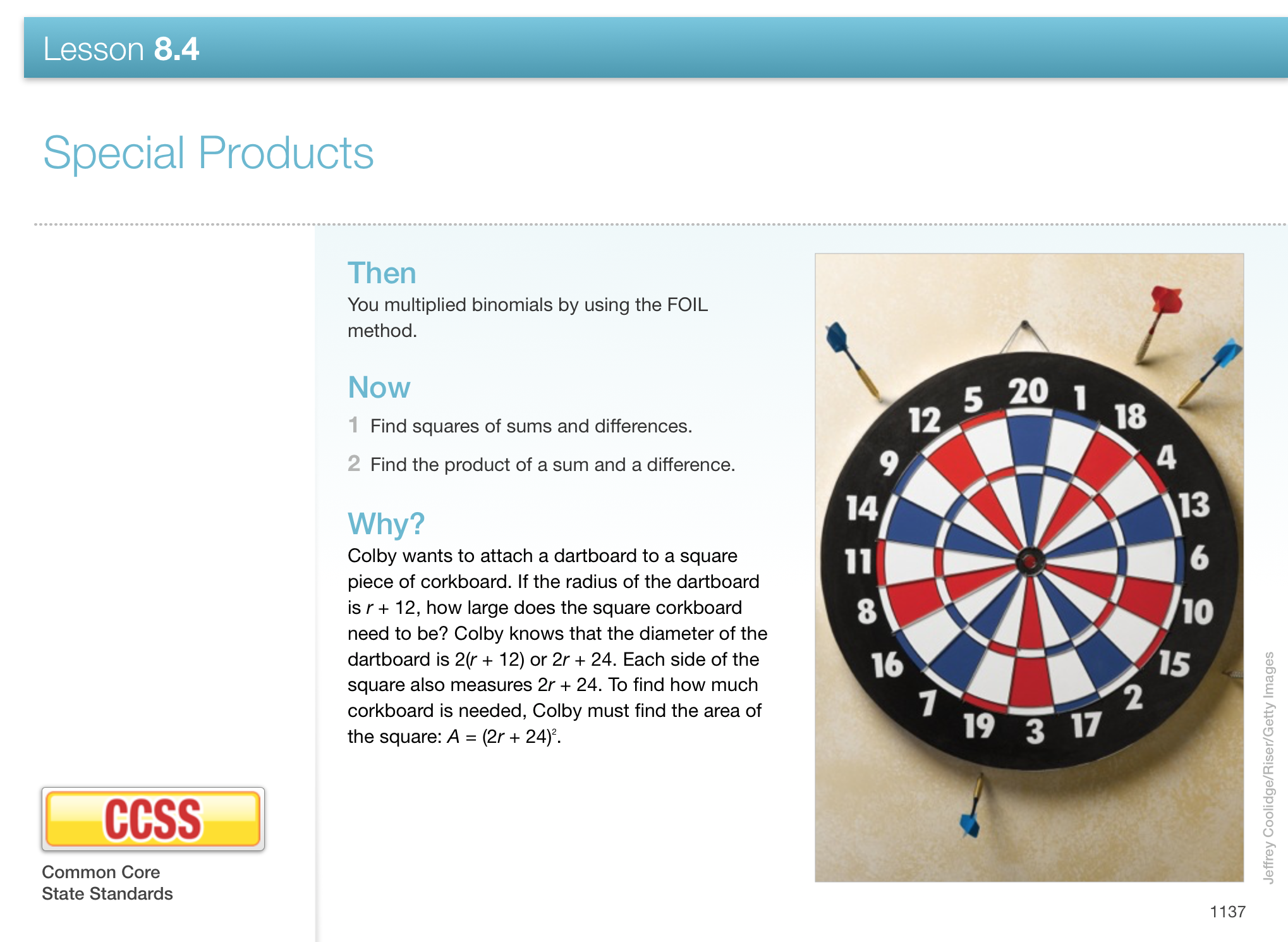
161016_1

But this is high-grade psuedocontext. Given a dartboard, few humans would wonder about the dimensions of a square that circumscribes it exactly. And even if they did wonder about it, none of them would name the radius r + 12. They wouldn’t even name it r. They wouldn’t use variables. They’d measure it.

The publisher included the dartboard as a means to interest students in special products. If you believe, as I do, that the publisher has done more harm than good here, positioning math as alien rather than real, what can be done? How do you handle special products?

Featured Comments

Amy Hogan:

Q #11: Pretend [certainly not a woman’s name] has no concept of darts, zero aim, and is liquored up at the bar anyway. What is the probability that he’ll hit a 20? Twice, with his eyes blindfolded?

Dennis Rankin:

Question: What percent of the dart board scoring area is red? white? blue?

Extension: Are the red, white, and blue percentages of area the same on an American flag?

Bowen Kerins:

Man, this “context” is an absolute embarrassment and wastes the time of students and teachers. This sort of thing is driven by textbook requirements for “full coverage” – some lessons have a useful “why” picture and description, therefore all of them must.

Awful.

Scott Farrand reacts to the commenters’ loss:

Now I see how to make the dartboard fit into our task. First we each randomly assign each the five options that Dan gave us to 4 of the 20 sectors of the dartboard, so that 1/5 of the sectors correspond to each option. Now all we need is a blindfold, and … let’s see if we can improve our results from 3% correct to about 20% correct.

Also, please enjoy this back-and-forth about the nature of pseudocontext between Michael Pershan, David Griswold, Sarah, and me. I know I did.

Four Ways to Not Quit Teaching

Zach Cresswell:

If you had told me that it would take me five years of teaching to figure out how to mentally leave work at work then I might not have continued in this career. I’ve gotten incrementally better at it each year but this year I’ve committed to prioritizing it. Here are a few things I’ve learned that help me do that. I hope you can, especially if you’re just starting out, find a piece of advice that will help you live a more balanced life.

I’ve grown to admire a kind of teacher I used to disregard — the teacher who knows she could create a better lesson than the one she taught last year, who knows she could help a student bring a B to a B+ with after-school tutoring, who knows she could do wonders coaching the basketball team, and who makes a principled choice not to do any of that.

That principle is:

It’s better for me to do 90% of what I know I can do this year if that 10% I save for myself means I’ll still be a teacher next year.

Cresswell’s post exemplifies that self-discipline. His post is practical also. He offers four of his best strategies for making teaching sustainable. Comments are closed here, but I hope you’ll load up his blog post with strategies of your own. This job can’t have enough of them.

I Was Wrong About #BottleFlipping

I didn’t think there was a useful K12 math objective in bottle flipping. My commenters served their usual function of setting me straight.

I was asking the question, “Can you predict whether or not a bottle will land?” A modeling problem.

Commenters like Meaghan asked the question, “What conditions will set yourself up for success in bottle flipping?”

How much water in the bottle? What kind of angle on the toss? Clockwise or counterclockwise? These are statistical questions.

Paul Jorgens followed that angle with his class:

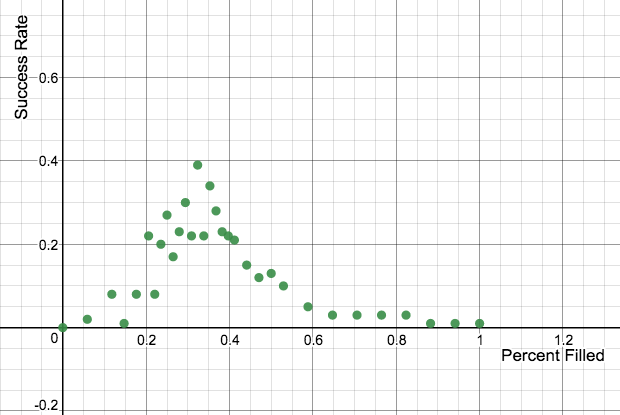
It started with an argument in class last week about the optimal amount of water in the bottle. Should it be 1/4 filled? 1/3? Just below 1/2? I told the group that we could use our extra period to try to answer the question. We met and designed an experiment. We thought about problems like skill of tosser, variation in bottles, etc. We started with 32 bottles filled to varying levels. During 20 minutes of class, 32 students flipped bottles 4,220 times. We the all filled in our data on a Google Sheet.

[..]

I meet again next week with the small group that had the idea. I think they want to produce something for school news. Did we answer the question about how much water to put in the bottle?

Check out the graph of their data.

161007_1

The Paper Helicopter is a similar exercise in experimental design. These activities come from the same template. If we understand that template, we can swap lots of different questions into the experiment, including those that seem most interesting to students in this moment.

We can teach students how to use mathematical tools to answer questions that interest them. We can also assign detentions. If there’s any middle ground, I’m not seeing it on Twitter right now.

Featured Tweet

BTW. Here’s a Desmos activity you can use to facilitate data collection in your class. Your students add their data on the first screen. Then they see the sum of their class’s data on the second screen.

#BottleFlipping & the Lessons You Throw Back

2016 Oct 7. I was wrong about everything below. After admitting defeat to #bottleflipping, my commenters rescued the lesson.

I’m sorry. I went looking for a lesson and couldn’t find it.

Relevant background information:

Last spring, 18-year-old Mike Senatore, in a display of infinite swagger, flipped a bottle and landed it perfectly on its end. In front of his whole school. In one try.

161005_1

That thirty-second video has six million views at the time of this writing. Bottle flipping now has the sort of cultural ubiquity that can drive even the most stoic teacher a little bit insane.

Some of my favorite math educators suggested that we turn those water bottles into a math lesson instead of confiscating them.

I was game. Coming up with a math task about bottle flipping should be easy, right? Watch:

Marta flipped x2 + 6x + 8 bottles in x + 4 minutes. At what rate is she flipping bottles?

Obviously unsatisfactory, right? But what would satisfy you. Try to define it. Denis Sheeran sees relevance in the bottle flipping but “relevance” is a term that’s really hard to define and even harder to design lessons around. If you turn your back on relevance for a second, it’ll turn into pseudocontext.

For me, at the end of this hypothetical lesson, I want students to feel more powerful, able to complete some task more efficiently or more accurately.

Ideally, that task would be bottle flipping. Ideally, students who had studied the math of bottle flipping would dazzle their friends who hadn’t. I don’t think that’s going to happen here.

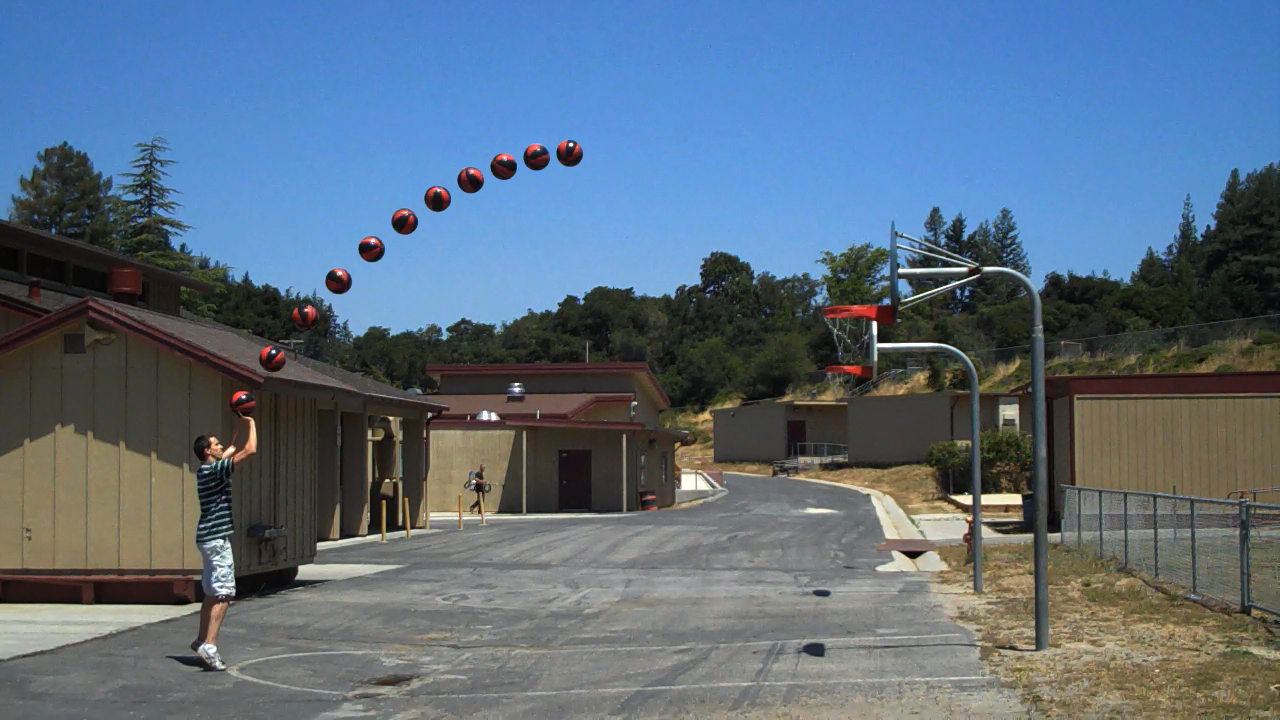
But what if the task wasn’t bottle flipping (where math won’t help) rather predicting the outcome of bottle flipping (where math might). You can see this same approach in Will It Hit the Hoop?

The quadratic formula grants you no extra power when you’re in mid-air with the basketball. But when you’re trying to predict whether or not a ball will go in, that’s where math gives you power.

161005_3

Act One

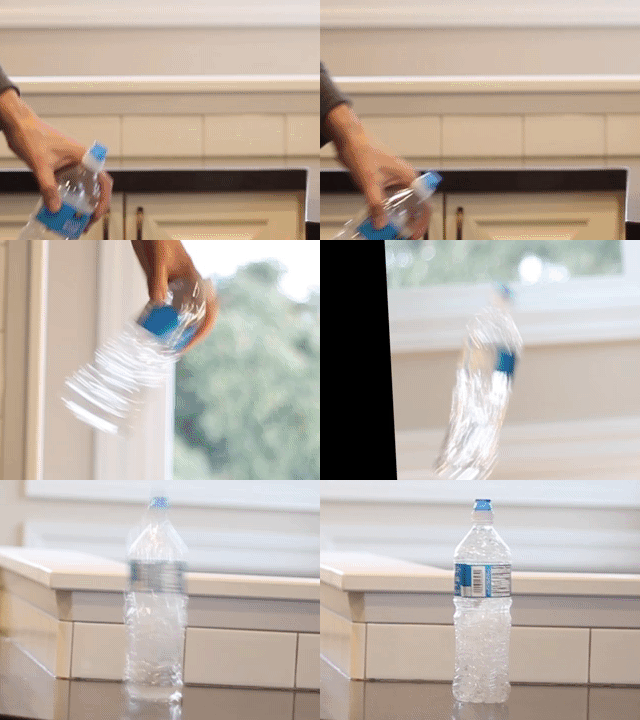
So in the same vein as that basketball task, here are four bottle flips from yours truly. At least one lands. At least one doesn’t. Each flip cuts off early and invites students to predict how will it land?

Act Two

Okay. Here’s a coordinate plane on top of each flip.

If you’ve been around this blog for even a day, you know what’s coming up: we’re going to show which flips landed and which flips didn’t. Ideally, the math students learn in the second act will enable them to make more confident and more accurate predictions than they made in the first act.

But what is that math?

I asked that question of Jason Merrill, one of the many smart people I work with at Desmos. I won’t quote his full response, but I’ll say that it included phrases like “cycloid type thing” and “contact angle parameter space,” none of which fit neatly in any K-12 scope and sequence that I know. He was nice enough to create this simulator, which has been well-received online, though even the simulator had to be simplified. It illustrates baton flipping, not bottle flipping

Act Three

Here is the result of those bottle flips. For good measure, here’s a bottle flip from the perspective of the bottle.

161005_2

I’m obviously lost.

Here’s a link to the entire multimedia package. Have at it. If you have a great idea for how we can resurrect this, let me know. I’m game to do some video editing on your behalf.

But when it comes to bottle flipping, if “math” is the answer, I’m not sure what the question is. Please help me out. What is the lesson plan? How will students experience math as power, rather than punishment.

Sure, it’s probably a bad idea to destroy the bottles. But it’s possible we shouldn’t turn them into a math lesson either. Maybe bottle flipping is the kind of silly fun that should stay silly.

2016 Oct 7. Okay: I was wrong about #bottleflipping. A bunch of commenters came up with a great idea.

Featured Comments

Elizabeth Raskin:

I see a couple students playing the game during some down time and my immediate reaction is, “There’s gotta be some great math in there!” One of the boys who was playing sees my eyes light up. He looks at me in fear and says, “Mrs. Raskin. Please. I know what you’re thinking. Please don’t mathify our game. Let us just have this one thing we don’t have to math.”

Mr K:

I suspect I should put as much effort into making this teachable as I would for dabbing.

Meaghan found a nice angle in on bottle flipping, along with several other commenters:

It would be neat if you could spend a, for example, physics class period talking about experimental design (for fill ratio questions or probability questions) and collecting the data, and then troop right over to math class with your data to figure out how to interpret it.

Paul Jorgens has the data:

It started with an argument in class last week with the optimal amount of water in the bottle. Should it be 1/4 filled? 1/3? Just below 1/2? I told the group that we could use our extra period to try to answer the question. We met and designed an experiment. Thought about problems like skill of tosser, variation in bottles, etc. We started with 32 bottles filled to varying levels. During class over 20 minutes 32 students flipped bottles 4,220 times.

Ten Lessons from Ten Years of Blogging

One final indulgence for my blog’s tenth birthday: a list of ten lessons I’ve learned from ten years of blogging.

Figure out why you’re blogging. I started blogging ten years ago because writing helps me think and I needed some public pressure to think through my lessons at the end of the school day. Nowadays I blog because blogging makes me curiouser and wiser. I don’t want to say there are bad reasons to blog, but if you’re blogging first and foremost for fame, fortune, or readers, you’re going to feel very fried very quickly.

Find your cohort. Then encourage each other relentlessly. Ten years ago, my cohort probably included more administrators and English teachers than math teachers. The pool of edubloggers was so small we all followed each other, encouraged each other, and griped at each other. Find people who started blogging around the same time you did. For many people, your blogging and tweeting cohort will be the faculty lounge you’ve always needed and never had.

Be careful with auto-generated #content. For a long time people used plugins that would algorithmically attach a stock photo or a set of related links to your posts. Those have fallen somewhat out of favor, which is a positive development. If your goal for blogging is to develop your ideas or create a community, there just aren’t many shortcuts. Do the work.

Be the blogger you’d want to read. Figure out what you like about writers you read. As you work to develop your own style and voice, borrow theirs for awhile. Me, I like short sentences and clippy paragraphs. I like a mix of confidence and humility — someone who has strong opinions but holds them loosely. I like people who don’t take themselves too seriously. I try to write a blog I’d like to read.

Be nice. No nicer. No, dude, you think you’re being nice but you’re still really crabby. It took me awhile to realize there were, like, actual people behind the screen names and web addresses. I still struggle to criticize ideas online in ways that don’t bum people out. Related: punch up or don’t punch at all.

Figure out what blogging measures in your life. If you find yourself not blogging after a good run of blogging, that may just mean you don’t have the time for it. But in my case I figured out that it meant I wasn’t learning enough. Lately it means I need to get into a classroom or I need to do some math. That’s valuable self-knowledge.

Tend your comments. I delete spam quickly. I delete abusive comments. Occasionally, I email people privately to let them know they need to be nicer. If someone has a typo or an unclosed HTML tag or a link that didn’t get formatted properly, I’ll often fix those. Delete comments that don’t add value or propel conversation — even complimentary ones! If someone posts something positive but unconstructive like “Agreed!” I’ll often email a quick thanks and then delete the comment. People will rise to whatever bar you set, so set a high one.

Learn from your readers. A healthy comments section is like a really smart extra brain you carry around all the time and can consult whenever you want. Also, when people care about you and know what you care about, they’ll send you articles and ideas and links they think will interest you. That’s crazy. It’s better than any existing recommendation engine. The brain you carry around with you spontaneously generates knowledge for the brain you keep in your head.

Amplify your readers. I pull interesting comments up into the body of the post itself and let people know I’ve done that. I try to do that quickly, before the post gets emailed the next day, so email readers understand how much I value my commenters and can benefit from their thoughts too. This process creates a bunch of interesting and virtuous cycles. One is that I get more (and more useful) comments the more people know I’m paying attention to them. Another is that the next generation of interesting math education bloggers is in your comments right now. So amplify them. Embolden them to set up their own project. (See also: Ten Years of Blog Comments.)

Turn learning into more learning. If you do all of this and you do it regularly, my guess is you’re going to get offered some interesting opportunities. For me, I was offered chances to study with great researchers, to design curriculum with great designers, and to work with great teachers all around the world. I went into all of those opportunities thinking, “What will I find here that I can share with the folks back at the blog?” Again, not for fame, fortune, or readers. But because I knew you’d all make me curious and wiser.

Related, but not algorithmically generated:

Featured Comment

Michael Pershan:

The advice I’d give others about comments is simply to ask for comments when you want them. The way blogs work in 2016, you probably don’t have very many people reading you via RSS and not so many people regularly checking your comments sections. You are probably connected to other educators on social media, though these people might not know that you want feedback on your ideas. If you invite feedback, though, you’ll get more of it. That’s my advice.