Dan Meyer

Total 1628 Posts
I'm Dan and this is my blog. I'm a former high school math teacher and current head of teaching at Desmos. He / him. More here.

Students As Dolphins

My TA (name’s Katy, perhaps you’ll recall) works at a veterinary hospital after school, holding down German Shepherds twice her size for vaccinations.

She was talking to me the other day about reinforcers and punishments, how punishments are so much less effective than reinforcers ’cause animals will modify their behavior just enough to avoid them and no further.

She also said that punishments are plainly ineffective with open water animals like dolphins, which can’t be caged up, or sent outside, or sent to their rooms for punishment.

They just swim away.

This anecdote’s application to classroom management is left as an exercise to the reader.

Fake It ‘Til You Make It

They came in yesterday grumbling of sleep lost, of buses nearly missed. I told ’em I loved the spring forward ’cause it meant I only had to wait 47 hours to see ’em again.

I do this after three-day weekends. I’ll curse the births of George Washington and Abraham Lincoln. I’ll tell ’em how much I worry about ’em over winter break.

It’s weird how it started out all silvertongued, kind of an inside joke between us with flattery/sincerity balanced somewhere around 90/10, but then, at one point, the balance swapped. And I meant it.

Linear Fun #1: Air Travel

We’re deep into linears

We’ve established “rate” as “something per one something” and the y-intercept as our initial condition, all without using the terms “slope” or “y-intercept” or the variables “y” or “x.”… or Graphing Stories, for that matter, which at the time seemed like the quintessential introduction to linears, dammit. I can’t decide if I hate or love this part of my job.

Maybe you frown at that kind of corner cutting but a) you have no idea how gradually you’ve gotta introduce those abstractions at the level I teach, and b) that’s why I don’t read your blog.

So watch as I take my kids through this tech-drenched project-based assignment. Squint through crossed eyes and I might look like someone you’d see at NECC.

  1. Set It Up

    If I fly 300 miles out of San Francisco, is the duration of my flight predictable? Is the cost? Would the graphs look predictable or random?

  2. Give Them Laptops

    We have a mobile lab of 15 MacBooks. That’ll do.

  3. Fly Out Of United Airlines

    Send them out of the same airport. (SFO is our local hub.) Have them pick fifteen one-way, non-stop destinations. Ask them if they have any international YouSpace or FaceTube friends they’d like to visit, thereby cementing your digital street cred.

    Baghdad, as many curious students found out, is somewhat inaccessible.

  4. Record Flight Data In Hard Copy

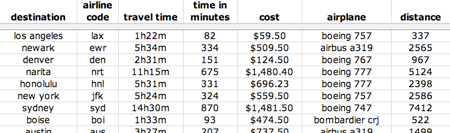
    Have them record:

    • airport codes,
    • departure times,
    • arrival times,
    • flight durationsHave fun explaining why a flight takes off from San Francisco at 9:00 AM, lands in Honolulu at 11:30 AM, and lists a 5.5 hour flight time.,

    and most crucially:

    • distance in miles,
    • time in minutes, and
    • cost in dollars.
  5. PDFs here! Getcher PDFs right he-ah!

  6. Enter Flight Data Into Excel

    If you want to skip past the hard copy step straight to this one, just know you’ll need a continuous two hours.

  7. Graph!

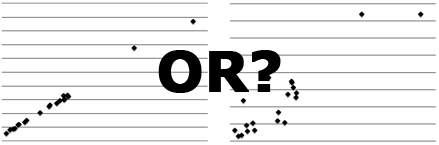
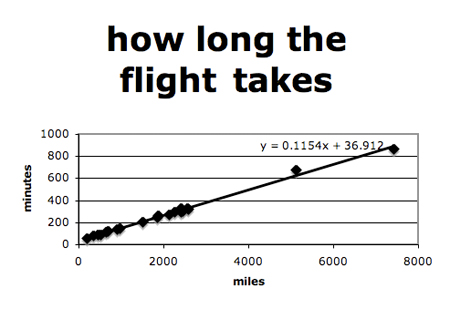
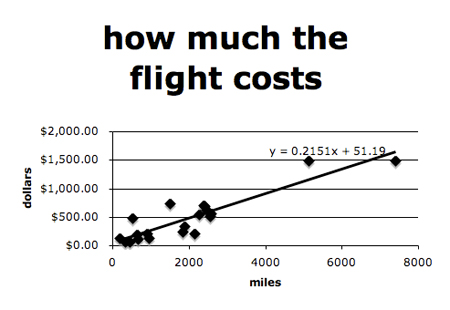
    Marvel a bit at how well Time v. Distance fits a regression line and how terribly Cost v. Distance does.

  8. Discuss
    1. What does the rate mean for each? The plane flies at .11 minutes per mile, roughing out to 545 miles per hour. Each flight costs 22 cents per mile.
    2. What does the initial condition mean for each? This one’s truly fantastic, as you’d expect the initial condition for time to be zero. (A flight of zero miles oughtta last zero minutes.) Instead, that 36.9 minutes is the time the airline builds in for sitting on the deck, waiting to take off. Elsewhere, that $51.19 initial condition is the charge just for stepping onto the plane.
    3. What does it mean if a dot is above / below the line? The flight is longer / shorter than you’d expect for that distance. The flight is costlier / cheaper than you’d expect for that distance.
    4. Why is cost v. distance such a terrible fit? What does cost depend on if not distance? Why, for instance, does a short flight to podunk li’l Eureka, CA, cost more than a flight to LA at double the distance? TFJ pulled the answer to that one outta thin air, eyes darting back and forth, putting it all together in what has gotta be one of the most satisfying moments of my career, a moment in which I was pretty much wholly uninvolved: “There’re only one or two flights to Eureka.”

Keeping Tabs On TMAO So You Don’t Have To

TMAO comments on Joanne Jacobs’ reblog of Scott’s Teachers Gone Wild series.

Exhumed for y’all:

Good teachers don’t have these problems. They don’t. Good teachers would never let classroom culture degenerate to this point, and if it did, they would not resort to screaming, throwing fits, and cursing. Please. These are not accurate cross-sections of anything except the various ways bad teachers make bad situations worse.

I’ll bet all the money in my pockets that you can see these same kids at different points of the day acting in dramatically different ways. Why? Because student behavior is a function of educator quality.

Did you watch the first video all the way to the end? Did you hear what the girl in the front row said? “Sir, we’ve been sitting hear for 1/2 an hour and you aren’t saying anything. You’re just standing there staring at us. Obviously, we’re going to get bored and talk.”

She’s right. Teach the kids. Be good at your job. Act like a human adult and not some petulant robot child, and watch all these little petty problems disappear.

Then this dude Michael’s all up in TMAO’s Kool-Aid like:

But if you believe no teenagers come to class without fear and primarily intent on showing off by thwarting the teacher’s will, I think you are naive.

Dayum! But then TMAO comes back with:

Fine. So what? A good teacher can 1) handle it in ways that don’t fall back upon the silly and ultimately ineffective use of fear, 2) create in their rooms conditions that are more interesting and appealing than showing off. If you don’t believe that, please change professions. And I gotta tell ya, there’s nothing soft about sending kids the message that you’re gonna bust your ass every minute you’re in my classroom; you’re gonna worker stronger and harder than ever before; you’re gonna transform your hollow dislike of these processes into pride and joy. There’s nothing soft about establishing ambitious, aggressive goals, and employing the will to get kids there.

TMAOed!

Litmus

The most fun I had the other night was lurking in the comments over at Scott’s placeSlow night., where he posted seven cellphone films of teachers gone wild, and asked if that kind of video qualified as student journalism or punishable infraction.

The comments came out in force, in volume, and few so far have gone anywhere near Scott’s prompt, most rephrasing his question as, “What do you think about these damn kids today?”

To which a bunch of YouTube-era pseudonyms (like, I swear, “MrStench”) reply somewhere in the neighborhood of:

We are too easy on children in our schools. If they don’t want to be in a regular class and learn, put them in a remedial class with a drill instructor as the teacher. The kids can self-study from their textbooks and take the tests without the advantages of good teaching.

and bonus nonsense from “Glen” (ha … imaginative pseudonym, pal!):

Most kids nowadays are punks. For them, school is a place to hang with friends and sell drugs… not to learn.

But what’s positively cool about this fracas is that, at the same time I’m mourning a world that grants these ageists and racists teaching credentials, that lets them run free and unjailed, a bunch of folks I routinely disagree with on matters of tech suddenly dash into the fray issuing replies and rebuttals all seasoned with grace and reason.

Nice job, people. I’m talking about Dana Huff, Taylor, Dave Sherman, and Dean Shareski, quoted:

Do our best teachers have this problem? I doubt it. So let’s work on developing great teachers and learning environments instead of band aid solutions that involve avoiding litigation and public embarrassment. Will students still act up and egg teachers on to go into rants? Certainly, but they’d be minimal with great teachers and great teachers would be less prone to react as some of these have done.

It’s cool to realize that, in spite of our frequent lower-case differences, we feel a comparable burden for our students’ engagement and recognize that their behavior is often a mirror of our own.

Group hug. C’mere.