Dan Meyer

Total 1628 Posts
I'm Dan and this is my blog. I'm a former high school math teacher and current head of teaching at Desmos. He / him. More here.

Ignore The Adjectives. Watch The Verbs.

Last spring, Mathematics Teacher published my paper on mathematical modeling. In this month’s issue, they’ve published a response from Albert Goetz [$].

Goetz worries that our collective interest in mathematical modeling risks granting the premise of the question, “When will we use this?” Math doesn’t have to be useful, argues Goetz. It’s beautiful on its own terms.

An emphasis on modeling–seeing mathematics as a tool to help us understand the real world–needs to be tempered by an approach that gives some prominence to the beauty that abounds in our subject. I want my students to understand how mathematics can explain the world–there is beauty in that notion itself–but also to see the inherent beauty and magic that is mathematics.

Agreed. But I no longer find adjectives helpful in planning classroom experiences, whether the adjective is “beautiful” or “useful,” “real” or “fake,” each of which is only in the eye of the beholder. Instead I focus on the verbs.

Mathematical modeling comprises a huge set of verbs that range from the very informal (noticing, questioning, estimating, comparing, describing the solution space, thinking about useful information, etc.) to the very formal (recalling, calculating, solving, validating, generalizing, etc.). One of the most productive realizations I’ve ever had in this job is that all of those verbs are always available to us, whether we’re in the real world or the math world.

Existence Proofs

“Math world” is the only adjective you could use to describe these experiences. When students find them interesting it’s because the verbs are varied and run the entire field from informal to formal.

Trick your brain into ignoring adjectives like “real-world” and “math-world.” Those adjectives may not be completely meaningless, but they’re close, and they mean so much less than the mental work your students do in those worlds. Focus on those verbs instead.

Related Reading

Real Work v. Real World

Featured Comment

Howard Phillips:

We shouldn’t overlook the usefulness of using this part of math to model that part of math. I see calculus as a way of describing and analyzing curves, including their curvature. I see analytical geometry as a way of representing “pure” geometry. I even see algebra as a way of modeling numerical patterns. Modeling is not just about the real world.

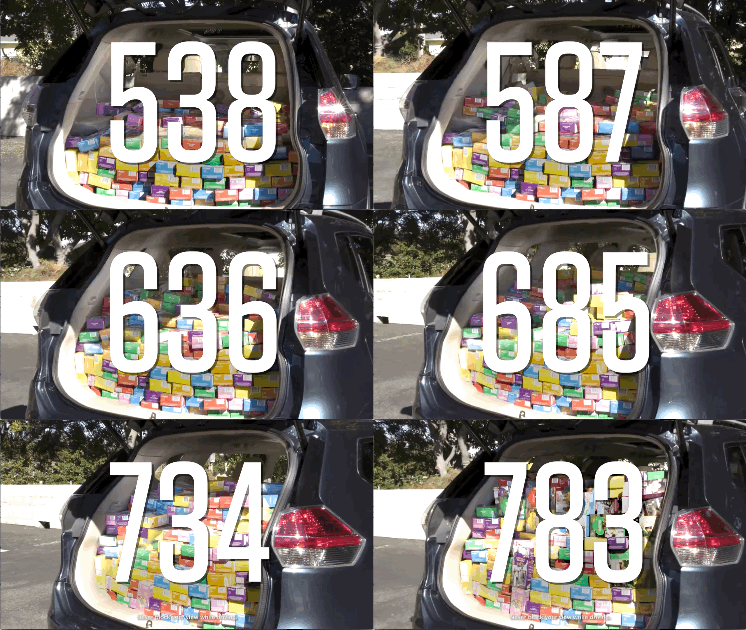
[3ACTS] Nissan Girl Scout Cookies

Treatment #1

A small rectangular prism measures 7 inches x 2.3 inches x 4.6 inches. How many times could it fit in a larger rectangular prism with a volume of 39.3 cubic feet?

Treatment #2

Nissan is going to stuff the trunk of a Nissan Rogue full of boxes of Girl Scout cookies. Nissan lists the Rogue’s trunk space as 39.3 cubic feet. A box of cookies measures 7 inches x 2.3 inches x 4.6 inches. How many boxes will they fit in the trunk?

Treatment #3

Show this video.

  1. Ask for questions.
  2. Ask for wrong answers.
  3. Ask for estimates.
  4. Ask for important information.
  5. Ask for estimates of the capacity of the trunk and the dimensions of the box of cookies.
  6. Show the answer.
  7. Ask for reasons why our mathematical answer differs from the actual answer.

Hypothesis

Treatment #1 and Treatment #2 are as different from each other as Treatment #2 is from Treatment #3.

A layperson might claim that Treatment #2 has made Treatment #1 real world and relevant to student interests. But the real prize is Treatment #3, which doesn’t just add the world, but changes the work students do in that world, emphasizing formal and informal mathematisation.

“Real world” guarantees us very little if the work isn’t real also.

Design Notes

You can check out the original Act One and Act Three from Nissan.

I deleted this screen from Act One because I wanted students to think about the information that might be useful and to estimate that information. I can always add this information, but I can’t subtract it.

160301_2

I added a ticker to the end of the video because that’s my house style.

160301_1

I deleted a bunch of marketing copy because it was kind of corny and because it broke the flow of their awesome stop motion video.

I left the fine-print advisory that you should “never block your view while driving” because the youth are impressionable.

The Goods

Download the goods.

[via whoever runs the Bismarck Schools’ Twitter account]

When Delayed Feedback Is Superior To Immediate Feedback

Craig Roberts, writing in EdSurge:

Beginning in the 1960s psychologists began to find that delaying feedback could improve learning. An early lab experiment involved 3rd graders performing a task we can all remember doing: memorizing state capitols. The students were shown a state, and two possible capitols. One group was given feedback immediately after answering; the other group after a 10 second delay. When all students were tested a week later, those who received delayed feedback had the highest scores.

Will Thalheimer has a useful review of the literature, beginning on page 14. One might object that whether immediate or delayed feedback is more effective turns on the goals of the study and the design of the experiment.

To which I’d respond, yes, exactly!

Feedback is complicated, but to hear 99% of edtech companies talk, it’s simple. To them, the virtues of immediate feedback are received wisdom. The more immediate the better! Make the feedback immediater!

Dan’s Corollary to Begle’s Second Law applies. If someone says it’s simple, they’re selling you something.

Ed Begle’s First And Second Laws Of Mathematics Education

Ed Begle:

  1. The validity of an idea about mathematics education and the plausibility of that idea are uncorrelated.
  2. Mathematics education is much more complicated than you expected even though you expected it to be more complicated than you expected.

Begle coined those two laws in the latter half of the School Mathematics Study Group, a multi-decade project to figure this mathematics education thing out. I’ve heard those laws before but I hadn’t tracked down the original source until today. He seems weary in the speech. His list of tried-and-failed innovations is lengthy and disturbingly current.

Over forty years after Begle’s work with SMSG ended, those laws still offer us lots of comfort and at least a little humility. Math education is hard. My gut is probably wrong. Anybody who says differently is selling something.

Reference

Begle, E.G. Research and evaluation in mathematics education. In School Mathematics Study Group, Report on a conference on responsibilities for school mathematics in the 70’s. Stanford, CA: SMSG, 1971.

2016 Feb 26. Bowen Kerins’ links to a better copy of the entire proceedings. That site also contains links to some of the SMSG “New Math” curriculum, which I’m excited to investigate.

2016 Feb 28. Raymond Johnson cautions us not to read Begle too pessimistically:

I really do love the history of my subject and posts like Dan’s send me into hours of searching through old papers and citations. But, I must be mindful of our tendency to underestimate change when we read from our wisest predecessors. It’s too easy for us to throw our hands up and say things like, “Dewey knew it all along!” or “We’re stuck in the same damned place we were 25/50/100 years ago.” Is Begle’s 2nd law (“Mathematics education is much more complicated than you expected even though you expected it to be more complicated than you expected”) still true? I would agree it is. But, as a field, we’ve made enormous progress since Begle gave this talk in 1971. The danger, as individuals, is to not learn from this progress. To avoid reaching the same conclusions as Begle, we need to avoid starting in the same place as Begle. When I browse the pages of Begle’s final book, Critical Variables in Mathematics Education: Findings From a Survey of the Empirical Literature, I’m struck by the sheer number of things Begle and the field knew little or nothing about compared to what we know now. Don’t we owe it to ourselves, as individuals and as a field, to push past prior conclusions by starting farther ahead and taking more seriously work already done?

How Do You Make A MTBOS?

I don’t have any answers here. I can only do my best to articulate the question.

The collection of tweeting and blogging math teachers we call the Math Twitter Blogosphere confuses me.

Look at this place.

  • It has a welcoming committee that organizes challenges to help new members find their feet. It also pairs volunteer newcomers with volunteer mentors. (Shout out to my mentee Lisa Garcia.)
  • It comprises thousands of blogs and Twitter accounts. Two weekly gazettes exist just to summarize the activity. (That first link is, without exception, the most valuable post of whatever week it’s published.)
  • It organizes weekly webinars with speakers and topics running across every spectrum.
  • It organizes an annual in-person conference, which sold out in two weeks last year and in eight hours this year.
  • 2016 Feb 12. It has maintained a physical booth presence at three of the last four National Council of Teachers of Mathematics’ conferences, staffed round-the-clock by volunteers.

It bears saying again: these are all volunteer efforts and self-organized.

Someone has to help me. Does the same organization and activity exist in other content areas?

If not, then why not? Each of the efforts above boasts some talented contributors — shout outs to Lisa Henry, Julie Reulbach, Sam Shah, Raymond Johnson, Tina Cardone, and the communities they lead — but I find it hard to believe similarly talented people don’t exist in other content areas. If you had to go back in time and bet that one group of teacher bloggers would break out in these amazing spasms of collaboration, admit that math teachers wouldn’t have been your first or second guess.

So how did this happen?

I don’t get it. I love it but I don’t get it.

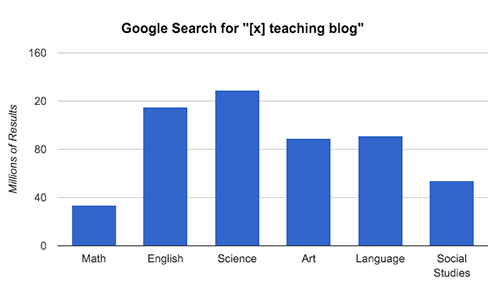
2016 Feb 11. Helpful data? Googling “[x] teaching blog,” I find in millions of results:

160211_1

  • Math: 33.9.
  • English: 115
  • Science: 129
  • History: 73.1
  • Art: 88.9
  • Language: 91.3
  • Social Studies: 53.8

Quality, not quantity.

Featured Tweets

Featured Comments

Claire:

I think of all the disciplines, math teachers are frustrated most with status quo. Personally, I want to change my practice, but on my own have struggled figuring out how to teach differently than I was taught. I don’t have a blog of my own (yet) but have grown so much by blogs I’ve found via Pinterest, Twitter, and google searches.

Brett Parker:

I think that curriculum is a huge part. Almost all secondary math curricula include the same topics. There is much greater variation in what states and districts require for social studies or even science. Different required texts for English classes.

Nathan Kraft:

In my own district, I found it hard to find anyone with much of a passion for trying new things…those who truly wish to invest the time for self-improvement. I sometimes wonder if some of my math colleagues even really like math. I certainly don’t get that vibe from the science teachers or the English teachers. Perhaps that is why I was drawn to this community. It is out of necessity in order to find those who are equally passionate.

Henri Picciotto:

But after a very few years, the group collapsed. Traffic stopped in the edWeb community, and the in-person meeting which had peaked at about 20+ people gradually shrank.

I think the fact that edWeb was a closed community, with formal membership was a fatal mistake. MTBoS is totally open.