Dan Meyer

Total 1628 Posts
I'm Dan and this is my blog. I'm a former high school math teacher and current head of teaching at Desmos. He / him. More here.

Great Moments In Classroom Culture

151019_1

This goes beyond “great classroom action.” These are great moments that go great lengths towards defining the culture of a classroom.

Nathaniel Highstein offers a full week of activities:

The start of the school year is one of the most important moments for my classes. Setting the right tone and attitude right from the beginning can mean buy-in from students right away — and conversely, a bad start can be really tough to recover from. I had a pretty good start this year in my Algebra 1 and Algebra 2 classes. I wanted to share some things that worked for me in case someone else might benefit, and to document the week, as I may repeat much of this work next year.

You can find lots of posters that describe the practices of a mathematician, the elements of a growth mindset, etc. Sam Shinde went a different direction, turning student work into a poster, and annotating it with mathematical practices.

Nora Oswald uses a viral YouTube video to illustrate the mathematical practice of perseverance:

After we watch this, I like to make the connection to the classroom.
“Do you ever feel like you’re driving around in circles?”
“Do YOU ever feel like you look like a fool and others are laughing at you?”
“Did this woman give up even though she may have looked foolish and stupid?”
“At what point do you ask for help?”

As best as I can tell, Jonathan Claydon has constructed a positive and productive classroom culture entirely out of gags like this.

Featured Comment

Mr. Corey Math:

I use my document camera for students to come up and “sacrifice their mistakes to the math gods”. The class usually makes eating sounds and says “yum”.
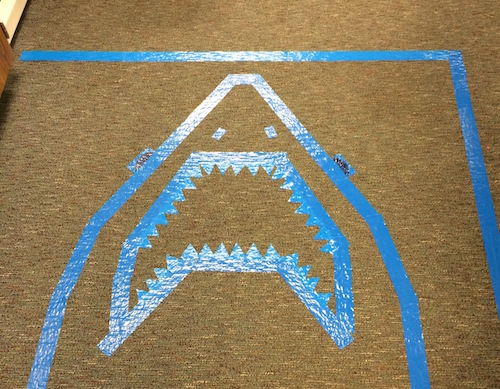
Falcon Radar

The speedometer in this video is broken.

Can you (or your students!?) fix it? Be careful: there are a couple of interesting ways to get this one wrong.

Also: what would the graph of speed v. time and position v. time look like here?

Let us know how you’re thinking about it in the comments.

2015 Oct 17. Updated to include the answer video and answer graph. You can also download these files at 101questions.

Announcing The Winner Of Our Fall Contest

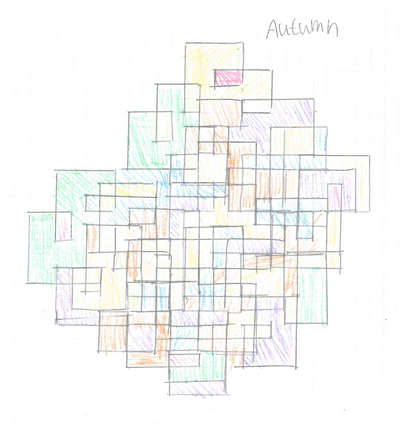
I received about one hundred loop-de-loops from teachers, parents, and students from several different countries. It took me an hour to take in all the awesome eye candy, which included dioramas, videos, 3D loop-de-loops made from snap cubes, and more. I pulled out my five favorites and sent them to three judges who I think embody the best of creativity in mathematics.

The Judges

  • Malke Rosenfeld, who uses dance and choreography to explore mathematical thinking.
  • George Hart, a research mathematician who also sculpts using geometry as his medium.
  • Michael Serra, author of Discovering Geometry, a geometry textbook infused from the front cover to the back with Michael’s love for math and art.

Five Finalists

Autumn, from Angela Ensminger’s class:

151012_4

Theo, from Alice Hsiao’s class:

151012_3

Trish Kreb’s seventh grade student:

151012_2

John Grade & his daughter:

151012_1

Maddie Bordelon and her math art team, “Right Up Left Down”:

151012_5

[BTW. In an early draft of this post, I reversed the second and third prize winners. Mistakes were made. Apologies have been issued.]

Third Prize

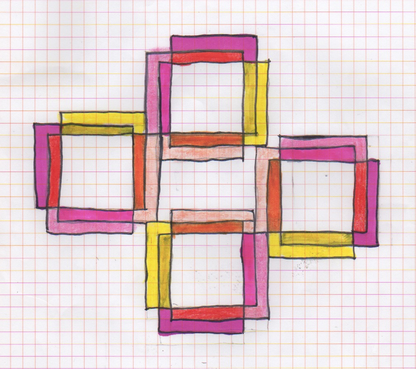
Third prize, which is a medium-intensity high five delivered if we ever meet, and one copy of Weltman’s book, goes to Maddie Bordelon and her math art team, “Right Up Left Down.”

151012_5

Second Prize

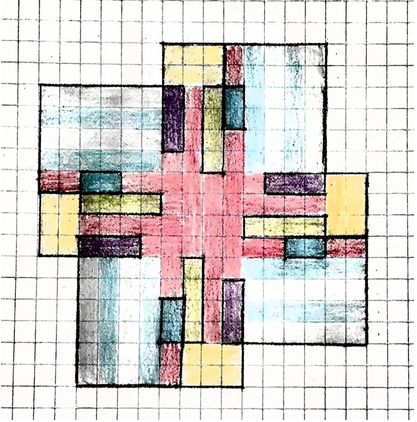
Second prize, which is sustained applause in a crowded, quiet room, and five copies of Weltman’s book, goes to Theo from Alice Hsiao’s class:

151012_3

One judge wrote:

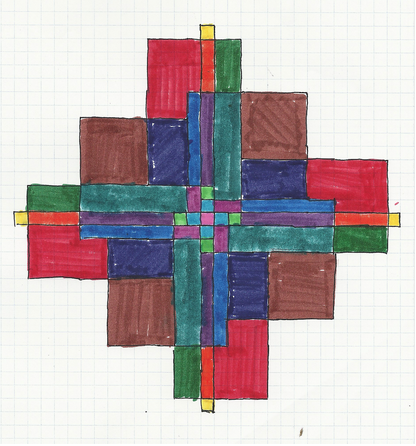
[E] completely holds my attention. The coloring choices pull me in and highlight the patterns and structure in a way that fascinates me. The long bands of white, blue and grey make a fantastic contrast to the brighter colors closer to the middle, which are also the shorter segments in the design. And, the bold outlines pull out the structure even more. I don’t know if it was intentional, but the overall effect of hand-coloring plus scanning the image made for a lovely final effect.

First Prize

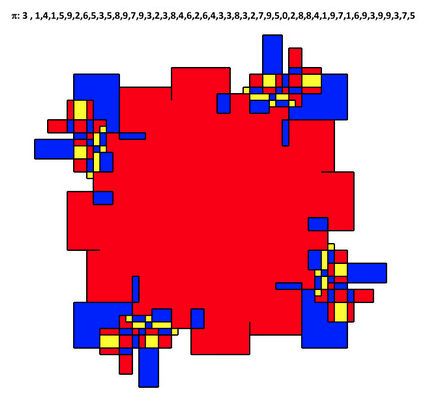
First prize, which is 40 copies of Anna Weltman’s awesome book, goes to John Grade & his daughter.

[2015 Oct 12. John Grade is graciously passing his first prize down to the second prize winner.]

151012_1

Our judges wrote about John Grade’s loop-de-loop:

It is very well constructed, brilliant use of color, and the number pattern chosen is pretty special.

A nice experiment to try Pi and see if a visible pattern emerges.

Congratulations, everybody.

Honorable Mention

I loved seeing students conjecturing mathematically about loop-de-loops, asking each other which ones converge and diverge, trying to predict the patterns they’d find in different strings of numbers. (See: Denise Gaskin’s comment for one example.)

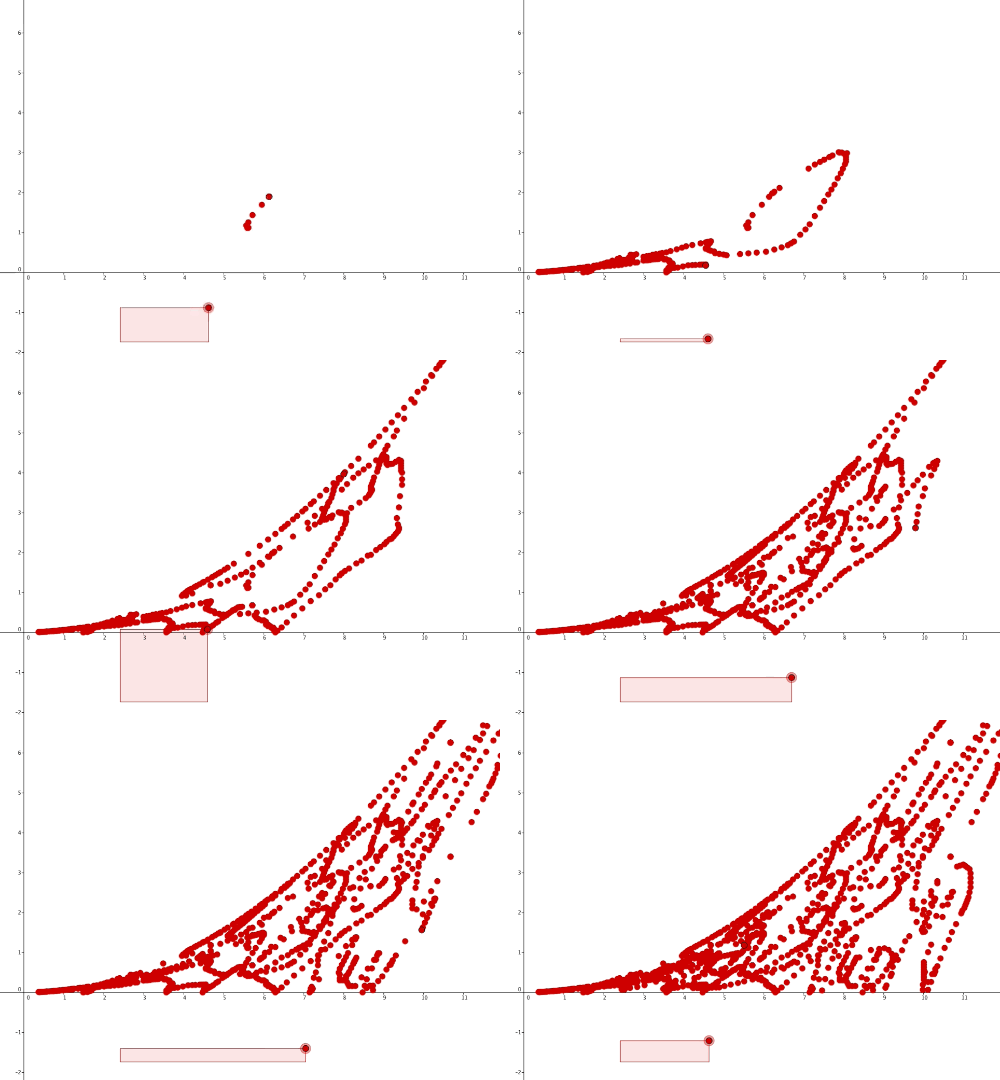
Also, The Nerdery really sank its teeth into this assignment. This blog’s collection of programmer-types produced some great loop-de-loop visualizations:

Four Animated GIFs Of The Same Awesome Problem

Here is the original Malcolm Swan task, which I love:

Draw a shape on squared paper and plot a point to show its perimeter and area. Which points on the grid represent squares, rectangles, etc? Draw a shape that may be represented by the point (4, 12) or (12, 4). Find all the “impossible” points.

We could talk about adding a context here, but a change of that magnitude would prevent a precise conversation about pedagogy. It’d be like comparing tigers to penguins. We’d learn some high-level differences between quadripeds and bipeds, but comparing tigers to lions, jaguars, and cheetahs gets us down into the details. That’s where I’d like to be with this discussion.

So look at these four representations of the task. What features of the math do they reveal and conceal? What are their advantages and disadvantages?

Paper & Pencil

You’ve met.

paper-pencil

Dan Anderson’s Processing Animation

Hit run on this sketch and watch random rectangles graph themselves.

processing

Scott Farrar’s Geogebra Applet

Students click and drag the corner of a rectangle in this applet and the corresponding point traces on the screen.

geogebra

Desmos’ Activity

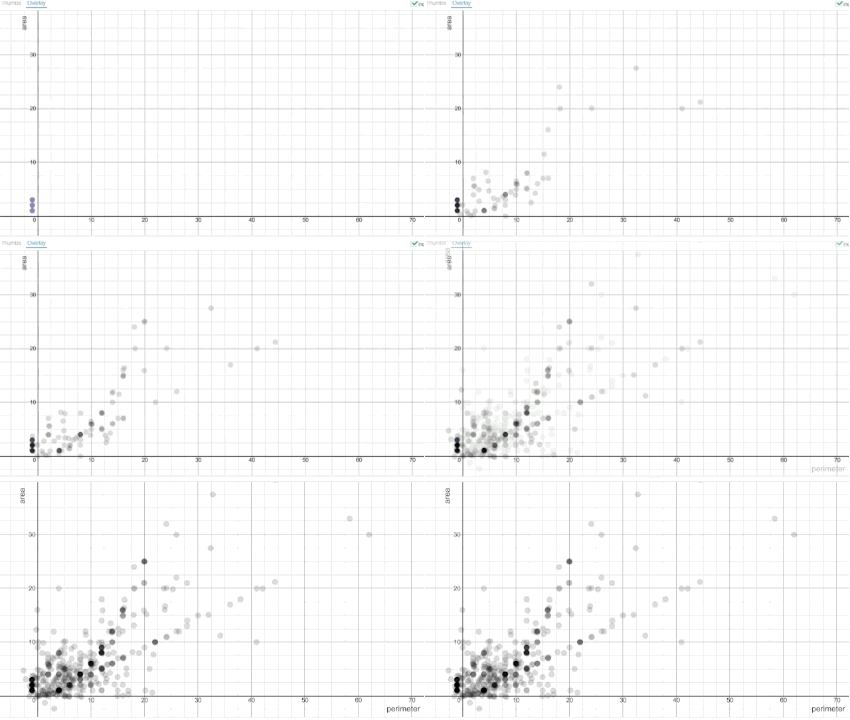
277 people on Twitter responded to my prompt:

Draw three rectangles on paper or imagine them. Choose at least one that you think that no one else will think of. Drag one point onto the graph for each rectangle so that the x-coordinate represents its perimeter and the y-coordinate represents its area.

Resulting in this activity on the overlay:

desmos

Again: what features of the math do they reveal and conceal? What are their advantages and disadvantages?

September Remainders

Quick programming note: our Loop-de-Loop contest ends 10/6 at 11:59 PM Pacific Time.

New Blog Subscriptions

New Twitter Follows

Commenters I Wish Had A Blog / Twitter Account / Zine / Etc.