Dan Meyer

Total 1628 Posts
I'm Dan and this is my blog. I'm a former high school math teacher and current head of teaching at Desmos. He / him. More here.

Tom Hoffman Takes The New England High School Math Exam

Tom Hoffman‘s perspective on Rhode Island’s summative graduation exam is worth your time:

Another question I thought was typical showed two spinners that would give you random numbers from 1 to four. It wanted to know the probability that the sum of the two would be a prime number. I drew a complete blank, until I realized I could easily write out all 16 combinations and just circle the ones that resulted in a prime number. That more clearly took mathematical reasoning, problem solving and content knowledge.

I like the question, and I like the direction it should push math curriculum. But I’m also aware that if even if kids have been taught probability, if they haven’t been taught it in a way that encourages flexible and resourceful problem solving — rather than pulling numbers out of stereotypical word problems and following procedures — they will be completely screwed.

I’m glad parents, policymakers, and stakeholders are taking these exams (or shortened versions of them) and reflecting on their results. But again we should be careful not to write expansive prescriptions for what we teach kids based on the test results of grownups. The proposition, “A middle-aged bureaucrat hasn’t used algebraic expressions in three decades and turned out fine therefore we shouldn’t teach algebraic expressions to fourteen year-olds” has yet to be nailed down for me.

The NRICH Approach To Probability

Jenny Gage, writing for NRICH, a math task design group based in Cambridge:

So what’s different about our approach:

  • We start from a problem, not from a technique.
  • The progression is from the empirical to the theoretical, with the formal aspects of the curriculum introduced through the problems.
  • We start each problem with an experiment (using eg. multi-link cubes, specially adapted dice, as well as counters, numbered dice and coins) so that in watching the data accumulate, then analysing it, students can gain a sense of what is happening before being asked to make predictions (which are so often totally ill-informed).

The rest of the description is just as good.

I’ve interacted with the NRICH group a number of times here in the UK. Their approach to math task design is as solid as they come. Be sure to check out their resources.

Featured Comment

Alison:

Thanks for your kind words about NRICH! The probability stuff had its formal launch yesterday and can be found here. There are a couple of interactive apps with the problems, and more in the offing.

[Future Text] Ice Cream Stand

a/k/a Dave Major Goes Bananas

Shorter: Dave Major and I are experimenting again with what math textbooks could look like on devices that are digital and networked. Our most recent experiment is Ice Cream Stand.

Longer: Last September, Kate posted this image to Twitter attached to the tweet, “Worst geometry problem ever: can’t be solved until after you solve it.”
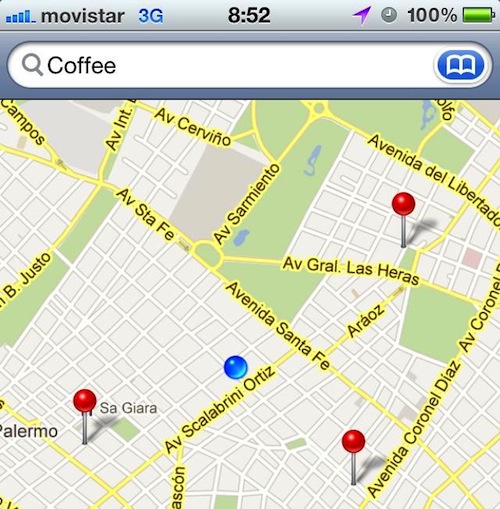
Clever bit, right? Classic Kate.

We could print that out and have students use a compass and straightedge to construct the circumcenter (the point that’s equidistant from all three coffee shops). That’d be a fine summative assessment. Very “real world,” etc.

But if you’d like to use Kate’s tweet to motivate the need for the circumcenter, to give students a reason to care about the circumcenter, we’ll need to start much lower on the ladder of abstraction. We’ll need to throw out formal vocabulary and formal operations for a few minutes. We’ll need to start with intuition.

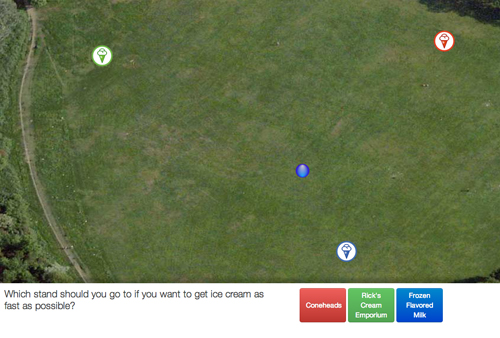
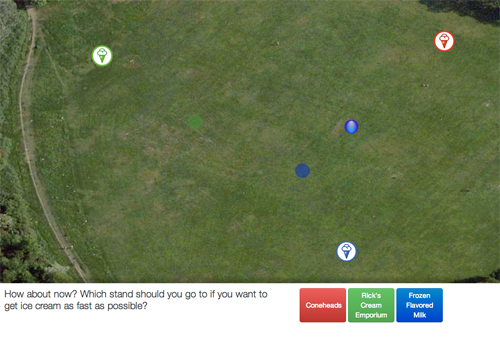
So we changed the domain from coffee to ice cream. We changed the environment from a roadway (a complicated space) to a park (an open space). And we gave students a few easy choices. “Which ice cream stand would you pick, given where you’re standing right now?

130318_1

Students see that they’re basically painting the field one dot at a time.
130318_2

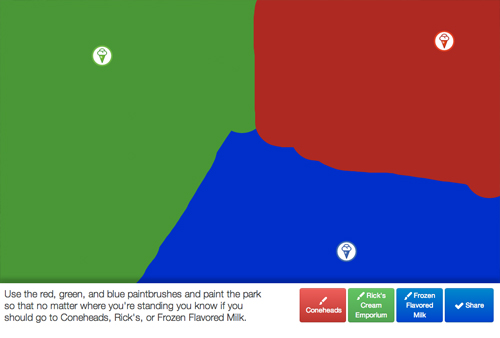
So we ask them to extend that metaphor and paint the entire field so that someone else can see which stand is the closest no matter where they are in the park.
130318_3

This is a task that a lot of students can complete regardless of their mathematical knowledge. It’s expensive, but not impossible, to provide this task on paper. It’s impossible to do on paper what comes next.

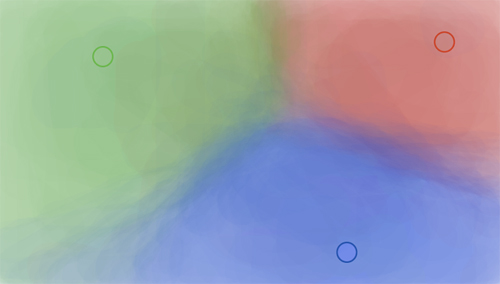
We combine the entire class’ park paintings.
130318_4

That’s a composite from three dozen people on Twitter.

Dave and I then asked students for some preliminary thoughts about how we could calculate the right painting. But that’s where we finished. The point is, students now want to know, “Who’s right? Who’s closest?” And what’s weird is that our intuition validates the math to a degree.

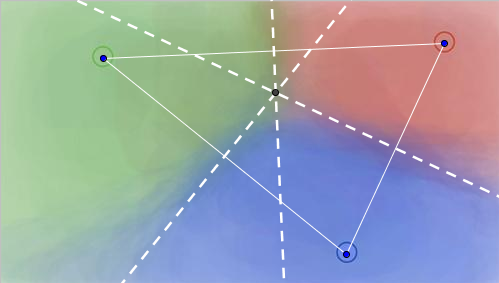
That is to say, you can see areas where Twitter agreed with itself. You can see areas where Twitter disagreed with itself. When you construct the circumcenter from the perpendicular bisectors, you’ll find that they overlay rather neatly on the areas of disagreement.
130318_5

That’s the ladder of abstraction. It isn’t impossible to climb it with print-based tasks, but a digital networked device makes it a lot easier.

Open Questions

  • Q: Where does this activity go next? We could add some expository text about the circumcenter. We could leave that to the teacher. We could calculate which student took the best guess in her painting of the field. A huge open question throughout these projects is, “What role does the teacher play here?”
  • Q: Another huge, open question is, “What happens to the first student who runs through this activity?” Her composite painting is just her own painting. Dave and I are developing activities that exploit the network effect. They get better and more interesting when more students use them. So again: what happens to the first student through?

BTW. Dave Major wrote his own post about this project.

Featured Comments

Alexandre Muniz:

The burning question I have after looking at this is, why is the average line a bit wrong? (Especially the blue/green line.)

Evan Weinberg:

The line of uncertainty shows where the intuitive power of the brain breaks down. This is where the power of mathematical tools can step in to hone in on a more precise answer. What strikes me here is that the mathematical tools don’t do that much better of a job.

Jason Dyer:

If you allow the first student through to see the picture as it gets revised (via a reload button or some auto-update), I don’t see a terrible problem (except for the usual classroom dilemma of what you do with any student that finishes fast).

[LOA] Sam Shah’s Worksheet

Sam Shah’s been writing a lot of thoughtful material about calculus instruction lately, including this piece on related rates.

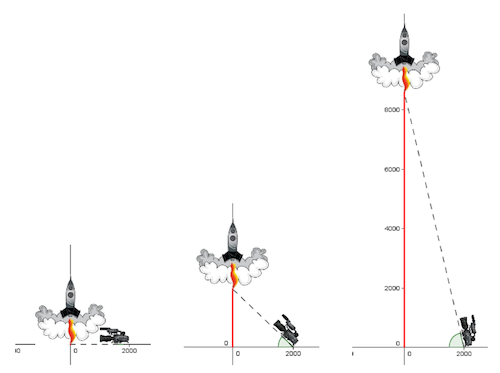
He includes a worksheet with that post and two items struck me. One, this is a pretty charming illustration of a rocketship climbing into space.

130313_1

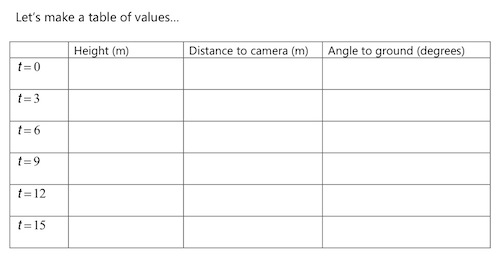
Two, it asks students to climb down, not up, the ladder of abstraction. Check it out. It asks students to calculate a table of values for the rocket …

130313_2

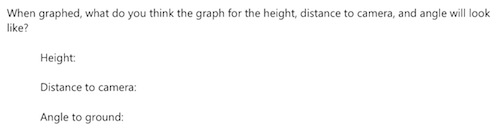
… then it asks for a prediction about the graph.

130313_3

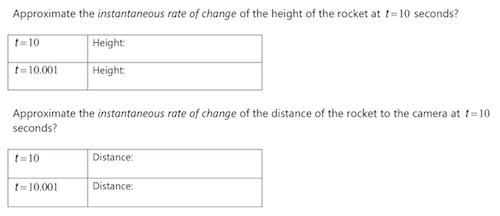
It asks students to calculate the instantaneous rate of change …

130313_5

… and then make a prediction about the instantaneous rate of change.

130313_6

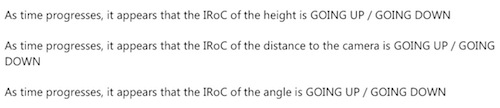
Calculation is something you can do once you’ve ascended the ladder and turned a concrete situation (a rocketship lifting off) into an equation (h = 50t2). Prediction is something students can do while they mill around at the bottom of the ladder and it’ll make their eventual ascent up the ladder easier.

So I’m here, again, wondering what would happen if the worksheet had asked the prediction questions first and then moved on to calculation. Would the students be more successful? Would they have enjoyed the work more?

2014 Feb 24. Sam Shah updates us:

Yup. I introduced the rocket problem this year and I had each group make guesses for what the three graphs were going to look like. I loved hearing their conversation and their incorrect thinking for some of them. Tomorrow they are going to do the calculations and see what they got right and what they got wrong…

Thanks for pushing back in this good way. I’m glad I remembered to go back and reread this this year!

[LOA] Family Feud

Once you see the ladder of abstraction you can’t unsee it. Family Feud is a game show that’s played on the ladder. When Steve Harvey says, “Name something that gets passed around,” that’s a higher level of abstraction than all of the items listed: a joint and the collection plate at church.

Every other quality of the joint and collection plate is eliminated except their passed-around-ness.

Which game show works in the other direction, giving you lots of items and asking you to move one level of abstraction higher to the category that includes them?

2013 Mar 18. Andrew Stadel mentioned on Twitter that he gives students on level of Family Feud’s abstraction (the joint and the collection plate) and asks students what higher level of abstraction they all belong to (“things you pass around”). Great idea, easily adaptable to mathematics also.