Dan Meyer

Total 1628 Posts
I'm Dan and this is my blog. I'm a former high school math teacher and current head of teaching at Desmos. He / him. More here.

Harder Than You Think

Kate Nowak:

So using the devices for something that I would like to take 5 minutes usually takes 15-20, with the associated distractions of attention and loss of momentum. It seems like with all the preparation in the world, I can’t get these interludes to take less than 15 minutes, and I can’t ever, hardly ever, get it so every single student can participate. And mind you, I am not a noob at this stuff. At the risk of sounding hubristic, I’m probably one of the more experienced classroom-tech-deploying teachers you are likely to meet. And everytime I’m like, “Oooh, we need a device for this part,” I’m also like, “Crap. Is there any way I can avoid this?”

This is a huge problem and if you’re a technology coordinator, this is your huge problem.

The difficulty of setting up and configuring these devices for a teacher’s own, personal learning is dwarfed by the difficulty of doing the same at classroom scale. It’s so difficult that highly competent educators like Kate would rather find another solution. That’s before you even look at the bottom 99% of computer-using educators.

At the very least, I hope anecdotes like Kate’s will put to rest specious comparisons to cash registers for grocers, CAD software for architects, and Bloomberg terminals for stock analysts. They aren’t even in the same universe of access and usability.

Featured Comments:

David Wees:

Iโ€™ve been basically leaning toward tools which can either be installed on every kids computer easily, or which get shared via a link. Nothing else. The time from sharing the tool to using the tool is minimal in both cases, which helps reduce associated problems with task transfer.

Garth:

Here follows an example of one of the problems with classroom tech. I am the guy in my school that is supposed to make the tech work. We purchased 60 iPads (not my idea). The administrator had planned that the teaching strategy would involve an app called AirServer which allowed iPads to project through a PC. AirServer was very non-cooperative so of course the usage plan took a digger. The teachers would not make teaching plans with tech that was not reliable. I now have a lot of unused iPads. Proper field testing would have solved a lot of time and money. But iPads in education are the cool thing so away we went. No testing, no significant teacher training and no curriculum writing or planning. From my reading this scenario does not appear to be uncommon.

Tom:

It is my huge problem.
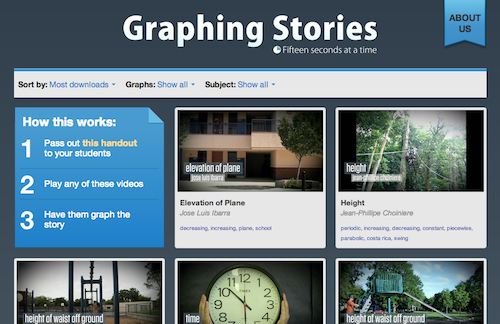
GraphingStories.com Is Open For All Your Graphing Story Needs

Five years ago I released a collection of 10 fifteen-second videos that helped orient my students to abstract and graphical representations.

Kids like them.

Last year I asked you guys to submit your own graphs and stories which I edited together by hand.

Today, in a joint collaboration with the BuzzMath team, we’re releasing 24 of those videos for immediate download and use in your classrooms, all tagged by content and math. (ie. “a step function about ponies”)

You guys were way more creative than I had anticipated:

Call for Submissions (Sort Of)

I’m never gonna do what I did a year ago ever again. Editing all those videos by hand took months of my time and probably a year off my life. But I would like to know what holes you see in this library and what we can do to plug them.

Do we need more videos with periodic functions? Do we need more videos featuring bacon? Suggest them in the comments. If it’s a good idea and you can film the video, I’ll make your graphing story on a case-by-case basis. This thing will grow larger and awesomer.

BTW. Be sure to drop a tweet @BuzzMath thanking them for their killer work here.

Riley Lark’s Red Dot

We know there are important steps [pdf] you can take to ready students for an explanation of key concepts. Riley Lark is helping you do several of them very easily with his open source ActivePrompt project. While Dave Major and I continue to bat around very specific implementations of digital curricula, Riley has created an extremely open framework, useful for all kinds of purposes.

This is everything: the student sees an image and has to place a red dot somewhere on top of it according to instructions given by the teacher. It sounds too simple to be of any use.

Two Uses

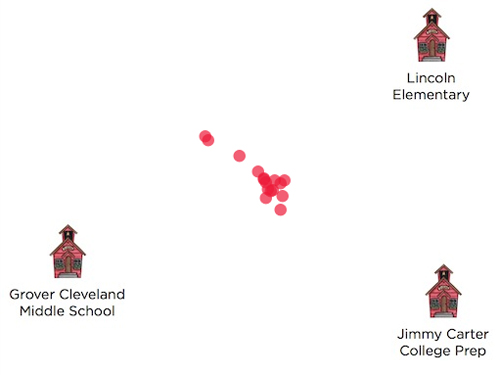
Drag the red dot to where you put the cafeteria so that it’s the same distance from each school.

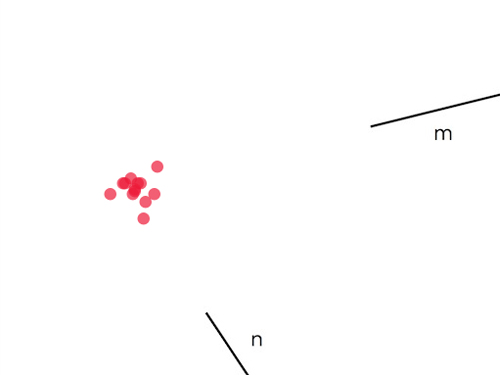
Drag the red dot to where line m will intersect line n.

You see where this goes, right? Even with the second prompt, which isn’t explicitly “real world” in the sense that we usually mean it, students now have experience with the context, which makes it real to them.

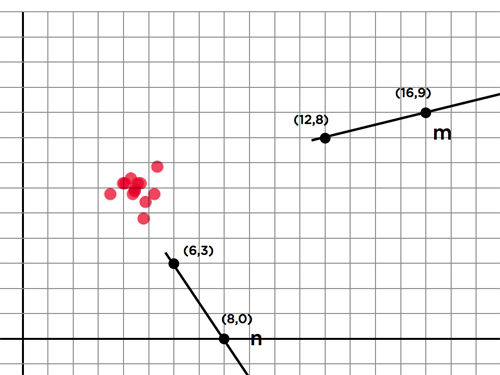
Then we start to abstract it and help students work with these concepts:

These brief experiences help immensely to set up and motivate the explanation that follows. It would be great (note to Riley) if the teacher could establish the correct answer at the end of the task (a teacher dot) which would then inform the students how close their guesses came. Also: student names on mouseover, mobile compatibility, vertical lines, and horizontal lines.

You can play with it immediately on Heroku. Be sure to link up your creations in the comments so we can all play along.

BTW. My hope in sharing Dave Major’s work and Riley Lark’s ActivePrompt and my own experiments is that you will become agitated and unhappy with whatever curriculum you are currently using, and that you will express that agitation and unhappiness to the people who publish and sell you that curriculum. None of us are anywhere close to nailing the question, “What do you do on day [x] with concept [y]?” for the entire set of x and y. But before we answer that question, we need to define the modern digital textbook. So here’s my pullquote definition, heavily informed by Dave and Riley’s work:

The modern digital textbook isn’t a collection of content to be consumed. It’s a collection of experiences, of which content consumption is only one part.

Riley Lark’s red dot is one of those experiences.

2012 Nov 29. Riley Lark takes you behind the scenes and shows off several creative ActivePrompts.

2012 Dec 4. Learning Catalytics (a for-profit product) seems to have done a lot of good work in this area already.

CMC-North 2012 & MathRecap.com

I’ll be at CMC-North this weekend and my schedule is jammed up with too many great options:

  • 8:00-9:00AM. Lisa Nussdorfer. Using the iPad in the Mathematics Classroom.
  • 9:30-10:30AM. Dan Meyer. Tools and Technology for Modern Math Teaching.
  • 11:00AM-12:00PM. Bob Petersen. Making Functions in Algebra Active and Interesting. Backups: Alteparmakian, Callahan, Doherty, Lim, Taylor.
  • 1:30-3:00PM. Karen Arth. Mathematical Modeling. Backups: Farrand, Humphreys, Pickford, Tucher.
  • 3:30-5:00PM. DeFazio. Learning Algebra Using C/C++. Backups: Bellman.

Very few math conferences have that kind of roster and as sad as I am for myself that I may miss Patrick Callahan and Megan Taylor and Tony Alteparmakian and others, I’m even sadder for you, because you may not be there at all.

So I’m kicking off Math Recap with several other Internet-types at CMC-North. We’ll be digesting and blogging the sessions we attend and we could probably use your help.

If a) you’d like to help open up the professional development that’s usually locked up at these kinds of conferences, b) you already have a blog, c) you’ll be at CMC-North, then send those details in an email pronto to dan@mrmeyer.com.

Thanks, team. Let’s make this awesome.

Featured Comment:

Elena Tomasetti:

Great idea! I could not afford to go, so I’m really glad you’ll be sharing what you learned.

[LOA] London Underground Maps

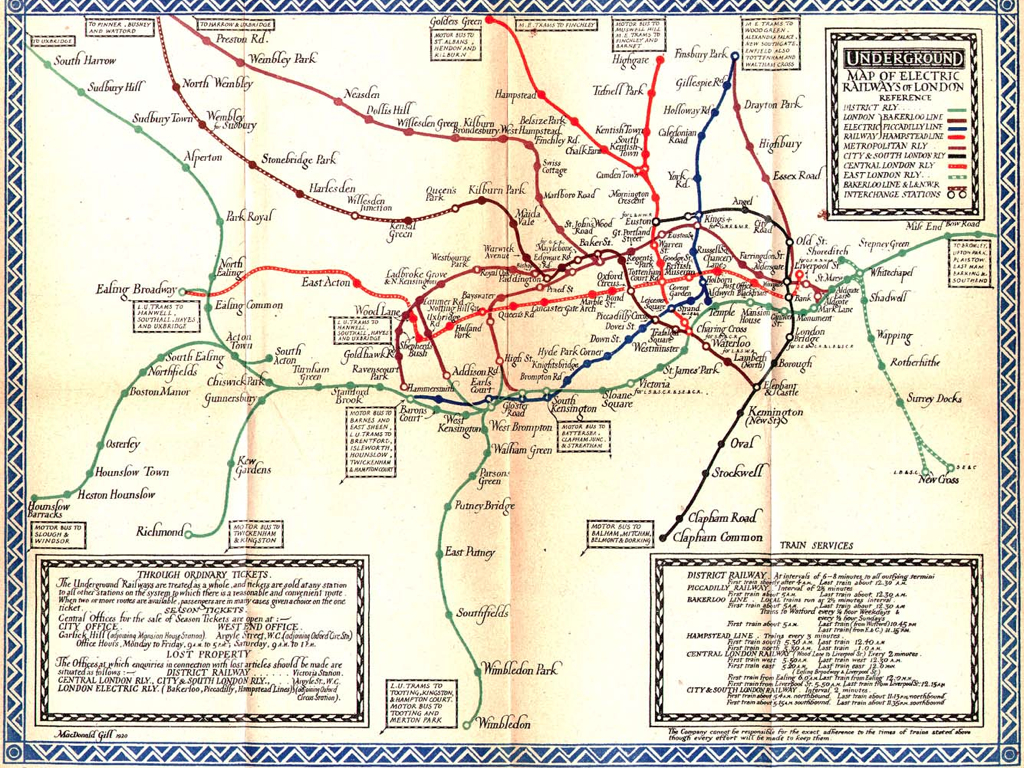
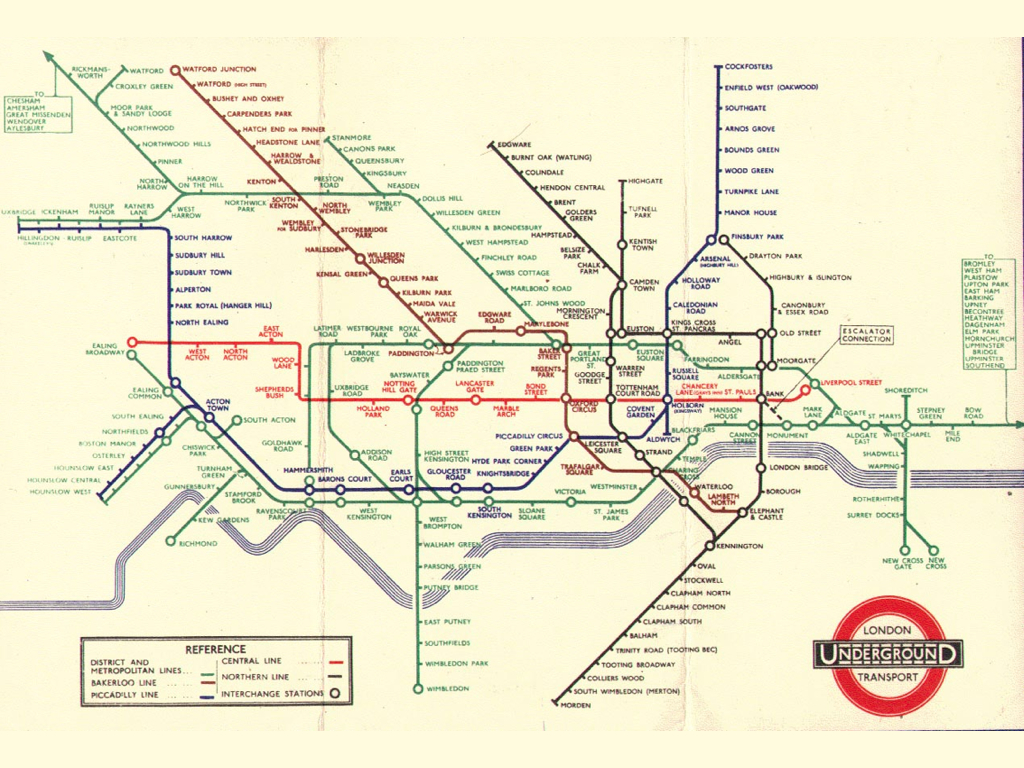
Here are two maps of the London underground railway, the first from 1928, the second from 1933.

1928

1933

I stipulated earlier that the act of abstraction requires a context (some raw material) and a question (a purpose for that raw material). These are two different abstractions of the same context. So what two different purposes do they serve? Rather, whom does each one serve?

BTW. If you’ll let me troll for a minute: aren’t we doing kids a disservice by emphasizing “multiple representations” rather than the “best representations?” Given that some abstractions are more valuable than others for different purposes, why do we ask for the holy quadrinity of texts, graphs, tables, and symbols on every problem rather than for a defense of the best of those representations for the job given?

BTW. I pulled those maps from Kramer’s 2007 essay, “Is Abstraction the Key to Computing?

2012 Nov 19. Christopher Danielson links up two examples of curricula (CMP) emphasizing “best representations” over “multiple representations.”

Featured Comments

Nik:

My intuition is the first (โ€˜realโ€™ scale, โ€˜realโ€™ layout) is more useful to anyone who cares about how far it is between locations that are not connected, or how they relate to things not shown on the graph, while the second is for those who only care about connections.

Sean Wilkinson

Iโ€™m not sure that I agree that both maps are same-level abstractions of the real-world subway system. I would argue instead that the second map is an abstraction of the first.

In order to abstract away the lengths and shapes of the curves that connect the nodes, we need to have already interpreted the subway system as a network of curves and nodes โ€” as the first map does โ€” rather than as a three-dimensional physical structure.

Similarly, I would argue that graphs and tables-oโ€™-values do not occupy the same rung; rather, a graph is an abstraction (and infinite extension) of a table-oโ€™-values.